cardiac: structural, infectious, and inflammatory disorders
 Call Kai
 Learn
 Practice Test
 Spaced Repetition
 Match
 Flashcards
 Knowt Play
1/39

There's no tags or description
Looks like no tags are added yet.
40 Terms
what are the 3 types of valve disorders
regurgitation - valve doesn't close properly and blood back flows
stenosis - narrowed valve and blood flow is reduced
valve prolapse - mitral valve leaflet is stretched into the atrium during systole (only mitral)

murmurs are often ?
different kinds of murmurs
systolic murmurs ?
diastolic murmurs?
how do we dx valve disease
Cardiac murmurs are often the first sign of underlying Valvular disease.
May be systolic or diastolic, pathological or benign.
Systolic murmurs may be due to physiological increases in blood velocity or might indicate asymptomatic cardiac disease.
Diastolic murmurs are almost always pathological and require further evaluation.
Echo cardiogram usually gold standard with murmurs and
valve disease
mitral valve prolapse s/s
May be asymptomatic or
Sensation of feeling the heart beat: palpitations
Chest pain not caused by CAD
Exertional dyspnea
Shortness of breath when lying flat (orthopnea)
Fatigue
Cough
Mitral click and possible Systolic heart murmur
mitral valve regurgitation
Blood flows back from the left ventricles into the left atrium during systole (contraction)
Edges of mitral valve leaflets do not close completely
most common causes of MVR
Degenerative changes in the mitral valve
Ischemia of the left ventricle
In developing countries, Rheumatic heart disease
MVR s/s
often ?
if acute ?
Often asymptomatic
If acute MVR (resulting from a myocardial infarction) may manifest as Congestive HF
Dyspnea
Fatigue
Weakness
Palpitations
SOB on exertion
Cough from pulmonary congestion
A systolic murmur at the apex
tx of MVR
treat
treat as ? meds?
Treat symptoms of shortness of breath, dyspnea and edema, H
Treat as heart failure due to the resulting hypertrophy
ACE inhibitors
ARBs
Beta Blockers
aortic stenosis
narrowing of aortic valve
common with old age
Left ventricle thickens as heart tries to compensate - hypertrophies
If symptomatic- management aimed at treating Left ventricular failure

s/s of aortic stenosis
may be asymptomatic
SAD - syncope, angina , dyspnea or exertion dyspnea
pulmonary edema
decreased CO - decrease exercise tolerance , low O2, weak pulses coolness low BP
s/s of LSHF
how can we treat stenosis
ballon vaalvulopasty placed via cath lab
stretches it out to allow for more blood flow

how can we treat valve prolapse
Annuloplasty Ring Insertion
strengthens muscles around valve to make it stronger and close properly

valve surgery
what kinds of replacements
if mechanical ?
valve replaces either by a mechanical valve or biological (human or porcine)
mechanical valve - r/o clotting, needs to be on Coumadin lifelong after the procedure
must get INR, & clotting factors checked weekly
can also be done non invasively for patients who are not surgical candidates for open heart surgery

nursing care with valvular disorders
Baseline date: Neuromuscular (r/o stroke and transischemic attack with clots), needs anticoagulants if mechanical valve replacement
Symptoms associated w/ valve disorder
History of infection/ cormorbidites
monitor Central venous pressure with central catheter (normal is 2-6mmHg)
monitor EKG, V/s, CO, respiratory staus
prophylaxis antibiotics before surgery needed
teach about warafin guidelines and ensure adherence to med
warafin/ Coumadin guidelines when pt has a mechanical valve
mitral valve - INR 2 - 3.5
aortic valve INR 1.8 - 2.2
If Annuloplasty is performed, Warfarin is needed for several months
Aspirin may be prescribed w/ Warfarin for high risk patients
teach pt to take at same time daily
aortic valve regurgitation
what is it
leads to?
decreased ?
increased ?
hallmarksign
leaflets of aortic valve do not close properly allowing regurgitation into left ventricle
60% of blood can be regurgitated
leads to LV hypertrophy
decreased CO
increased preload
hallmark sign - water hammer pulse (carotid artery has a bounding pulse )

s/s of aortic valve regurgitation
SOB, orthopnea
Paroxysmal nocturnal dyspnea - dyspnea that wakes you out of sleep
Signs of heart failure
Diastolic murmur - high pitched
Fatigue and dyspnea on exertiom(especially during times of increased activity)
Angina pectoris
tx of aortic valve regurgitation
treat as HF
aortic valve replcacemt
dilated cardiomyopathy
heart chambers?
effects what function
leads to ? and risk of ?
caused by
most common
all heart chambers dilate
poor systolic function (contraction)
leads to stasis of blood & risk of clots
can be caused by many drugs- cocaine

hypertrophic cardiomyopathy
heart muscle ?
impaired ?
risk of?
due to ?
heart muscle asymmetrically increases in size
impaired diastolic function (ventricles cannot fill properly)
risk of sudden death in young athletes
can be genetic or due to uncontrolled HTN

restrictive cardiomyopathy
stiff, rigid, ventricular walls
effects diastolic function (filling of ventricles)
can be caused by radiation therapy or infection
arrythmogenic RV cardiomyopathy
right ventricle infiltrated by scar and adipose tissue
causes electrical disturbances
genetic causes
s/s of cardiomyopathy
Impaired cardiac output/ heart failure
• PND-Paroxysmal nocturnal dyspnea
• Cough
• Orthopnea
• Fluid retention
• Nausea (poor perfusion to GI)
• Chest pain (decreased cardiac output)
• Dizziness; syncope
• Dysrhythmias
what devices/ procedure can be used for myopathies
LVAD
pacemaker
myectomy: removes hypertrophic cardiac muscle
muscle wrap around heart to increase strength and contractility
heart transplant or artificial heart
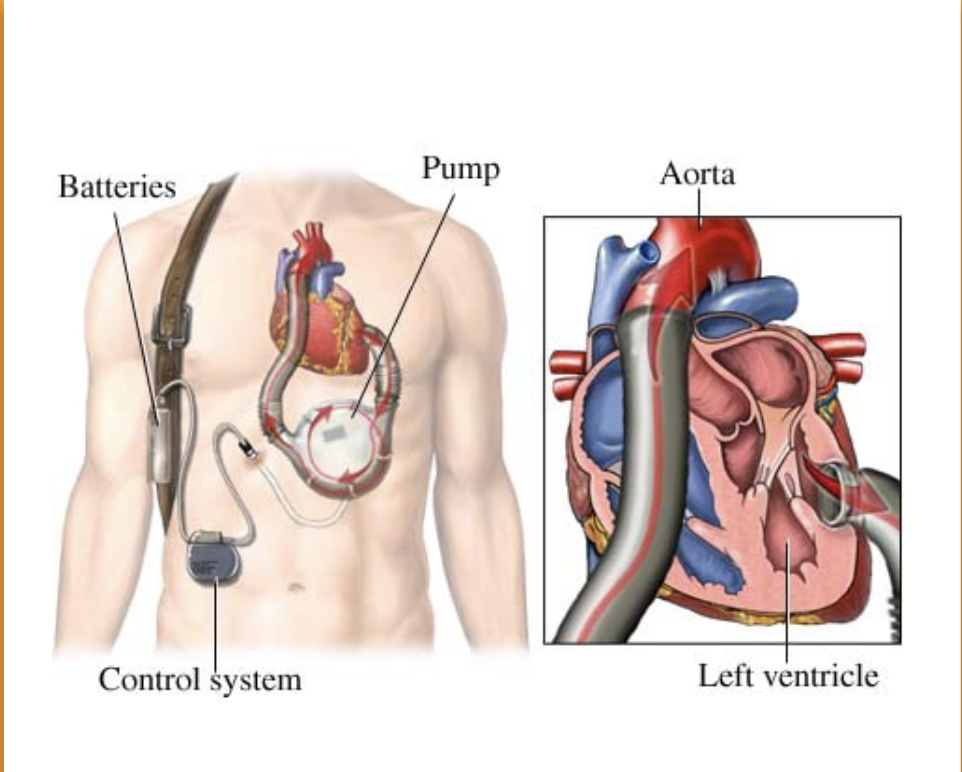
LVAD - left ventricular assist device
used in ? how many more years
what does it do
control system ? needs ?
must maintain?
hard to get?
what kind of pt is a candidate
used in end stage HF , gives about 7-10 more Years
takes load off the failing heart and help maintain blood flow to vital organs
pumps the heart for you
control system set for rate, force , rhythm
must maintain strict sterility when changing dressing - r/o infection
battery run device - if battery dies, pt dies, always needs extra batteries
hard to get BP, bc you hear machine running
very very strict rules, type A patients only who can maintain sterility and maintanance
rheumatic endocarditis
happens to?
results from
what is the consequence
may not see?
rare, but mostly occurs in school age children
consequence of group A strep
endocarditis results - inflammation of valves , causing permanent damage
may not see cardiac changes until years later
parent education on rheumatic fever
must educate parents to take children to get tested if they are showing sings of strep throat
must be promptly treated With antibiotics to prevent rheumatic fever
s/s of rheumatic fever
Fever/ Chills
Sore throat (sudden onset) + Diffuse redness of throat with exudate on oropharynx
Petechiae on the roof of mouth
Enlarged lymph nodes
Abdominal pain (more common in children)
Acute sinusitis or acute otitis media
Sandpaper like rash
s/s of infective endocarditis
3 hallmark signs
r/o? why?
low grade an intermittent fever + headache
new or worsening heart murmur
Hallmark signs: osler’s nodes, Jane way lesions and splinter hemorrhages
r/o TIA and CVA bc blood is stasis (valves are inflamed not working properly)

difference between TIA and CVA
TIA (trans ischemic attack) - warning sign of CVA, caused by partial blockage or narrowing of arteries to the brain , resolves on its own after 10-15 minutes
CVA - full on stroke, complete blockage, does not resolve on its own
dx of infective endocarditis
hx of ?
tests 2
based on H and P (hx of strep A? valve replacement?)
echocardiogram to dx
blood cultures
tx of infective endocarditis
4-6 weeks if IV antibiotics
surgical - may need valve debridement or full valve replacement bc of stiff valves/ vegetive growth on valves
pericarditis
inflammation of ?
normal amount if fluid vs with inflammation?
what does it do to the heart
inflammation of pericardial sac - up to 1000ml of fluid
usually holds 20-50 ml of fluid, needed for lubrication when the heart pumps
puts major pressure on the heart → decreases ventricle filling and decreases strength of contractions → decreased CO

s/s of pericarditis
pain worsens when ?
what can we hear on ascultation? where ? best heard how?
labs?
possible ?
Pain worsens with inspiration; lying down or turning (fluid moving)
Friction rub at the Left sternal edge - 4th ICS
Rub best heard sitting leaning forward
Louder at end of expiration
Elevated C-RP and ESR (indicates inflammatory process in the body)
Possible fever if developed from infection
managing pericarditis
rule out ?
meds ? 4
monitor for what r/t meds ?
rule out MI (EKG, labs drawn)
NSAIDs and steroids to decrease inflammation
monitor for bleeding r/t NSAIDs
monitor for glucose levels r/t steroids
may require large amount of morhpine for pain
should also have order for PPI
potential complications of pericarditis
pericardial effusion - accumulation if fluid in pericardial space, affects heats ability to pump
cardiac tamponade - advanced pericardial effusion (excessive amount of fluid) , affects CO. medical emergency!!!
other risk factors of pericardial effusion
pericarditis w/ increased fluid buildup
blunt chest trauma
lupus
neoplasm (cancer)
cardiac tamponade is?
results in decreased decreased ?
the restriction of heart function due to this fluid (effusion),
results in decreased venous return, decreased ventricular filling, and decreased CO
emergency!! quick assessment necessary, be prepared to call a code
s/s of cardiac tamponade
becks triad ?
feeling of?
pulses ? 3
resp?
Nuero? 2
becks triad: JVD, Low or labile (fluctuating) BP and muffled/ distant heart sounds
ill defined chest pain/ fullness
pulsus paradox
narrowing pulse pressure
rising venous pressures / falling arterial pressure
SOB
Low Bp → syncope → cardiac arrest
anxiety/ feeling of impending doom

pulsus paradox / paradoxical pulse
the fall of systolic BP of more than 10 mmHg during the inspiratory phase (breathing in)
able to see if pt is on continuous hemodynamic monitoring
tx of cardiac tamponade
pericardotomy - cut made into the pericardium to relieve fluid and pressure
pericardiocentesis - draining of fluid
sample of fluid sent to lab if indicative of infection to see what antibiotics to be prescribed
if fluid is blood - serial CBC and H and H
