Bio Exam 3
 Call Kai
 Learn
 Practice Test
 Spaced Repetition
 Match
 Flashcards
 Knowt Play
1/56

Earn XP
Description and Tags
Mendelian & Non-Mendelian Genetics, Pedigrees, DNA Replication, Mutations
57 Terms
Genetics, Heredity, and Traits
genetics — branch of biology focused on the inheritance of traits
heredity — inheritance/transmission of traits from parents to offspring
trait — observable characteristic of an individual
outward appearance (height) to molecular characteristics (ex. primary structure of membrane protein)
Mendel’s Question
What are patterns of heredity?
Leading hypotheses at the time:
Blending inheritance hypothesis — traits are blended in inheritance (ex. white bunny and black bunny will have grey babies)
Mendel demonstrated the basic principles of transmission genetics using the pea plant as his experimental organism
Mendel’s Model Organism
model organism = garden pea
easy to grow & inexpensive
produce large seed #s
short reproductive life cycle
easily recognizable traits (polymorphic traits - trait appears commonly in 2+ different forms)
How did Mendel Control Mating?
peas can self-pollinate (self-fertilization)
cross-pollinating (cross-fertilization) allowed Mendel to control mating
anthers of female (the male part) are exposed then cut off to prevent self-fertilization
mature pollen (pollen grains = sperm) is collected from another flower and deposited on the stigma of female parent, which contains the ovules
small cloth bag is tied around flower to prevent stray pollen from entering
What Traits Did Mendel Study?
7 traits, each with 2 recognizable phenotypes
color of seeds (yellow/green), shape of seeds (round/wrinkled), color of pod, shape of pod, color of flower, position of flower, plant height
Autosomal Inheritance
pattern of inheritance of genes not on a sex chromosome
studied by Mendel
Gene
heredity factor that influences a particular trait
region of DNA in a chromosome that codes for a particular RNA/protein
Allele
particular form of a gene
helps determine an organism’s phenotype by forming its genotype
2 alleles in a diploid may be the same or different for a particular gene
Genotype
alleles of a particular gene in an individual
diploid = genotype lists 2 alleles of each gene
haploid = genotype lists 1 allele of each gene
Phenotype
an individual’s observable traits
specific expression of a trait
from molecular level to whole organism
influenced by genotype (to varying degrees) → also environmental influence
Homozygous & Heterozygous /Dominant & Recessive alleles
Homozygous — two of the same allele
Heterozygous — two of a different allele
of a particular gene
Dominant allele — allele that produces same phenotype in heterozygous/homozygous genotypes
Recessive allele — allele that produces its phenotype only in homozygous genotypes
does not relate to frequency in a population or fitness
Lineage
Pure line — individuals identical in phenotype that when crossed produce offspring with same phenotype
pure line individuals are homozygous for gene in question
ex) TT x TT
Hybrid — any offspring from a cross between two genetically different parents or pure lines (ex. TT x tt)
Monohybrid cross — cross involving one trait/gene
ex) Tt x Tt
Dihybrid cross — crossing involving two traits/genes
ex) TtAa x TtAa
Polymorphic Trait
trait that appears commonly in 2+ forms (phenotypes)
Crosses
Reciprocal cross — cross in which phenotypes of male and female are reversed compared with prior cross; used to test if sex of a parent influences transmission of a trait
Test cross — (known genotype w/ unknown genotype to determine the unknown based on outcome) cross of homozygous recessive individual & individual with dominant phenotype but unknown genotype
Linkage
X-linked: gene located on X-chromosome
Y-linked: gene located on Y-chromosome
Mendel’s Crosses
crossed pure line of garden peas differing in just one trait (parental generation)
yellow seeds (YY) x green seeds (yy)
F1 generation (offspring/progeny)
all yellow (Yy)
yellow = dominant trait
green = recessive trait
F1 x F1 → F2 generation
flowers allowed to undergo self-fertilization
3:1 phenotypic ratio (3 yellow, 1 green)
Does gender influence inheritance of a trait?
Mendel ran a reciprocal cross = identical results
Interpretation of Results
particulate inheritance — hereditary determinants (genes, alleles) maintain their integrity from generation to generation; act as discrete, unchanging particles that don’t blend together
2 copies of a single gene // 2 alleles that are either the same or different (an allele is a particular version of a gene)
2 sister chromatids carry same allele of a particular gene (DNA replication during S phase = identical DNA)
each homolog in a homologous pair carries 1 allele (1 version of a particular gene)
separation of homologous chromosomes = organism’s 2 alleles for a gene separate during gamete formation so that each gamete receives 1 allele per gene
principle of segregation — 2 members of each gene pair must segregate into 2 different cells during formation of gametes
in 2n cell, each individual chromosome carries one allele of a particular gene, but because they are paired, cells carry 2 alleles total for that gene
segregation during meiosis, dominant and recessive alleles, random fertilization
Mendel’s Genetic Model for Monohybrid Cross (5 Conclusion)
2 copies of each gene and thus 2 alleles of the gene
particulate inheritance — genes are particles of inheritance that don’t blend
each gamete contains one copy of each gene (1 allele)
each parent contributes equally to genotype of offspring (offspring has 1 allele from sperm, one from egg)
dominant and recessive alleles
Law of Segregation
every individual has 2 alleles for each gene which separate randomly during meiosis
each gamete receives one allele for each gene
Law of Independent Assortment
alleles of different genes sort into gametes independent to one another
applies to unlinked genes
allele gamete receives for one gene does not influence allele it receives for another gene
refers to 2+ genes (inheritance of seed color doesn’t affect inheritance of shape if genes are located on different chromosomes)
Dihybrid Cross
mate parents that differ in 2 traits
9 different offspring genotypes with 4 phenotypes
4 phenotypes present in ratio: 9(yellow round):3:3:1(green wrinkled)
Principle of Independent assortment: alleles of different genes are transmitted independently of one another if not located on the same chromosome
Exceptions to Mendelian Genetics
Gender doesn’t influence inheritance pattern → sex linkage
Principle of Independent Assortment → gene linkage
Single Trait Inheritance → incomplete dominance & codominance
One Gene Affects One Trait → pleiotropy
Principle of segregation → nondisjunction
Sex Linkage
Gender doesn’t influence inheritance (Mendel)
reciprocal cross
Human sex chromosomes
autosome homologous pairs have same genes along their length and match in size and shape
sex chromosomes differ
nearly no genes in X chromosome have counterparts in Y chromosomes
tips of arms of X & Y chromosomes share small region of homology (corresponding genes)
X chromosome is much longer & contains more genes than Y chromosome
X and Y pair in males (at tips) even though not homologous
Thomas Hunt Fly Experiments
fruit fly = drosophila melanogaster = model organism
wild type = common phenotype for each trait (can be recessive)
red eye (dominant)
mutant = individual with unusual phenotype attributable to mutation (change in a gene)
white eye (recessive)
crosses
wild type female x mutant male = wild type F1 (dominant alleles, expected)
reciprocal cross
mutant female x wild type male = wild type F1 females + mutant F1 males (recessive alleles/not expected)
why does this occur? the eye color gene is sex linked!
SKILL: writing the alleles

X-linked Recessive Disorders
Hemophilia — bleeding disorder/improper clotting
Duchenne Muscular Dystrophy — progressive muscle-degenerative disorder
Fragile X syndrome — intellectual disability and developmental delays
Gene Linkage
physical association of 2+ genes found on the same chromosome
tendency of alleles of particular genes to be inherited together (predicted to be transmitted together during gamete formation unless crossing over occurs)
violates principal of independent assortment
KEY: less genetic diversity → if eye color and body color are transmitted together red eye, white body male and a yellow eye, grey body female will only produce red eye, white body or yellow eye, grey body genotypes (respectively) if crossing over does not occur between homologs
why? alleles can’t reshuffle via independent assortment and produce new phenotypes (ex. red eye, grey body)
What actually happens? (Gene Linkage)
Recombination!
alleles with on same chromosome often stay together, but not always
gametes with new combination of alleles is generated when crossing over during Prophase I of Meiosis
crossing over is rare between genes that are close together and occurs more frequently in genes that are far apart
crossovers can reshuffle alleles
Case Study: Santhi Soundararajan — Background Info
sex assigned at birth
anatomy (primary & secondary sex characteristics)
physiology (function & interaction of sex organs)
chromosomes
genes (genes determine male/female development)
source of genetic variability during meiosis = crossing over (non-sister chromatids exchange corresponding segments of DNA)
recombinant chromosome contains maternal and paternal genes
in males, sex chromosomes (X & Y) only cross over at the tips
Case Study: Santhi Soundararajan
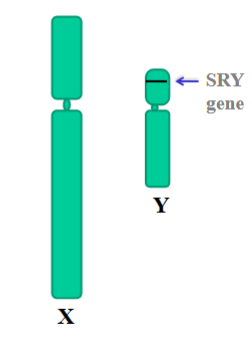
SRY Gene - Sex Determining Region of the Y Chromosome Gene
early embryonic development: immature gonads (primary reproductive organs: ovary and testes) of males and females are indistinguishable
SRY Gene Expression
Males: 7th week of development
SRY gene on Y chromosome activates a # of genes → gonads develop as testes
Female: no SRY gene
gonads develop as female by default
require SRY gene expression for differentiation
inappropriate crossover: exchange of SRY onto X chromosome (in male parent)
leads to sex reversal (in child)
X^(SRY+)X male
XY^(SRY-) female
How Many Alleles Can a Gene Have?
multiple allelism: existence of 2+ common alleles of same gene
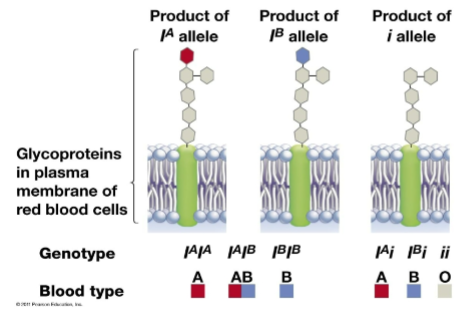
ABO blood group system is I^A/I^B/i
blood type gene has 3 common alleles that can exist at the same genetic locus
KEY: each I gene controls production of different polysaccharide attached to a glycoprotein found in the plasma membrane of a red blood cell
I^A and I^B alleles code for different forms of enzyme that add different sugar to the ends of polysaccharide
i allele codes for nonfunctional form of this enzyme (no terminal sugar on protein in plasma membrane of RBC)
I^A and I^B are each dominant to i, but I^A and I^B exhibit codominance (enzymes add both sugars to ends of polysaccharide attached to glycoprotein in plasma membrane)

Codominance
refutes Mendel’s theory of complete dominance
only phenotype associated with dominant allele appears in heterozygotes
simultaneous expression of phenotype associated with each of the alleles in a heterozygote
ex) AB Blood type (I^A/I^B)
both A and B phenotypes
has glycoproteins A and B (diff. polysaccharide ends) in plasma membrane of RBC
Incomplete Dominance
alleles of gene are not clearly dominant/recessive
heterozygotes have intermediate phenotype
ex) four o’ clock flowers
RR = red; rr= white; Rr = pink
Pleiotropy
Mendel: one gene influences one trait
Reality: many genes are pleiotropic — one gene influences MANY traits
Pleiotropy occurs because a single gene produces a protein that is used in multiple tissues or plays a central role in a shared cellular pathway
Marfan syndrome
cause: a mutation in just a single gene (FBN1 on Chromosome 15)
FBN1 encodes protein called fibrillin (protein that assembles into microfibrils — essential for formation of elastic fibers found in connective tissue)
mutated fibrillin = elastin core cannot organize/anchor property = weak and poorly formed elastic fibers
Effects:
Trait A: skeletal defects
Trait B: cardiovascular disease
Trait C: ocular defects

Nondisjunction
Mendel: Principle of Segregation
each gamete carries one allele per gene (one copy of each gene) because alleles segregate during meiosis
diploid: 2 copies of each gene, one on each chromosome
haploid: 1 copy of each gene located on the single chromosome that segregated
Pedigree Analysis
experimental cross cannot be done in humans
pedigree (family tree) must analyze pre-existing crosses (genotypes & phenotypes)
relationships, biological sex, and phenotype for a single trait are shown
reveals mode of transmission
autosomal or sex linked?
dominant or recessive?
carriers — have allele and transmit it without expressing the phenotype
approach:
is it dominant or recessive? (does not skip generations or skips generations)
If recessive, more sons = X-linked
If dominant
X-linked (look at affected fathers)
affected fathers can’t pass the trait to their sons
all daughters of an affected father will be affected
else, recessive
What are Genes Made of?
DNA is hereditary material
DNA Structure
polymer (nucleic acid) made up of monomers (deoxyribonucleotides)
deoxyribonucleotide: deoxyribose sugar, phosphate group, nitrogenous base
polymerization via phosphodiester linkage
covalent bond
3’-OH of one deoxyribose to 5’ phosphate of another deoxyribose
backbone (sugar phosphate groups of covalently linked deoxyribonucleotide monomers)
bases projecting from backbone
directionality/polarity (5’ (exposed phosphate) → 3’ (exposed -OH))
double helix
antiparallel strands
complementary base paring via H-bonds (A - -T) and (C- - - G)
major and minor grooves (spiral indentations running outside DNA double helix due to asymmetrical attachment of base pairs)
DNA Replication Overview
single parent DNA molecule → 2 daughter DNA molecules
separation of 2 strands of double helix at replication fork
each strand serves as a template for directing synthesis of new strands
semiconservative process
nucleotides added to 3’ end (5’ → 3’ synthesis following rules of complementary base pairing)
at replication fork, leading strand is continuously synthesized (into) and lagging strand is synthesized in small pieces ligated together (away from replication fork)
DNA polymerase requires RNA primers for DNA synthesis
DNA polymerase can correct its own mistakes by detecting mismatches between template bases and new, incorrect bases
Chromosome Replication Overview
replication of linear/chromosomal DNA
mechanisms ensure efficient and complete replication
linear chromosomal DNA has many origins of replication
replication proceeds from all origins simultaneously
telomerase prevents chromosomes from shortening after each replication by adding DNA to ends of chromosomes (noncoding telomeres)
Early Hypotheses About DNA Synthesis
semiconservative
parental strands of DNA separate and each serves as a template for synthesis of new daughter strand
conservative
bases of both strands temporarily turn out from helix and serve as a template for synthesis of new double helix all at once
experiment: Bacterial DNA Replication Model (Meselson & Stahl)
distinguished between paternal and daughter DNA to see nature of DNA replication
grew E. coli cells for successive generations in presence of different isotopes of nitrogen (15N first — heavier, 14N next —lighter)
E.coli cells used nitrogen isotopes to synthesize nitrogenous bases of their DNA
density gradient centrifugation results!

Eukaryotic DNA Replication
replicate semi conservatively
cells grew in medium with fluorescent labeled nucleotides
after 2 rounds of replication, produced the resulting chromosome
chromatid 1: DNA double helix is marked by fluorescent labels
chromatid 2: hybrid DNA (labeled strand & unlabeled strand)

DNA Strands are Templates for Synthesis
Watson & Crick — DNA structure is key to its replication (each strand serves as template for production of new strands using complementary base pairing rules)
Meselson-Stahl — DNA replication is semiconservative
DNA Polymerase
major enzyme involved in DNA synthesis that catalyzes formation of phosphodiester bond
selects a nucleotide to add to 3’ -OH base with appropriate base pair
speed (high catalytic rate) → attaches ~50 nucleotides per second in humans
accuracy (fidelity) → inserts exact matching base and avoids mistakes
processivity (enzyme’s “staying power”)
Major Replicative Polymerase
DNA Polymerase III → prokaryotes (1000 nucleotides/second)
ex. E.coli
DNA Polymerase Delta, and Epsilon → eukaryotes (50/nucleotides a second)
DNA Polymerase Alpha: primase-polymerase complex (synthesizes RNA primer)
DNA Polymerase Epsilon: synthesizes leading strand
DNA Polymerase Delta: synthesizes lagging strand
DNA Polymerization is Exergonic
(Gibbs Free Energy, delgaG < 0) → spontaneous rxn!
releases energy into surroundings
polymerization is usually endergonic, so how?
PE of deoxyribonucleotide monomers increase due to reactions that add 2 phosphate groups to form deoxyribonucleotide triphosphate (dNTPs)
3 close phosphate groups → dNTP has high PE (like charges repel)
subsequent formation of phosphodiester bond is exergonic as 2 phosphates are cleaved off
DNA Polymerization — Steps
Nucleotide Addition
incoming building blocks come as dNTPs
DNA polymerase attaches nucleotide to free 3’—OH end, releasing 2 outer phosphates as a single PP molecule
provides chemical energy to form a phosphodiester bond
Immediate Hydrolysis of PP
PP → P + P via enzyme inorganic phosphatase
makes replication irreversible by removing a product (locking nucleotide into DNA chain) // pulls rxn forward
side note: DNA Polymerase cleaves the incoming deoxyribonucleotide at the same time the nucleotide is added to the DNA chain
DNA Polymerase Structure — Palm Domain
the builder
active site, catalyzes formation of phosphodiester bond between nucleotides
requires two Mg2+ ions
ion one — activates growing DNA strand’s 3’ —OH end
other ion — stabilizes incoming nucleotide’s phosphates

DNA Pol. Structure — Finger Domain
selector
helps position incoming dNTPs
checks that it pairs correctly with template
grabs and positions/checks fit/rejects mistakes
DNA Pol. Structure — Thumb Domain
grip
holds elongating duplex in place
increases processivity by holding onto template strands (enzyme’s ability to add nucleotides in a row without letting go)
Exonuclease Domain
proofreader
detects and removes incorrectly base paired nucleotides via 3’ → 5’ exonuclease activity
DNA Polymerase — How Parts Work
Open Hand
thumb holds DNA steady against palm
fingers stay open so new dNTP can enter and match template base
Fingers Close (nucleotide incorporation)
confirmational change due to SHAPE FIT and charge interactions (amino acids in fingers to phosphate groups)
when free dNTP drifts in, fingers curl inward and press it up against template DNA
check fit: if incoming nucleotide is right match, fingers close tightly around it
lock nucleotide into palm’s active site so phosphodiester bond can form
rejects mistakes: if wrong nucleotide enters, base pair forms awkward bulky shape — fingers cannot close properly & wrong nucleotide is kicked out before it attaches
Reopen & Slide (DNA translocation)
PP (pyrophosphate) leaves, fingers open back up, and DNA slides forward by one base so cycle can repeat
places newly formed free 3’—OH group in starting position and exposes new unpaired template
Exonuclease Domain Work
if wrong nucleotide is attached, enzyme stalls and cannot add next nucleotide
mismatched 3’ end of new DNA peels away from template strand, swings out of Palm, and into exonuclease domain
Exonuclease Domain
enzyme snips phosphodiester bond in 3’ to 5’ direction, clipping off single nucleotide and spitting it out
Reset: shortened DNA strand snaps back into palm domain and synthesis resumes normally
Formation of Phosphodiester Bond in Palm
nucleophilic attack by 3’ —OH of ribose on a-phosphatase (innermost) phosphate of incoming dNTP
nucleophilic attack: interaction between negatively charged O (from the O- left after Mg2+ pulls off H ion to activate the 3’ end), which attacks positively polarized P atom of a-phosphate in dNTP
electron transfer
new covalent bond forms
as new covalent bond forms, bond holding outer PP snaps simultaneously
Where does DNA Replication Start?
replication bubble forms at a specific sequence of bases called the origin of replication
bacterial chromosomes (prokaryotes): one
eukaryotes: multiple along each chromosome (forming multiple replication bubbles)
makes up for DNA polymerase slower catalytic activity
active DNA synthesis takes place at replication fork
Y-shaped region where parental DNA double helix is separated into single strands and copied
bidirectional replication
DNA synthesis occurs in both directions at once from origin of replication
Bidirectional Replication
at each replication fork, strand with free 3’ end is leading strand (5’ → 3’)
strand with free 5’ end is lagging strand