Tectonic hazards
 Call Kai
 Learn
 Practice Test
 Spaced Repetition
 Match
 Flashcards
 Knowt Play
1/47

There's no tags or description
Looks like no tags are added yet.
48 Terms
Lava flows
Primary hazards
Viscosity is determined by the amount of silicon dioxide e.g. Rhytholitic lava is highest viscosity.
Steep slopes 15m/sec
Andesitic lava flows like plastic and moves very slowly
Destroys agricultural land and infrastructure
e.g. Kilauea volcano in Hawaii destroyed 180 houses been erupting since 1983,covering 78km²
Pyroclastic flows
Primary hazards
Mixture of hot rock fragments,lava particles and ash buoyed by hot gases
Associated with subduction zones
Move at high speeds
Most dangerous are those directed laterally when the main crater is blocked by viscous lava and gas pressure builds up and releases through a weak area.-Mount Saint Helens USA in the 1980
High speed and temperatures mean they destroy everything in their path
Tephra
Rock fragments ejected by volcanoes
Fine ash is carried high in the atmosphere by prevailing winds which means it can cover large distances.
Finer ashes cover larger distances affecting global weather patterns and are hazards to air crafts.
Breathing difficulties
Agricultural production can be reduced causing a loss in economic losses
Mount St. Helens (1980, USA) — Ejected over 500 million tons of fine ash into the stratosphere affecting Washington and Idhao.
Volcanic gases
Active volcanoes produce large amounts of water vapour,Carbon dioxide,hydrogen
Primary hazard
Rarely reaches lethal level
Carbon dioxide causes most deaths-colourless,odourless and accumulates in hollows and depression due to density
Lahars
Mudflows of volcanic material
Second greatest threat after pyroclastic flows
Huge amounts of ash and debris produced after eruption mix with water and move rapidly over long distances.
Jokulhlaups
Glacial outbursts
Landform modification through erosion and deposition
Large in volume,including ice,water and debris
Flooding is the result of glacial failure due to heat from the eruption or collapse of a moraine dam.
How is Basaltic lava formed?
Melting of mantle minerals(e.g. olivine) from upper zone but sometimes core-mantle boundary.
How is Andestitic lava formed?
Subducted oceanic plate melts and mixes with seawater,lithospheric mantle and continental rocks.
How is Rhyothitic lava formed?
Melting of lithospheric mantle and slabs of previously subducted plates.
Flow characteristics of Basaltic lava?
Thin and runny(low viscosity,gases escape).
Flow characteristics of Andesitic lava
Slow(intermediate viscosity traps gases).
Flow characteristics of Rhyolitic lava?
Thick and stiff(high viscosity trap gases).
Eruption energy of Basaltic lava?
Gentle,effusive
Eruption energy of Andesitic lava?
Violent,moderately explosive
Eruption energy of Rhyolitic lava?
Very violent,cataclysmic
Location of Basaltic lava?
Ocean hot spots
Mid ocean rigdes
Shield Volcanoes(e.g. Mauna Loa).
Location of Andesitic lava?
Composite volcanoes e.g. Chance Peak
Subduction zones
Location of Rhyolitic lava
Supervolcanoes(e.g. Taupo) or composite cone volcanoes e.g. Chance Park
Case study-Vatnajokull Glacier Island 1966 MINI CASE STUDY
Was preceded by a large earthquake 29 September.
Eruption melted over an overlying ice fissure 4.
Subsidence cauldron had formed in the overlying ice which was between 400 and 600m thick.
Steam column 9000 metres high had formed-Wednesday
Eruptions beneath Icelandic glaciers produced Jokulhlaups.
Jokulhaups lifted ice dam.
Damages were US 15 million
Volcanic case study-Mt Pelee Martinique 1902 MINI CASE STUDY
Killed 29,025 people
Lies on destructive margin-magma is highly viscous
Pyroclastic flows
Big port Saint-pierre town meant high population density
No coordinated evacuation of vunerable areas-refugees were crammed into saint-pierre which was believed to be a safe haven.
Soufriere Hills,Montserrat 1997-Volcanic case study MINI CASE STUDY
Lies on a destructive plate margin
Highly acidic viscous magma at temperatures of 800+ celsius
19 people died-returned to the island prematurely
Low death toll attributed to monitoring and massive evacuatio programme.
Nevado del Ruiz,Colombia 1985-Volcanic erruptions MINI CASE STUDY
Low VEI of 3
50m deep lahars-formed when 10% of snow and ice cover was melted by pyroclastic flows.
23,000 deaths
Mount St Helens USA 1980-Volcanic erruptions MINI CASE STUDY
Unexepected lateral blast
Remote location-limited fatality.
57 people killed
Composite volcano
Highly viscous lava-trapping gases
Mt Merrapi 2010-Volcanic eruption MINI CASE STUDY
473(500) people died
Zones desiginated where no one lives permanetly
9 villages will no longer have new infrastructure-risk of destruction is great
Impacts of Mount Merapi Indonesia 2010
Economic impacts:
Crop prices e.g. rice fields were damaged and the price increased due to crop damage-mostly affecting Cangkringan and Kemalang.
Mineral mining increased-the volcano deposited millions of cubic meters of high-quality, easily accessible volcanic materials directly into the surrounding riverbeds and slopes
Social impacts:
Sulphur dioxide caused irritation to human skin.
What did Arthur Holmes discover in 1919?
Mantle was semi-molten
Meaning convection currents flow in the mantle
What is convection?
Convection is a mode of heat exchange where hot material rises and cold material sinks.
Primary impacts of Nyriagongo eruption 2002
The lava flows destroyed crops, and many livestock were killed.-c
80 per cent of the airstrips at Goma International Airport were covered in lava.-Goma heavily relies on NGOs.
The majority of the 200 deaths were caused by carbon monoxide poisoning from the eruption (this continues to be a threat today).
Secondary impacts of Nyriagongo eruption 2002
Acid rain fell due to the reaction of volcanic gases in the atmosphere, damaging farmland as it makes the land acidic .Many people in the region are subsistence farmers.
Social impacts:Overcrowding and poor hygiene conditions led to the spread of cholera in refugee camps.400,000 people displaced.
Factors affecting volcanic eruption Nyiragongo 2002
Lies on a divergent/constructive plate
Tectonic spreading of the Kivu rift causes the ground to fracture allowing lava to flow from ground fissures.
Low amounts of silica making it a basaltic lava flow at speeds of 60km/h
Key facts about Eyjafallajokull 2010
Iceland lies on the Mid-Atlantic Ridge.
Constructive plate margin
Two plates move apart due to ridge push along the Mid-Atlantic Ridge.
Impcts of Eyjafallajokull 2010
Economic Impact: The airline industry alone lost £130 million a day due to airspace closure, totalling an estimated $1.7 billion.(Tephra)
Farmers have laid off 5000 workers after flowers and vegetables were left rotting at airports-short shell life
Key facts about Pintubo 1991
Destructive plate boundary where the Eurasian plate is moving towards the Philippine plate, this creates many subduction zones.
The subduction of the Eurasian plate beneath the Philippines plate caused the earthquake.
High population density of 240 people per km², with up to 2,000 people per km² in the megacity of Manila.
Impacts of Pintubo erruption 1991
Social impact:847 people were killed with 300 by collapsing roofs (due to the number of people who still live below the poverty line). 100 people were killed by lahar mud flows.
Wilson cycle
Describes how continents split apart drift and eventually collide again.
Continents begin to pull apart along cracks in the rcust.(Rift causes a new gap called rift valley.)
Magma rises along cracks in the crust→forming oceanic crust
Widening crack becomes a full oceanic basin
As tectonic plates move,the oceanic plate sinks to the subduction zone.
This shrinks the basin
Volcanic activity,earthquakes and deeo ocean trenches appear.
Closing ocean brings contiental plates together.
Hypothesis testing using Paleomagnetism.
Magma extrudes from the mid-ocean ridge.Contains iron which aligns with the Earth’s magnetic pole and becomes stuck with that alignment when it cools.
How do we prove the Wilson cycle?
Hypothesis testing using Paleomagnetism.
Magma extrudes from the mid-ocean ridge.Contains iron which aligns with the Earth’s magnetic pole and becomes stuck with that alignment when it cools.
Proof of continental drift
Sea floor spreading
Fossils of tropical plants have been found in the Artic Ocean suggesting that they have may have had a warmer climate in the past.
Geological ecidence for continetal drift-When using Wegner’s map on Pangea these moutains line up into one major range.
Glacial evidence-Form and land and move towards he ocean.About 300 million years ago Glaicers covered the Southern hemisphere.The pattern they made makes sense when looking at Wegner’s model.
Ridge Push
Newly formed plates at the oceanic ridges are warm and so have a higher elevation at the oceanic ridge then the colder,more dense plate material further away;gravity causes the higher plate at the ridge to push away the the lithosphere that lies from the ridge.
What is slab pull?
Older,colder plates sink at subdction zones,because as they cool they become more dense then the underlying mantle due to gravity.Cooler sinking plate pulls the rest of the warmer plate along it.
Constructive(Divergent plates) features?
SEISMIC ACTIVITY:Shallow focus and a low magnitude.
VOLCANIC ACTIVITY:Frequent,gentle
Destructive(convergent:oceanic and oceanic)
Heavier plate subducts leaving and ocean trench.Fold moutains will occur.
Built up pressure causes underwater volcanoes burstingthrough oceanic plate.
Lava vools and creats new land called island arcs.
Destructive(convergent:oceanic and continental)
Denser oceanic plate is subdcted underneath the continentak.
The subducted plate froms a deep ocean trench.
The oceanic crust is melted as it subducts into the asthenosphere.
Extra magma causes pressure to build up.
Pressurised mahma forces through weak areas in the continental plate.
Explosive high pressure volcanoes erupt through the continetal plate know as composite volcanoes.
Fold moutains occur when sediment is pushed upwards during subduction.
Hot spot theory-1
1.Plume rises-very hot mantle mantle rises beneath the lithosphere.
Pressure falls-decompression melting produces magma beneath the plate.
3.Magma breaks through-magma passes through the crust and builds a volcano across the hot spot
4.The mantle keeps moving-a chain of volcanoes form because the plume stays broadly fixed while the plates move.
The youngest and most active lie directly over the plume.
Hot spot theory 2
1.Plate contains weaknesses-past collisions,rifting and subduction can leave faults and scars in the lithosphere.
2.Some plates are streched-pulling at plate edges can make parts of a plate thinner and vunerable.
3.Old material lies below-previously subducted material may melt more easily when pressure decreases.
4.Magma follows the weak zones-magma rises through the weaknesses and produces volcanoes within the plate.
Explain the causes of intra-plate tectonic hazards-6M
Occur above a hot spot.
Mantle plume of unusually hot,buoyant material may rise from near core-mantle boundary.
Base of lithosphere-fall in pressure causes decompression melting.
Basaltic magma rises through weakness and forms broad shield volcano
Hawaiian island lie 3200 km from the nearest plate margin.
Pacific plate moves north-west over a broadly stationary over hot spot.-kileau volcano remains active.
Volcanoes became oldee towards the north-west as they move from magma source.
BecomesCool and becomen denser.
Stresses reactive ancient weaknesses within a plate.
Forces generated at distant margins,continuing collision or slab pull-transmitted through rigid plate.
Stress builds along old faults until friction is overcome.
Sudden movements release stored strain energy as seismic waves.
2001 Gujarat earthquake north-west India.
Hundred of km away from Indian-Eurasian plate boundary

186+145 =331
331/12 =27.583
= 27.6
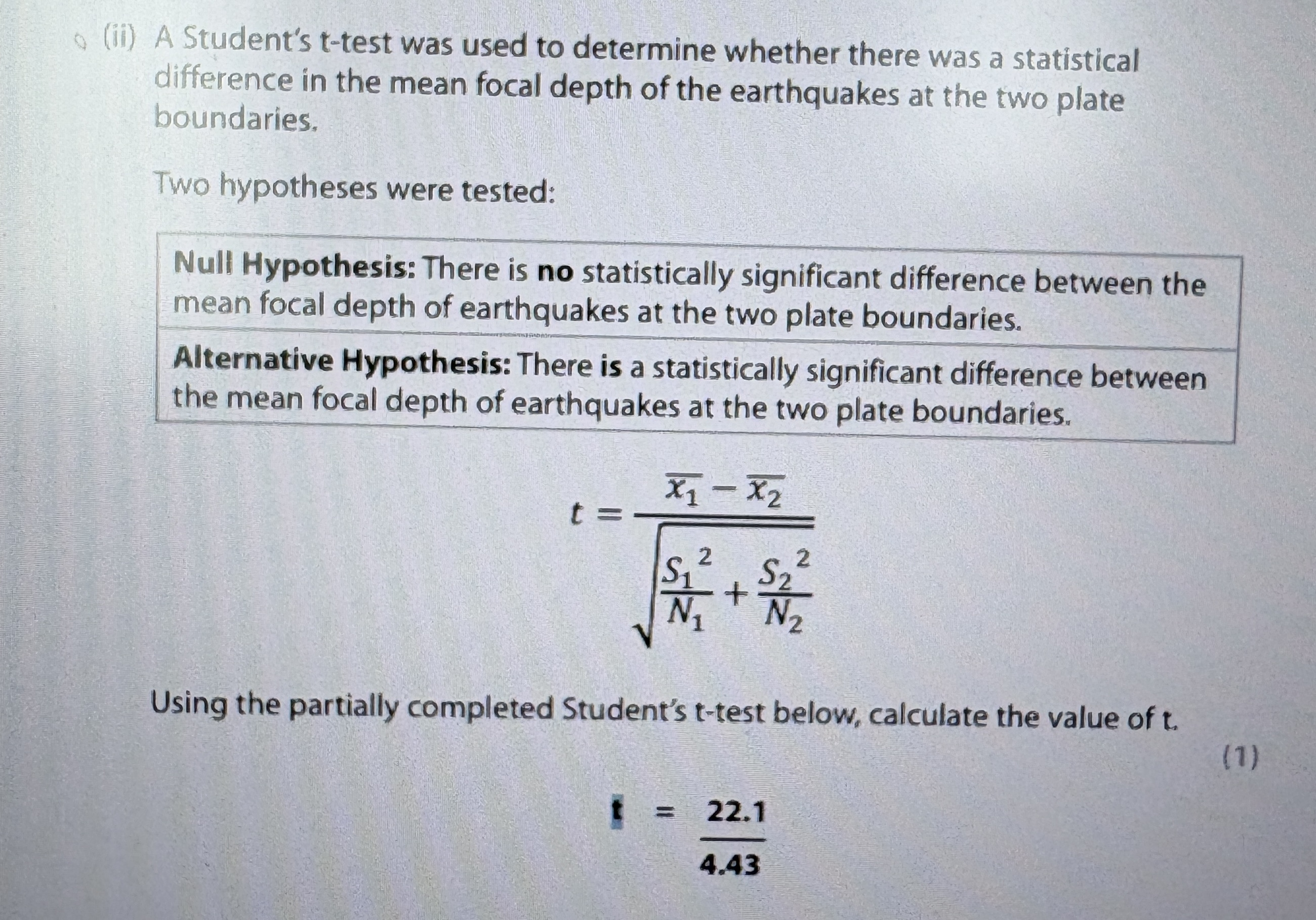
5.0

Rejecteion of the null hypothesis as t value is more than critical value at all confidence levels and the acceptance of the alternative hypothesis there is a statistically significant difference in the mean focal depth of the earthquakes at the 99% confidence level.