Business Prelim
 Call Kai
 Learn
 Practice Test
 Spaced Repetition
 Match
 Flashcards
 Knowt Play
1/28

There's no tags or description
Looks like no tags are added yet.
29 Terms
Describe the 4 methods ( ONLY NEED TO KNOW 2 FOR PRELIM ) of the private sector And briefly describe their aims
Private limited Companies -
the owners of as limited company are called shareholders, as they share ownership of the business with others. In a private limited company shares are not available to the general public and are sold privately to investors who the business knows.
Private limited companies aim to maximise profits, to grow and perhaps increase market share. They are controlled by a board of directors
Public limited companies -
Public limited companies are owned by shareholders who have limited liability. They are also controlled by a board of directors. Public limited companies can sell their shares publicly, through the stock market
Public limited companies aim to dominate the market, increase market share and increase market value
Franchise -
Multinationals -
Give 4 advantages and disadvantages each of private limited company
A
owners have limited liability
Ownership is not lost to outsiders
The business usually retains a close and tight-knit, friendly feel with a high level of customer service
Expertise and business acumen are gained from an experienced board of directors
D
profits have to be split with many shareholders by issuing dividends
A complicated legal process is required to set up the company
A limited source of capital is available as shares are not sold publicly
Financial statements have to be shared with companies house meaning profits are not kept private
Give 4 advantages and disadvantages each of public limited company
A
shareholders have limited liability
Public limited companies easily dominate the market
Large amounts of finance can be raised through the public of shares
It is easy to borrow finance due to public limited companies size and reputation, so less risk for banks
D
setting up a public limited company is costly and complicated
Annual accounts have to be published
Dividends are shared with many shareholders
Control of the business can be lost as anyone can buy shares on the stock market
Name and describe 6 types of objectives
Profit maximisation - making a profit means bringing in more money through the business’s core activities, such as selling goods and services, than they spend on purchasing materials and your running costs of the business, such as wages and rent. As a business grows it will aim to maximise profits
Corporate Social responsibility - refers to organisations aiming to act in an ethical way or in any way that benefits either society or the environment
Providing a quality service - all organisation aim to provide a quality service to their customers or members.
Growth -to make the business larger
Satisficing - aiming for satisfactory result, rather than the best possible outcome
Managerial objectives - They may try to achieve objectives which they will improve their status within the company. They may also aim to have many subordinates reporting to ten in order to increase their responsibility, and therefore their salary
What is corporate culture
Give 6 methods used to promote corporate culture
C
Describe and give 2 advantages and disadvantages of methods of growth
Internal growth - businesses deciding to grow on their own without getting involved with other organisations. Increases market share without losing control to outsiders
Method + description
hiring more staff - increasing the number of staff will improve the businesses ability to make sales
Introducing e-commerce - by selling online a business can trade 24/7 to a global market
Horizontal integration - occurs when two businesses from the same sector of industry become one business
A
the new business can benefit from economies of scale
Due to reduced competition, the new larger business can raise prices, increasing profits
D
Customers may have to pay higher prices for the same goods
Quality may suffer due to lack of competition
Forward vertical integration -business takes over or merges with a business in a later sector of industry
A
can increase profits by cutting out the middle man and adding value itself
The business can control supply of its products and could decide to not supply to competition
D
focusing on new activities can adversely affect core activities
Monopolising markets may have legal repercussions
Backward vertical integration - business takes over or merges with a business in an earlier sector of industry
A
quality of supplies can be strictly controlled
Guaranteed and timely supply of inventory
D
focusing on new activities can adversely affect core activities
Monopolising markets may have legal repercussions
Lateral integration - business acquires or merges with a business that is in the same industry but doesn’t provide the exact same product
A
The business can target new markets and therefore increase sales
New products can complement existing one
D
it may adversely affect core activities
The lack of knowledge in a slightly different market may affect the performance of the products
Conglomerate integration - businesses in different markets join together. To spread the risk of failure, increase chances of maximising period by having more and varied products and services for sale
A
the business is larger and therefore more financially secure
The buyer acquires the assets of the other company
D
one business may take on another in a market they know nothing about and this may cause the new business to fail
The business may become too large and inefficient to manage
Describe 6 ways to fund growth (ONLY NEED TO KNOW ONE FOR PRELIM)
Outsourcing - organisation arranges for another organisation to carry out certain activities for it, instead of doing it itself. A business could outsource its administration, IT work, printing, legal services, marketing or accountancy.
Give 4 advantages and disadvantages each of outsourcing
A
the business is able to use the service when its required, so saving costs on idle staff and machinery
There should be high-quality work from the outsourced business as it should have greater expertise and specialist equipment
Less labour and equipment is required for outsourced activities
Outsourcing allows the business to concentrate on doing what its good at, rather than getting bogged down with additional services
D
the business will have less control over outsourced work so quality may fall
Outsourcing could be more expensive than in-house as specialists and expertise come at a price
Communication between the business needs to be very clear to make sure exact specifications are met
The business may have to share sensitive information with the outsourced business that could get into the hands of competitors
Give 4 characteristic each of market led and product led
MARKET LED
the business develops products based on customers wants
High levels of market research carried out to determine customers wants
Market-led businesses often exist in highly competitive markets
The marketing mix will be responsive to changes in external factors and consumer neighbouring
PRODUCT LED
the business produces products that it believes customers will want and tries to convince taken to buy them
Market research is not seen as important. there are however high levels of product research and development
New technologies with little to no competition are often product led
Often the product is unresponsive to changing external factors
What are the 2 methods of market research and describe them
Field Research- involves gathering brand new information suitable for the businesses exact needs
Desk Research- involves researching and analysing information that has already been gathered
Give 4 advantages and 2 disadvantages of field research
A
information is accurate as it can be validated
Information is fit for purpose it’s needed for
Information is up to date
It has complete information, meaning no parts are missing
D
requires trained and paid interviews which make it expensive
It’s time consuming as you have to find the correct people for the job
Give 6 methods of field research with description, 1 advantage and 1 disadvantage
Personal interview -involves a face to face interview. Personal interview Can be held in the street or home
A- allows 2 way communication D- can be expensive as researchers have to be selected and trained
Focus group - involves specially selected groups of people, usually led by an experienced chairperson who puts forward points to encourage open discussion
A- customers have agreed to participate therefore considered responses are more likely D- strong personalities within the group can sway discussion and opinions
Telephone survey - involves a market researcher telephoning people at home and asking them questions
A- a large number of people can be surveyed quickly D- many people don’t like strangers asking questions over the phone, met w hostility
Postal survey - involves a market researcher sending a questionnaire out through the post
A- inexpensive as it doesn’t require a trained interviewer D- questions must be simple and easy to answer
Hall test - involves inviting customers to look at/ try a product and then give their reaction to it
A- information gained is qualitative D- can be difficult to analyse qualitative information
Online survey - when a website or email is used to ask customers questions
A- customers can be surveyed across a very large geographical area. D- access to the internet must be available
What is a product portfolio
And what are the two types of product portfolio and describe them
Product portfolio - range of products on sale
2 types of product portfolio: -
Product Line Portfolio - having a variety of similar products on sale. Greater profits can be gained by having so many products on sale as different products in the line will appeal to different market segments with different tastes.
Diversified Product Portfolio - having products for sale across completely different markets business segments. The variety spreads the risk across different markets in case one fails
Give 6 advantages of a product portfolio
businesses can spread risk over different markets
business can meet the needs of different market segments and appeal to more customers
Newer products can replace those at the ends of their life cycle
A range of products increases the awareness of the brand as a whole
A business will find it easier to launch new products with a large existing portfolio
Cash cows can fund other, riskier, ventures such as the marketing of stars
Give 4 disadvantages of a product portfolio
There are high costs involved in researching and developing a large volume of products
High marketing costs are incurred to promote all of the products
Bad publicity surrounding one product can affect the whole portfolio
Resources assigned to new products may affect the performance of existing products
What is a Boston matrix
And Name and describe the 2 areas that enables a business to analyse its products
businesses can analyse their product portfolio using a Boston matrix
2 areas: -
Market share - the percentage of sales in the market a product makes
Market growth - the overall potential for sales that the market has as a whole
Draw and label the Boston matrix

State the 4 types of products in the Boston matrix with their descriptions and 2 impacts
Stars - products that have a high market share in a high growth market
Impacts - allow a business to be a market leader - need constant investment in marketing to keep ahead in a competitive market
Cash cows - products that have a high market share of a low growth market
Impacts - require little marketing expense due to lack of competition - funds generated can be used to further strengthen stars and improve riskier ventures
Question marks/ problem child - products that have a low market share in a market with high growth potential
Impacts - can be invested in due to their position in a promising market - need development of a strong marketing mix if they are to be turned into stars
Dogs - products that have a low market share of a market with low growth
Impacts - adversely affect profits. - should be divested due to lack of market share and the declining market for the product ( can’t be turned into stars)
What is into-the-pipeline and out-of-the-pipeline
Into-the-pipeline - sales promotions are offered by the manufacturer to encourage retailers to purchase products from them
Out-of- the-pipeline - sales promotions are offered by the retailer to encourage the customers to purchase products from them
Give 4 methods of into the pipeline and give a description, 1 advantage and 1 disadvantage
Trade credit - manufacturers offer retailers credit to pay for goods at a later date
A- retailers can purchase stock and then pay for it once it’s sold D- this could lead to bad debt if retailers are unable to sell stock
Merchandising materials - free posters and display materials are given to retailers to display products to customers
A- enhance the look of the retail store D- retailers may need to dispose of bulky display materials at the end of the promotion
Sale or return - manufacturers give retailers the option to return stock that does not sell
A- it allows retailers to try new products without the risk of being stuck with unsold stock D- products may be returned in a poor condition, creating waste
Bulk buying discounts - discounts used to encourage retailers to stock up on a product
A- retailers can save on the unit cost of products, allowing for greater profits to be made. D- retailers may overstock and find they are unable to sell
What is direct selling
What kind of channel of distribution is direct selling And what does this mean
What are the 4 methods (ONE METHOD FOR PRELIM) of direct selling , give descriptions and 2 advantages and disadvantages each
Direct selling - selling direct to the consumer from the manufacturer
This is the shortest channel of distribution and means there are less people taking cuts of the profits And control how their product is marketed
4 methods of direct selling :
E-commerce - a business sells its products using the internet
A- an entire range can be shown online D- customers need to have access to the internet
A- customers in the global market can be reached 24/7 D- can take a lot of time and expense to design attractive, high-quality websites
Mail order
Direct selling
Shopping channels
What is public relations (PR) and give 6 methods of PR with descriptions, 1 advantage and 1 disadvantage
PR - act of controlling the image of a business that is perceived by the public
Examples of PR: -
Press conferences - Media are invited to a business presentation, where they are given information or news
A- business can send an update out to a wide audience while keeping control of what is reported D- could have to face difficult questions and be put on the spot
Press releases - Media are provided with a written account of a businesses newsworthy activities
A- used to counteract bad publicity D- take a long time to ensure wording is perfect, especially if the business is already under pressure due to a mistake
Sponsorship - some businesses pay to sponsor an event, team or venue
A- businesses can benefit from the successes of those that they sponsor D- it can cost a lot to sponsor big events
Company visits - businesses may choose to open up their factories to the public for a limited period
A- customers are able to get a sense of what the business is like and how it’s run. D- a dedicated staff member will have to show visitors around, affecting their productivity elsewhere
Product endorsement - involves business using celebrities to promote the product
A- higher prices can be charged as the use of a celebrity gives the product exclusively. D- it can be expensive to pay celebrities to endorse products
Product placement - involves businesses paying for products to appear in films, TV shows or video games
A- awareness of products is generated, often to worldwide audiences. D- the time of exposure can be very short, limiting the chances of consumers remembering the product they have seen
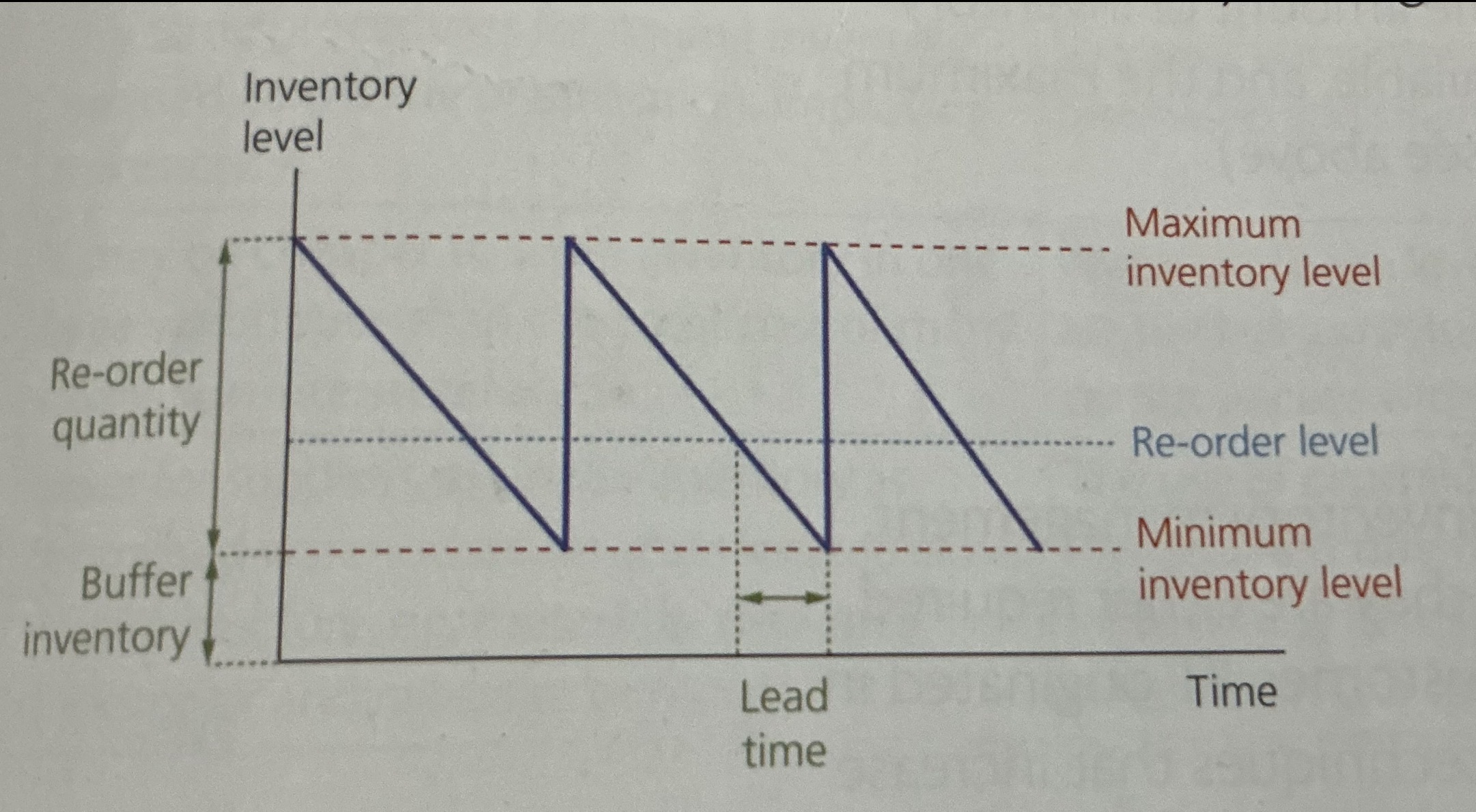
Draw the inventory management control system and describe and justify each thing labeled
Maximum inventory level - most amount of inventory that should be held
setting this level avoids consequences of overstocking
Minimum inventory level - least amount of inventory that should be held
Setting this level avoids consequences of understocking
Re-order level - level at which inventory is re-ordered
Avoids running out of inventory
Re-order quantity - the amount that is ordered
Ensures the quantity ordered is to too much or too little
Lead time - time taken between an order being placed and inventory arriving
as short a lead time as possible allows the business to react to rush orders
Buffer inventory - extra inventory below the agreed to be used in emergencies
ensures that production doesn’t stop and sales continue to be made
Describe 3 factors that take place when setting inventory levels
maximum inventory levels - depends on the storage available, the cost of storing goods and the maximum amount of demand
Minimum inventory levels - depends on the relationship with suppliers, the skill levels of staff so materials are not wasted, the finance available, the minimum amount of demand and the likelihood of drastic changes to taste and fashions
Re-order level - depends on lead time, the amount of inventory already held, if bulk-buying discounts are available, and the maximum and minimum inventory levels themselves
Describe just-in-time and give 4 advantage and disadvantages each
Just in time for- process of ordering supplies only when they are either required or production or when an order is placed by a customer
A
no warehouse is required, saving costs
The business is more responsive to changing external factors
No money is tied up in inventory, improving cash flow and working capital
Allows production to be lean e.g no wastage as all inventory is used for production
D
no room for error in production
Relies on a good infrastructure between the business and supplies e.g road
If deliveries are late then the business will face the negative consequences of understocking
Requires excellent relationships with suppliers to work efficiently, which can take time to develop
What are the two types of methods of production and describe them
And state the other two types of one of the method of production
Capital-intensive production - involves producing products primarily by means of machinery and equipment
2 types of capital-intensive production : automation and mechanisation
Automation - This involves the use of computer aided manufacturer to control fully automated assembly lines that use robotics
Mechanisation - refers to labour and machines working together to produce products.
Labour-intensive production - involves human doing most of the work
Give 3 advantages and disadvantages each of automation , mechanisation and labour-intensive production
AUTOMATION
A- robots can do jobs that are dangerous for humans to do
robots don’t take breaks, holidays or sick leave so can work 24/7
Fewer employees are needed as automation doesn’t require human control, reducing wage costs
D - huge investment is needed to automate a production line
replacing labour with automated robotics will demotivated retained employees
Breakdowns can be catastrophic, losing hours of production time and wasting vast amounts of materials
MECHANISATION
A- using machinery can speed up production
using machinery improves accuracy over purely handmade products as human error is lessened
Unlike automation, a human element exists in mechanisation, improving creativity
D - If machinery breaks down the business has to repair it, leaving workers idle
production can’t be 24/7 as humans require breaks, holidays etc
The machines and equipment can’t be used without humans, so are liable to some human error
LABOUR-INTENSIVE PRODUCTION
A- labour can be less expensive than capital-intensive production
employees are motivated as they are not ‘giving up’ tasks to machines
Humans can use initiative and creativity, something that is often lacking in automated systems
D - recruitment, training and wage costs needs to be considered
humans have to take breaks, holidays etc, which limits production time
Humans have to be paid overtime for working over normal hours whereas machines costs the same at any time of day
Describe 4 reasons for the importance of quality
poor quality goods can result in customers returning their purchases, causing a loss in sales
Extremely low quality can result in products not meeting safety standards, which can lead to bad PR
Conversely, high quality goods can result in a good reputation
The highest quality goods can be sold for higher prices
Describe 4 uses of technology in marketing
spreadsheets can be used to accurately and quickly produce production budgets
Computer aided manufacturer such as robotics, can be used in automated production
The internet can be used to research supplier prices
EPOS (electronic point of sales ) can be used with computerised inventory control to automatically re-order depleted inventory