Proteins
 Call Kai
 Learn
 Practice Test
 Spaced Repetition
 Match
 Flashcards
 Knowt Play
1/13

There's no tags or description
Looks like no tags are added yet.
14 Terms
What are proteins made from?
Monomers - amino acids. Dipeptide is formed when two amino acids join together, polypeptide is more than two. Proteins are made up of one or more polypeptides.
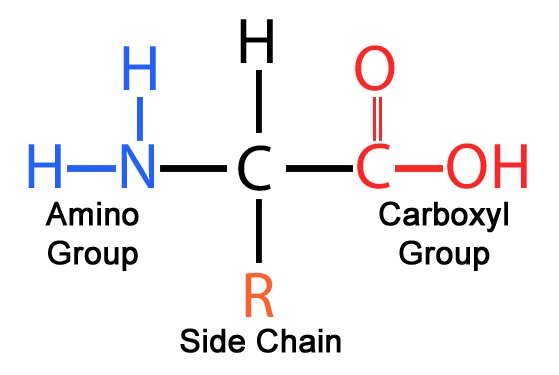
Amino acid structure
A carboxyl group (COOH) , amino group (NH2) and R group (variable group) attached to a carbon atom.
R groups usually contain C (glycine exception - R group one H atom)
All living things share bank of 20 amino acids. The R group is what differentiates them.
Polypeptide formation
Condensation reactions - water molecule released
Peptide bonds between amino acids
Reverse reaction hydrolysis

Primary Structure
The sequence of amino acids in the polypeptide chain
Secondary Structure
Hydrogen bonds form between amino acids in the chain
This makes it: coil into an alpha helix OR fold into a beta pleated sheet
Tertiary structure
coiled or folded chain is coiled or folded further
more bonds form between different parts of polypeptide chain (hydrogen and ionic - attraction between positive and negative charges of different parts of the molecule)
Disulfide bridges also form - when two molecules of amino acid cysteine come close together - a sulphur atom from each acid bond.
IF protein is single polypeptide chain, tertiary is final 3D structure.
Quaternary structure
Several polypeptide chains held together by bonds (ionic, covalent)
The final 3D structure (haemoglobin, insulin, collagen)
Protein’s final 3D structure
What are the main protein functions?
Enzymes
Antibodies
Transport proteins
Structural proteins
Enzymes
roughly spherical - tight folding of polypeptide chains
soluble - often roles in metabolism - i.e breaking down or synthesising large food molecules
Antibodies
immune response involvement found in blood
two short (light) polypeptide chains two long (heavy) polypeptide chains bonded together
have variable regions where amino acids sequences vary greatly
Transport proteins
i.e channel proteins in cell membranes (contain hydrophobic and hydrophilic amino acids, which cause protein to fold up and form a channel
transport molecules and ions across membranee s
Structural proteins
physically strong
long poly peptide chains lying parallel to each other with cross links between them
i.e keratin, collagen
Fibrous proteins
The Quaternary structure is made up of three polypeptide chains -(whose tertiary structure is tightly
wound helix) wound together around each other in a helix fashion like in a rope.
o This gives them specific properties – namely strength
o A good example is collagen or tendons because they need to be strong to hold muscle to bone.
Globular proteins
these carry out metabolic functions – like enzymes which catalyse reactions in the body.