Social Psychology
 Call Kai
 Learn
 Practice Test
 Spaced Repetition
 Match
 Flashcards
 Knowt Play
1/44

There's no tags or description
Looks like no tags are added yet.
45 Terms
Social psychology definition
The scientific study of how people's thoughts, feelings, and behaviours are influenced by the actual, imagined, or implied presence of others (Allport, 1985)
Guiding principles of social psychology
The social brain: The power of the situation: the social contexts we find ourselves in shape the way we think, feel, and act
The power of the situation: the social contexts we find ourselves in shape the way we think, feel, and act
Levels of analysis: in social psychology we are interested in individuals, dyads, and groups
Critical thinking: healthy skepticism
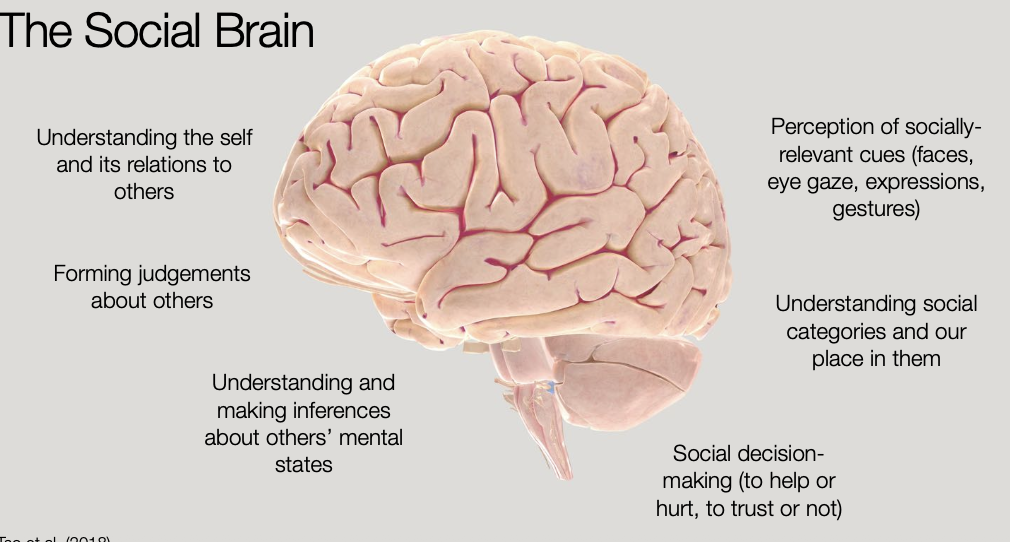
social brain
our brains are good at taking in and processing social information
The power of the situation
Kurt Lewin (1935): the behaviour of people is always a function of the field of forces around them
The field of forces for humans is the situation they find themselves in
As such, human behaviour can be thought of as resulting from a combination of particular personal attributes in a particular situation
A person x situation interaction

Levels of Analysis

Challenges in Social Psychology
• In many ways, social psychology is the study of context
• We don’t always have a one-size-fits-all answer
• Not all findings are true in every situation
• Understanding how and why context matters is part of what makes social psychology so interesting
Scientific rigour and critical thinking
• BUT a guiding principle of science is replicability
• In 2015 a paper attempting to replicate 100 psychology studies found only 36% replicated
• Some of the studies we’ll be talking about have failed to replicate or have been reinterpreted in light of new data
• Use your knowledge of psychology and research methods to judge the quality of the evidence for a given claim
Benefits of Social Psychology
• Gives us insight into our own and others’ behaviour
• Helps us understand the causes and consequences of current events (e.g., COVID compliance, climate action, social justice movements etc)
• Gives us tools to act effectively in the world and help others do the same
• It’s fun! Impress your friends and confound your enemies
Roadmap - Aspects of self-identity
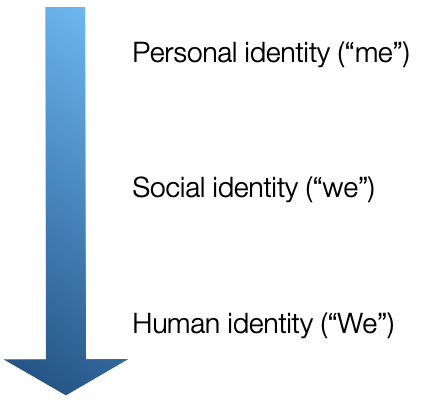
Personal identity: Who we are as individuals
Social identity: Who we are based on our groups
Cultural identity: Who we are based on our upbringing
The Social Self
The self is a unitary and continuous awareness of who one is (Morf & Koole, 2012)
The same person who fell asleep last night and woke up this morning
This is not to say the self never changes! Our sense of self can change due to external factors (new job, moving country) or our own efforts (therapy, personality change) over time
Many aspects of the self are influenced by social experiences
How we think of ourselves (what are you ‘like’?)
What (and who) we like and dislike
Habits we form
Values we adhere to
How we (learn to) behave
Even personality is affected by social context
Have you ever pretended to be more extraverted than you are?
• Elaborate cover story - the bread and butter of social psychology studies
• Present yourself as an extraverted or introverted person
• Extraverted: “outgoing, socially skilled, a people person, eager to meet new people”
• Introverted: “shy, thoughtful, sensitive, and quiet, not pushy or bossy”
• In public or in private
• Then participants rated their “true selves”

Social Identity
We often think about identity as something unique to us, that distinguishes us from other people
But a big part of who we are comes from the groups we belong to (Tajfel, 1979)
Try describing yourself without reference to groups
Gender, nationality, ethnicity, political orientation, religion
Ideology groups (environmentalist, feminist), interest groups (study, hobbies), work groups
Identity is something that binds us with others, not separates us from others
The Social Me (William James, 1890)
• What we know about ourselves from social relationships
• Who a person is in one context (e.g., at work) isn’t necessarily the same person they are in another context (e.g., at home)
Working self-concept (Markus & Wurf, 1987)
• A subset of our self-knowledge is brought to mind in a given context
• The self relevant to relationships may be the mind’s prime focus in romantic contexts; the self related to competition in sports contexts
Self-categorisation theory
Categorisation: a basic human process
• We group things together to help us understand the world
• Categorisation as a process emphasises the differences between groups and the similarities within groups
• At the group level, we categorise people into ‘ingroups’ (groups to which we belong) and ‘outgroups’ (groups to which we don’t belong)
We categorise ourselves as well as other people
• The self can be construed at various levels of identity abstraction
• Different identities become salient in different contexts (a psychology student in this lecture; a mother when homeschooling)
• Shifting the salience of different identities can make previous outgroup members (e.g., engineering students) become ingroup members (e.g., fellow University of Melbourne students)
• ‘Who we are’ depends on the context in which we find ourselves
Cultural Identity
Our sense of self derived from groups we belong to that have a distinct culture (nationality, ethnicity, social class, etc)
A form of social identity, but one that is often with us from the day we are born and encompasses a total way of life and the way we view the world
Can be fostered directly (through socialisation efforts) or indirectly (through background exposure to ways of life, predispositions toward seeing the world in a particular way)
Cultural self-construal (Markus & Kitayama, 1991)
Individualist (or independent): the self is an autonomous entity separate from others; people should assert their independence and celebrate their uniqueness
My environment should change to fit me
Many Western countries: USA, Australia, UK
Collectivist (or interdependent): the self is fundamentally connected to other people; people should seek to fit in a community and fulfil appropriate roles
I should change to fit my environment
Many East Asian, South Asian, African and Latin American countries

Culture and the Social Self
‘Who am I’ exercise (Kuhn & McPartland, 1954)
List 20 statements that describe who you are
Americans’ self-descriptions tend to be context-free responses about traits and preferences (“I like camping”; “Hard working”)
Responses by people from interdependent cultures tend to be context dependent and refer to relationships (“I’m serious at work”; “I’m Jan’s friend”)
Culture and the Social Self
Even within cultures there are differences in self-construal (Ma & Schoeneman, 1997)
‘Who am I’ exercise among different groups living in Kenya
Undergraduate students living in Nairobi with greater exposure to Western culture and being educated in Western tradition
Traditional Maasai herding peoples who had very little contact with Western principles

Being with others meets basic needs - what are these?
Humans have basic psychological needs (Williams, 2009)
• Belonging: to be accepted by others
• Self-esteem: to be liked by others
• Control: to be capable of achieving goals
• Meaning: to have relevance in the world
Connection with others fosters these needs (Greenaway et al., 2016)
People were asked to remember they gained or lost an important identity or group membership
Then reflected on how this event affected basic needs

Social belonging, self esteem? - The Sociometer Hypothesis (Leary et al., 1995)
• Things that make us feel good about ourselves (self-esteem) are also the things that make others accept and like us (belonging)
• Like a fuel gauge, self-esteem is a readout of our likely standing with others
• High self-esteem signals social inclusion
• Low self-esteem signals social exclusion
• Self-esteem cues us when we need to attend to and shore up our social bonds
• Leary and colleagues argue we don’t need self-esteem for personal reasons, just social reasons
Social Comparison Theory (Festinger, 1954)
Two assumptions of this theory
We seek to gain accurate self-evaluations
Comparisons with other people help us reality-check our own self-evaluations
We make two types of comparisons (Wills, 1981):
1. Downward comparisons: when we compare ourselves to others we think are worse than us on a particular dimension (can improve our self-evaluation)
2. Upward comparisons: when we compare ourselves to others we think are better than us on a particular dimension (can worsen our self-evaluation)
Self-Evaluation Maintenance Model (Tesser, 1988)
Two assumptions of this theory
We seek to maintain or improve our self-evaluation
Comparisons with others influence our self-evaluation
• Two processes in this theory
1. Reflection: Other people improve our self-evaluation
2. Comparison: Other people worsen our self-evaluation
Reflection
Usually happens when evaluation happens in a domain that is not relevant to the self
My sister won her rowing race at 6am in the freezing Melbourne winter - I feel so good!
Self-evaluation goes up because the self shares in the success
Comparison
Usually happens when evaluation happens in a domain that is relevant to the self
My friend got the highest score on the MBB2 assignment - I need to eat my feelings
Self-evaluation goes down because it invites unfavourable comparison with our own abilities
BIRG-ing and CORF-ing

Social Comparisons
The Better-Than-Average Effect (Alicke & Govorun, 2005; Taylor & Brown, 1988)
Most of us tend to view ourselves positively
So much so that people think they are above average on a wide range of positive dimensions
Most drivers said their driving skill was closer to “expert” than “poor”…while hospitalised for being in a car accident (Preston & Harris, 1965)
Does not differ when comparing a general or similar other
Alone Together
We can be apart from others in more ways than physical distance.
• Psychological distance: Loneliness
• Social distance: Social network centrality
• Induced distance: Rejection and discrimination
Loneliness
Subjective feeling of distress when social relations are not going how we would like
Discrepancy between the level of connectedness we want to have and what we currently have
We can be surrounded by others and still be lonely or can be alone but not feel lonely
Loneliness is affected by lack of relationship quantity (e.g., number of friends)
But is more affected by lack of relationship quality - feeling misunderstood or that relationships are not meaningful
Different from social isolation, which is a state of having minimal contact with others
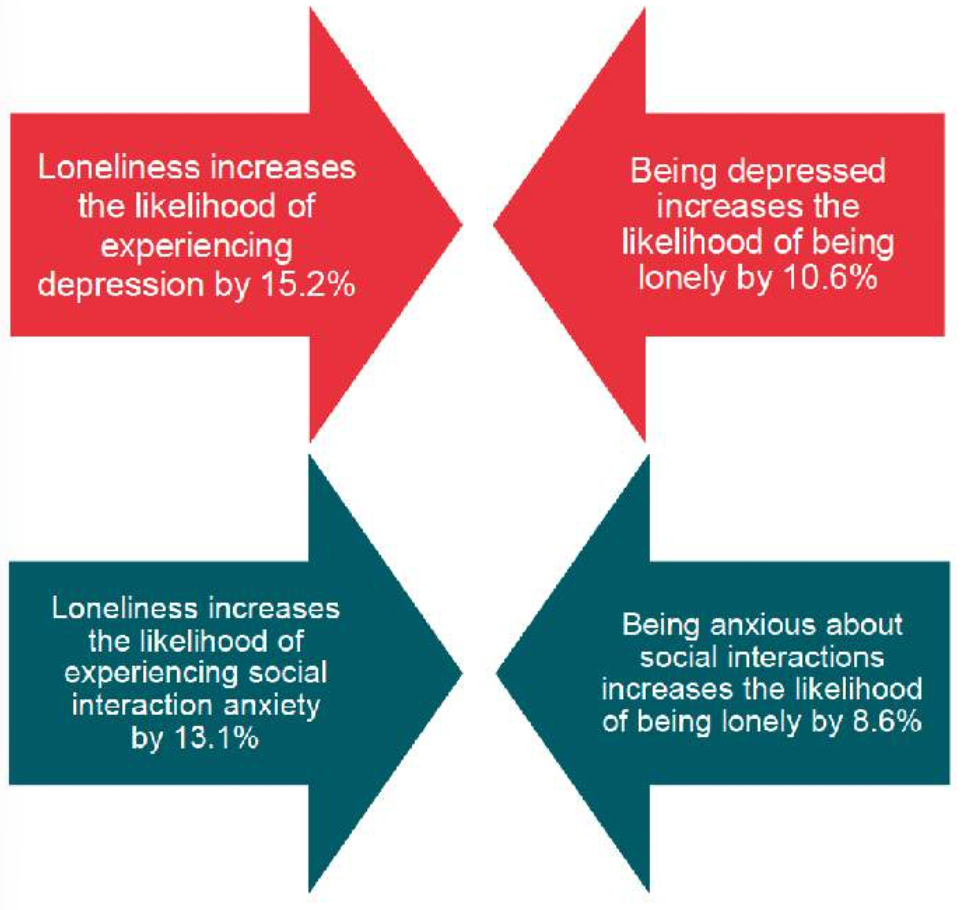
Effects of loneliness

Loneliness - negative feedback loops
Social Distance in Social Networks
A way of quantifying social structures
Characterises networked structures in terms of nodes (individuals within the network) and the ties that link them
Yields several measures - who knows whom in a network, popularity within a network, closeness between people in a network etc
Given the importance of connectedness with others, lack of inclusion in a social network is detrimental for health
Greater social integration is associated with lower mortality
Berkman and Syme (1979) reported the results of a 9-year prospective study of 6,928 adults in Alameda County, California
Assessed social ties in the form of marriage, friends, relatives, organisational and church membership
The fewer social ties people had, the more likely they were to die over the next 9 years
Same pattern for men and women and across age groups

Loneliness is catching
Cacioppo and colleagues (2009) found people directly connected to a lonely person in a social network were 52% more likely to be lonely
Loneliness grows in networks over time - extends up to a friend of a friend of a friend
Growth is particularly strong when the lonely tie is close - a friend or family member
Three explanations for this:
Induction: Emotion contagion within a network
Homophily: Similar people are connected (like with like)
Shared environment: Exposure to the same social challenges and upheavals
Ostracism
A procedure from Ancient Greece in which a citizen was expelled from the city-state for 10 years
In modern terms, refers to social shunning
“Any act of ignoring and excluding of an individual or group by an individual or a group” (Williams, 2001)
Cyberball
Online version of a ball-tossing game
Participants are instructed to throw a ball with other players - when included, participants receive the ball 1/3rd of the time; when excluded they receive the ball once or twice and then never receive it again
Still used regularly in studies today, despite the laughably simple rendering
Effects of being excluded in cyberball are similar to “in person” ostracism
it’s a very effective method of inducing ostracism
That said, some modern paradigms seek to incorporate more ecological validity in the exclusion process
o-Cam
A modern experimental paradigm that increases the realism of the ostracism experience
Ostracism Hurts
From an evolutionary perspective, ostracism signals danger (no access to social resources)
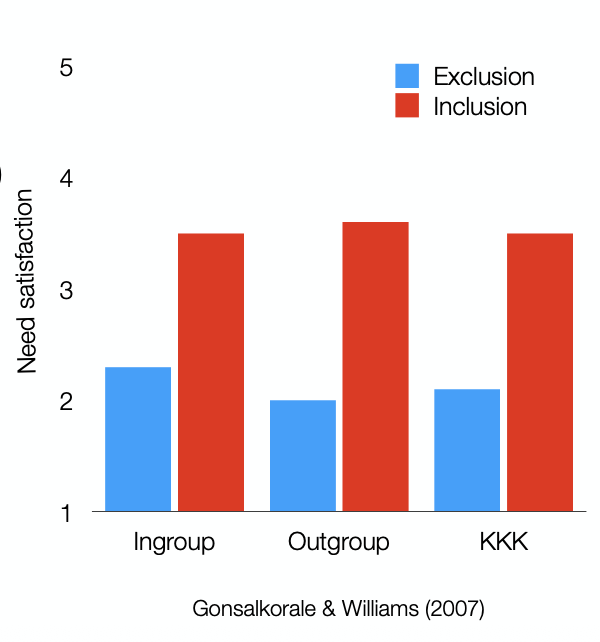
As a result, being excluded or ostracised harms basic psychological needs and makes us feel bad

Ostracism Hurts
From an evolutionary perspective, ostracism signals danger (no access to social resources)
As a result, being excluded or ostracised harms basic psychological needs and makes us feel bad
In fact, we’re so sensitive to social feedback that ostracism hurts no matter who does it!
Same with exclusion via person and computer
Discrimination
How others treat us on the basis of our group membership impacts on our mental and physical health
Discrimination can lead to ill-health through:
Stress and emotional reactions with detrimental impacts on mental health
Negative coping responses (e.g., smoking, drug use)
Reduced access to resources (e.g., education, employment, housing, medical care)
Physical injury via racially-motivated assault
Is Social Media Good or Bad for Us?
Stimulation hypothesis: Online interactions strengthen existing relationships and thus have a social benefit
Displacement hypothesis: Social media replaces offline, face-to-face interactions, thus incurring social costs
Stimulation Hypothesis
Social media can strengthen social ties
Social media can stimulate well-being when it facilitates meaningful connections
Two main ways social media can help us
Active use of social media that involves attempts to connect with others (e.g., private or public exchanges with others)
Active use is associated with greater social support and well-being (Godard & Holtzman, 2024)
When social media enhances self-disclosure it can improve relationships and well-being (Valkenberg & Peter, 2009)
People can be less concerned with how others view them when online vs. in person

Displacement Hypothesis
Social media can weaken social ties
Social media can harm well-being when it displaces good activities like face-to-face interaction or sleep
Three main ways social media can hurt us
Problematic use includes experiencing withdrawal when not using social media, loss of control over use or preoccupation with use
Problematic use predicts worse social relationships (Marciano et al., 2024)
Social media that displaces face-to-face interaction increases loneliness (Teppers et al., 2014)
Social media is harmful when it promotes upward social comparison (Verduyn et al., 2022)

Does Restricting Social Media Help?
Social media bans operate on the assumption that restricting social media use will make us feel better
Research is divided on whether asking people to limit or abstain from social media use improves well-being (Burnell et al., 2025) or has no effect on well-being (Lemahieu et al., 2025)
Our reasons for using social media might matter more than how much we use social media
The Impact of Social Media Depends on Us
How we use social media matters
Active vs. passive: engaging vs. lurking
Motives for use: connect with others vs. compare to others
Type (vs. amount) of use: we control social media vs. it controls us
When actively used to enhance existing relationships and forge new social
connections, social media can be a force for good
When passively used to escape the social world or compare ourselves
with others, social media can be harmful
Just like social interactions in real life!