Bio2 ch31- Fungi
 Call Kai
 Learn
 Practice Test
 Spaced Repetition
 Match
 Flashcards
 Knowt Play
1/42

There's no tags or description
Looks like no tags are added yet.
43 Terms
Suppose two species live in close contact with each other. One species benefits by eating the tissues of the other, and the other is harmed (by having its tissues consumed). The ecological interaction between these species is an example of
a) symbiosis and mutualism.
b) parasitism and symbiosis.
c) mutualism and parasitism.
d) symbiosis and commensalism.
b) parasitism and symbiosis.
Which of the following statements correctly describes a difference between plants and fungi?
a) Fungi are heterotrophic, but plants are autotrophic.
c) Plants produce spores.
d) Plants have diploid and haploid phases, but fungi have only haploid stages.
e) Fungi are strictly asexual, but plants undergo sexual reproduction.
a) Fungi are heterotrophic, but plants are autotrophic.
Fungi obtain minerals through _____.
photosynthesis
endocytosis
absorption
ingestion
absorption
The body of most fungi consists of threadlike __________, which form a network called a __________.
mycelia, hyphae
hyphae, chytrid
mycelia, dikaryon
hyphae, mycelium
hyphae, mycelium
An important example of interaction between fungi and certain other organisms is mycorrhizae, in which the fungal partners _____.
a) cause the decay of cellulose and lignin
b) provide carbohydrates to the plant partner
c) help plants take up nutrients and water
d) sicken herbivores that attempt to feed on plants
c) help plants take up nutrients and water
All fungi are _______.
flagellated.
symbiotic.
decomposers.
heterotrophic.
heterotrophic
If all fungi in an environment were to suddenly die, then which group of organisms is most likely to benefit, due to the fact that its fungal competitors have been removed?
a) prokaryotes
b) grasses
c) flowering plants
d) protists
a) prokaryotes
When pathogenic fungi are found growing on the roots of grape vines, grape farmers sometimes respond by covering the ground around their vines with plastic sheeting and pumping a gaseous fungicide into the soil. Which of the following results might be a concern for the grape farmers who engage in this practice?
a) Fungicide might also kill mycorrhizae.
b) Lichens growing on the vines' branches are not harmed.
c) Fungicide might also kill the native yeasts residing on the surfaces of the grapes.
d) Sheeting is transparent so that photosynthesis can continue.
a) Fungicide might also kill mycorrhizae.
Which of the following statements describes an adaptive advantage associated with the filamentous nature of fungal mycelia?
a) the potential to inhabit almost all terrestrial habitats
b) the ability to form haustoria and parasitize other organisms
c) an extensive surface area well suited for invasive growth and absorptive nutrition
d) the increased probability of contact between different mating types
c) an extensive surface area well suited for invasive growth and absorptive nutrition
Some fungal species live in plants and can kill herbivores that feed on the plant. What type of relationship does this fungus have with its host?
parasitic
commensal
mutualistic
predatory
mutualistic
The diploid phase of the life cycle is shortest in which of the following?
Angiosperm
Gymnosperm
Moss
Fungus
Fungus
What sexual processes in fungi generate genetic variation?
a) Budding and meiosis
b) Karyogamy and meiosis
c) Haustoria and karyogamy
d) Plasmogamy and meiosis
b) Karyogamy and meiosis
Which of the following cells or structures are associated with asexual reproduction in fungi?
a) ascospores
b) basidiospores
c) conidiophores
d) zygosporangia
c) conidiophores
At which stage of a basidiomycete's life cycle would reproduction be halted if an enzyme that prevented the fusion of hyphae was introduced?
a) karyogamy
b) germination
c) plasmogamy
d) fertilization
c) plasmogamy
Which of the following statements correctly describes the daughter cells that result from cytokinesis in budding yeasts?
a) similar nucleus and less cytoplasm than the mother cell
b) similar nucleus and more cytoplasm than the mother cell
c) smaller nucleus and less cytoplasm than the mother cell
d) larger nucleus and less cytoplasm than the mother cell
a) similar nucleus and less cytoplasm than the mother cell
In most fungi, karyogamy does not immediately follow plasmogamy. Which of the following statements would describe the cells that completed plasmogamy but not karyogamy?
a) The cells are haploid.
b) The cells are spores.
c) The cells are heterokaryotic.
d) The cells are diploid.
c) The cells are heterokaryotic.
Select the correct statement(s) about fungal life cycles.
Select all that apply.
a) Meiosis produces gametes in fungi.
b) In some fungi, plasmogamy precedes karyogamy by decades.
c) Fungi reproduce sexually but do not have male or female genders.
B and C only
In fungi, haploid hyphae fuse to produce dikaryotic and then diploid nuclei, only to restore the haploid condition by meiosis before the growth of new hyphae. What is the significance of a transient diploid state in fungi?
a) All organisms must reproduce sexually at some point in their life cycle.
b) The diploid state is more advanced than the haploid state.
c) These sexual processes generate genetic variation.
c) These sexual processes generate genetic variation.
b) The diploid state is more advanced than the haploid state.
a) All organisms must reproduce sexually at some point in their life cycle.
Which of the following groups of organisms are most closely related to fungi?
animals
mosses
slime molds
vascular plants
animals
Which feature seen in chytrids supports the hypothesis that they diverged early in fungal evolution?
a) the absence of chitin within the cell wall
b) parasitic lifestyle
c) flagellated spores
d) coenocytic hyphae
c) flagellated spores
Chitin is a long-chain polymer derived from glucose. It strengthens cell walls of fungi and the outer covering (exoskeleton) of arthropods (including crabs, shrimps, and insects). The presence of chitin in these groups is likely the result of which of the following processes?
a) convergent evolution
b) paraphyletic evolution
c) horizontal gene transfer
d) secondary endoparasitism
a) convergent evolution
Which of the following observations would best support the hypothesis that the ability to form mycorrhizal associations arose very early in plant evolution?
a) fossils that show hyphae wrapped around seeds
b) presence of genes for chitin in the oldest flowering plants and oldest fungi
c) formation of mycorrhizae by a flowering plant that expresses a gene from a liverwort
d) presence of genes in the earliest fungi that showed an ability to digest cellulose and lignin
c) formation of mycorrhizae by a flowering plant that expresses a gene from a liverwort
Select the correct statement(s) about the origin of fungi.
Select all that apply.
a) Fungi evolved after the first plants colonized land.
b) Fungi are more closely related to plants than to animals.
c) Multicellularity probably arose independently in fungi and animals.
C only
Which of the following features is a characteristic that is unique to fungi in the Phylum Ascomycota?
zoospores
a dikaryotic structure
yeasts
saclike structures
saclike structures
From the human perspective, which of the following kinds of fungi would be considered the least useful or beneficial?
Rusts
Truffles
Yeasts
Decomposers
Rusts
You observe the gametes of a fungal species under the microscope and realize that they resemble animal sperm. To which of the following groups does the fungus belong?
a) basidiomycota
b) ascomycota
c) zygomycetes
d) chytrids
d) chytrids
Which of the following characteristics would be most helpful in distinguishing among different species of fungi?
a) hyphae structure
b) DNA sequence
c) morphology
d) life cycle
b) DNA sequence
Fungi form mutualistic relationships with plants and animals; which of the following statements is an example of such a relationship?
a) Fungi can help increase drought tolerance in plants
b) Fungi help break down plant material in the guts of grazing mammals.
c) Endophytes in leaves produce toxins that deter herbivores.
d) Fungi help break down wood in the guts of termites.
e) All of the above.
All of the above
In which of the following human mycoses should one expect to find a growth pattern most similar to that of the mycelium that produces a fairy ring?
a) systemic (blood-borne) Candida infection
b) infection of lymphatic vessels
c) coccidiomycosis (lung infection)
d) skin mycoses
d) skin mycoses
Which of the following statements best describes the physical relationship of the partners involved in lichens?
a) Fungal cells are enclosed within algal cells.
b) Fungi grow on rocks and trees and are covered by algae.
c) Photosynthetic cells are surrounded by fungal hyphae.
d) Lichen cells are enclosed within fungal cells.
c) Photosynthetic cells are surrounded by fungal hyphae.
Mycorrhizae are often found associated with the roots of vascular plants. Where are fungal endophytes typically found in vascular plants?
a) leaf mesophyll
b) xylem
c) root apical meristems
d) stem apical meristems
a) leaf mesophyll
Fungi interact with many organisms in mutualistic ways. Which of the following scenarios involves a fungus that is mutualistic with another organism?
a) a fungus that produces penicillin that is used by humans to kill infectious bacteria
b) a fungus and a protozoan that live together as a lichen
c) a fungus that lives inside plant roots and produces toxins that kill neighboring plants
d) a fungus that is raised by ants on leaves that the ants collect from trees and shrubs
d) a fungus that is raised by ants on leaves that the ants collect from trees and shrubs
Truffles are the fruiting bodies of certain fungi whose mycelium grows below ground. The truffle is also underground and can be detected by many mammals, which eat the truffle and expel the spores with their feces. Which of the following statements is likely accurate with respect to this interaction?
a) The truffle spores are probably wind dispersed.
b) Truffle fruiting bodies are important in decomposition of wood.
c) Truffles probably produce toxins that can harm the mammals that eat them.
d) Truffles produce an odor that mammals can detect and find attractive.
d) Truffles produce an odor that mammals can detect and find attractive.
Which of the following ecological roles is/are played by at least some fungi?
Select all that apply.
a) Autotrophy
b) Predation
c) Decomposition
B and C only
Which statement(s) correctly describe(s) the interactions between plants and fungi?
Select all that apply.
a) Plants are harmed by fungal pathogens.
b) Plants depend on fungi as mutualistic symbionts.
c) Plants compete with fungi for access to soil nutrients.
A and B only
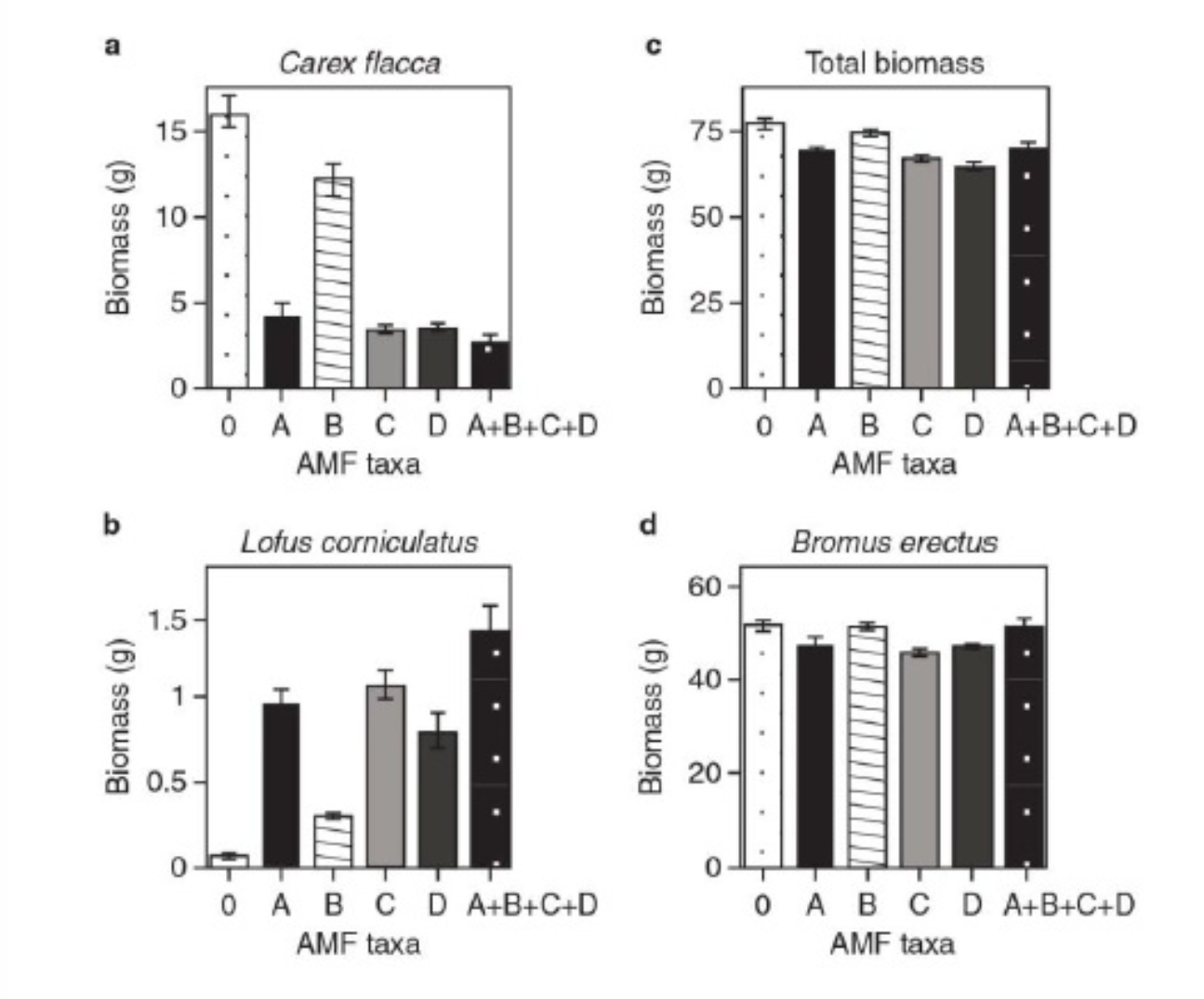
What is the major difference between Bromus erectus (graph f) and the other plant species (graphs a-d) included in the study?
a) Bromus erectus produces very little biomass regardless of AMF.
b) Bromus erectus grows best with a diversity of fungal partners.
c) Bromus erectus is unaffected by AMF diversity.
d) Bromus erectus does not form mycorrhizal associations.
c) Bromus erectus is unaffected by AMF diversity.

Place the labels in their appropriate locations on the diagram of the fungus and hyphae below.
a) mycelium
b) pore
c) septum
d) septate hypha
e) coenocytic hypha

The following statements describe something about the body structures or functions of fungi. Identify those statements that are correct.
Select all that apply.
a) Some fungi secrete digestive enzymes into the environment and then absorb the digested nutrients.
b) Nutrients can flow through the entire mycelium in fungi with coenocytic hyphae, but not in fungi with septate hyphae.
c) All fungi are heterotrophs; some species live as decomposers and others as symbionts.
d) Cellulose gives rigidity and strength to the cell walls of fungi.
e) Mycelia are made up of small-diameter hyphae that form an interwoven mass, providing more surface area for nutrient absorption.
f) Some fungi can grow as either filamentous or single-celled forms.
A, C, E, and F only
Which of the following characteristics belong to decomposer fungi?
a) fungi in association with a dead rabbit
b) mycorrhizal fungi in pine tree roots
c) Cryphonectria parasitica
d) fungi in association with a fallen log
e) fungi in the family Lepiotaceae
f) Septobasidium spp. and an individual scale insect infected by fungal hyphae
g) coprophilous fungi
h) Cordyceps spp.
i) Trichophyton spp.
A, D, and G only
Which of the following characteristics belong to mutualistic fungi?
a) fungi in association with a dead rabbit
b) mycorrhizal fungi in pine tree roots
c) Cryphonectria parasitica
d) fungi in association with a fallen log
e) fungi in the family Lepiotaceae
f) Septobasidium spp. and an individual scale insect infected by fungal hyphae
g) coprophilous fungi
h) Cordyceps spp.
i) Trichophyton spp.
B and E only
Which of the following characteristics belong to parasitic fungi?
a) fungi in association with a dead rabbit
b) mycorrhizal fungi in pine tree roots
c) Cryphonectria parasitica
d) fungi in association with a fallen log
e) fungi in the family Lepiotaceae
f) Septobasidium spp. and an individual scale insect infected by fungal hyphae
g) coprophilous fungi
h) Cordyceps spp.
i) Trichophyton spp.
C, F, H, and I only

The figure depicts the outline of a large fairy ring that has appeared overnight in an open meadow, as viewed from above. The fairy ring represents the furthest advance of this mycelium through the soil. Locations A-D are all 0.5 meters below the soil surface.
Where would you expect to find the oldest portion of this mycelium? A, B, C, or D?
Location C