Drosophila Development
 Call Kai
 Learn
 Practice Test
 Spaced Repetition
 Match
 Flashcards
 Knowt Play
1/58

There's no tags or description
Looks like no tags are added yet.
59 Terms
Why should we care about how fruit flies are patterned and establish their axis?
Conserved mechanisms between invertebrates and vertebrates in how our bodies were patterned as embryos
What happens 0 to ~1 hour after fertilization?
Egg undergoes rapid nuclear divisions without cell division (syncytial stage)
What happens 2-3 hours after fertilization?
Cellularization occurs, and the embryo begins to form distinct tissue layers
What happens 3-10 hours after fertilization?
Major body segments start to form, and the germ band extends (posterior end that curves around itself)
What happens 10-13 hours after fertilization?
The germ band retracts, and organogenesis proceeds
What happens roughly 24 hours after fertilization?
Embryo completes development, hatches and emerges as a first-instar larva
When looking at early cleavage divisions of a fly embryo, what is characteristic of the syncytial blastoderm?
Cells have migrated to the periphery
pole cells form
When looking at early cleavage divisions of a fly embryo, what is characteristic of MBT?
Cell membrane has formed and grows inward (cellular blastoderm)
What drives cellularization?
Microtubules and microfilaments
What does cellularization form?
Epithelium of cells, facilitating gastrulation (so cells can move together)
Apical adherens junctions between cells
What features mark gastrulation?
Ventral furrow: invagination on ventral surface that internalizes ~1000 cells then closes up (precursors of mesoderm)
Anterior/Posterior midgut invaginations = how endoderm gets inside
Cephalic furrow is boundary between head and rest of body
Pole cells in posterior midgut invagination = germ cell precursors (oocytes or sperm)
When does the germ band extend and retract?
Extends at end of gastrulation and retracts (~12 hours) when organogenesis starts
What is germ band extension driven by?
Converging and intercalating at the ventral midline
cells inserting in between each other allows extension along perpendicular plane
What does the germband eventually develop into?
Future thoracic and abdominal segments
What gives oocyte anterior-posterior polarity and pre-pattern the early embryo?
Maternal Effect Genes (MEGs)
What are the anterior (head) morphogens?
Bicoid and hunchback
What are the posterior morphogens?
Nanos and caudal
What is step 1 in the anterior-posterior patterning of Drosophila?
Maternal Effect Genes (MEGs)
mRNAs deposited in oocyte
Set up early polarity
Translated at fertilization
Creates cytoplasmic polarity
What do MEGs activate?
Gap Genes
Expressed from zygotic genome
Broad expression domains
1-2 broad stripes created
What do gap gene products activate?
Pair-rule genes
7 stripes
define boundaries of segments
Most important
What do pair-rule gene products activate after cellularization?
Segment polarity genes
Give each segment polarity
What are MEGs expressed by?
Nurse cells of the egg chamber
Oocyte precursor cell (oogonium) undergoes 4 incomplete cell divisions to produce 16 interconnected cells → 15 nurse cells, 1 oocyte
Nurse cells supply proteins and MEGs (bicoid, hunchback, nanos, caudal mRNAs)
How are MEGs localized to set up early anterior-posterior axis during oogenesis?
Nurse cells are localized to anterior end with polarized microtubules on posterior half
Positive towards posterior, negative towards anterior
Bicoid mRNA localized on negative end
Nanos mRNA localized to positive posterior end
mRNA will produce proteins that diffuse
What mRNA is associated with kinesin I?
Oskar mRNA associated with kinesin I; Oskar protein associated with nanos mRNA
What establishes the dorsal-ventral axis?
Organization of nucleus on dorsal side
What is the order of Syncytial specification?
MEG mRNAs (bicoid and nanos) are distributed assymetrically in oocyte
mRNAs translated at fertilization → proteins diffuse
Proteins form morphogen gradients (syncytium) and are incorporated into cells at cellularization
What does bicoid encode?
Morphogen responsible for head structures
What will a bicoid-deficient mutant have?
Two tails (one at each end)
If bicoid is added to mutant anterior, mutant middle or WT posterior end what will happen?
Anterior: WT; head at anterior
Middle: Head in middle
Posterior: Two heads (one at each end)
**head develops wherever bicoid is placed (bicoid dominant over nanos)
What mRNA is asymmetrically distributed? Symmetrically distributed?
Asymmetric: bicoid and nanos
Symmetric: hunchback and caudal
If the mRNA is symmetric, then how is hunchback protein higher on anterior side and caudal protein higher on the posterior side?
Bicoid protein halts the translation of caudal
High [Bicoid] binds BRE in caudal mRNA 3’ UTR, and eIF4E that is bound to the 5’ cap
Low [Bicoid]: eIF4E and elF4G can interact normally
Nanos halts the translation of hunchback
High [Nanos] binds pumillo on NRE and causes deadenylation of PolyA tail
Low [Nanos]: Only Pumilio bound to NRE → translation
What is the WT gap gene?
Kruppel (boundary between two segments)
What is the pattern of pair-rule gene expression?
Expressed in 7 stripes, where each stripe spans two fragments (control development of every other fragment)
Even-skipped (eve) and Paired (prd) for example
What are examples of segment polarity genes?
Engrailed (en) and wingless (wg)
MEGs establish broad anterior-posterior identity of the embryo, what establishes the segments?
The hierarchy of zygotic genes! Gap, pair-rule, segment polarity, the homeotic selector (HOX) establish the identity of each individual segment
What happens if there is a mutation in any of the zygotic segmentation genes?
Embryonic lethal
What happens in a Gap mutant?
Missing several segments in a row
What happens in a pair-rule mutant?
Missing portions of every other segment (can delete boundaries and reduce the number of segments)
What happens in a segment polarity mutant?
Polarity disrupted in each segment (segment number does NOT change!)
When are pair-rule genes induced?
Onset of cellularization
How many gap genes are known?
9 (like Kruppel; parasegments 4-6)
When pair-rule genes are expressed at cellularization, what regulates them?
Gap genes transcriptionally activate and repress
How are parasegments positioned relative to segments?
Shifted one compartment forward
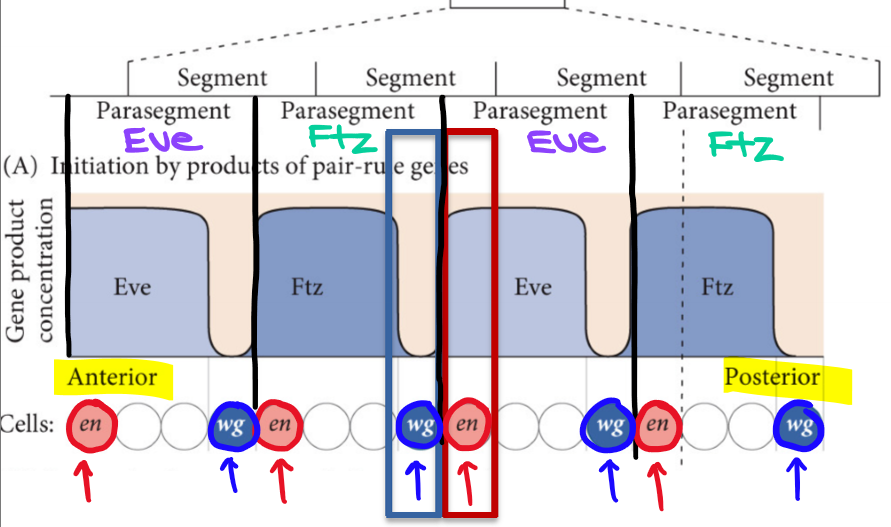
If we were looking at pair-rule genes eve and ftz (fushi tarazu), how would they be placed?
Each would be in their own parasegment, in an alternating pattern
[eve] [ftz] [eve] [ftz]……
What is the difference between parasegments and segments?
Eve and Ftz are expressed in alternating stripes, and these patterns help establish parasegment boundaries. There are 7 stripes of Eve, 7 stripes of Ftz = 14 parasegments
Segments form, containing half of two neighbouring parasegments (one segment will have expression of two pair-rule genes to form posterior/anterior ends) => these are what we can actually see on a bug!
What are all of the segments of a Drosopholia embryo?
Ma: Mandibular
Mx: Maxillary
Lb: Labial
T1-T3: Thoracic
A1-A8: Abdominal
When are segment polarity genes expressed? What are they activated by?
AFTER cellularization. They are activated by different combinations of pair-rule proteins acting as TFs
How many stripes of expression do the products of the pair-rule genes create?
14 alternating stripes; 7 of Eve and 7 of Ftz
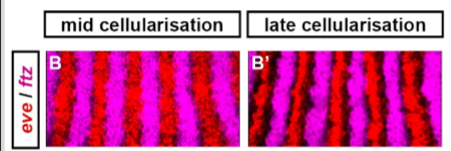
How does the expression of pair-rule genes change when comparing mid cellularization to late cellularization?
Mid-cellularization: thin to no boundary between Ftz and Eve
Late-cellularization: thicker bands of no expression acting as a boundary between Ftz and Eve => boundaries have been established so now segment polarity genes will be induced, to reinforce these boundaries
What is the function of segment polarity genes in Drosophila development?
They establish and maintain parasegment boundaries and help establish anterior and posterior polarity, allowing different regions of each segment to develop distinct structures
Which two segment polarity genes are involved in reinforcing parasegment boundaries?
Engrailed (en)
TF
Anterior compartment of each parasegment
Activated by Ftz and Eve
Wingless (wg)
Wnt Ligand
Posterior compartment of each parasegment
Activated where there are no pair-rule genes
How do Engrailed and Wingless reinforce parasegment boundaries?
Engrailed-expressing cells produce Hedgehog, which maintains Wingless expression in neighbouring cells by activating Patched and allowing transcription of Wg. Wingless signals back (WNT ligand) to maintain Engrailed and Hedgehog expression, creating a positive feedback loop that reinforces the boundary
Is the positive feedback loop between cells at the parasegment boundary a morphogen affect?
Since the cells depend on each other to maintain their gene expression patterns, this is an example of reciprocal signalling that maintains two adjacent cell populations, rather than concentration dependent
By reinforcing parasegment boundaries, segment-polarity genes differenciate cells on the anterior and posterior halves of segments. This does what?
While maintaining Para segment boundaries, they are also simultaneously polarizing each segment so they can go onto produce different identities and structures (posterior wg of parasegment 1 is beside anterior en of parasegment 2 and they have established a positive feedback loop with eachother)
like the alternative pattern of the denticles
If polarity genes are mutated, what happens to denticle patterning?
If Wg or En is mutated, polarity will be lost within the segment and it will be a lawn of denticles rather than an alternating pattern
its like a handshake. Wg requires En and En requires Wg
How many homeotic complexes are formed in Drosophila by HOX genes?
2 homeotic complexes at 3R!
Antennapedia complex (head and thorax); 5 genes
Bithorax complex (Abdomen); 3 genes
How are the genes within both homeotic complexes arranged?
Genes are ordered in the same sequence as the body plan they make
most anterior gene = most anterior body part
What does ultrabithorax (Ubx) knockout do?
When Ubx is knocked out, the fly will form a pair of wings at both T2 and T3
Ubx usually inhibits wing development at T3, and instead develops a pair of small balancing wings
What happens if Antennapedia (antp) is misexpressed in the head?
GOF! Antp usually develops the middle pair of legs
Misexpression in the head causes a homeotic transformation since antennae develop as legs instead (ectopic expression of Antp)