Animal Lab Quiz 2
 Call Kai
 Learn
 Practice Test
 Spaced Repetition
 Match
 Flashcards
 Knowt Play
1/48

There's no tags or description
Looks like no tags are added yet.
49 Terms
Ventral vs Dorsal
Ventral: Belly
Dorsal: Back
Phylum Mollusca 4 T.M.O.S
True coelomates
Muscular foot and mantle
(Mostly) open circulatory system with pumping heart
Synapomorphy: radula
Class Polyplacophora 6 + example R.R.S.B.M.U
Reduced head
Radula present
Shell with 8 dorsal plates
Broad, flat foot
Multiple gills (ctenidia) on side of body
Usually dioecious
Example: Chiton
Class Bivalvia 6 + examples C.N.F.P.M.M
Cephalization greatly reduced
No radula
Foot usually wedge-shaped
Plate-like gills
Mantle two-lobed, enclosing body
Mostly dioecious
Examples: Clams, oysters, scallops, etc.
Class Gastropoda 6 + examples H.R.L.L.1.D
Head well developed (high degree of cephalization)
Radula present
Large, flat foot
Locomotion via waves of muscle contraction
1-2 gills or modified mantle → secondary gills/lung
Dioecious OR monoecious
Examples: Snails and slugs
Class Cephalopoda 5 + examples S.W.A.S.D
Shell reduced/absent
Well developed head
Arms or tentacles
Siphon present
Dioecious
Examples: squid, octopus and nautilus

Dorsal side, male

Ventral side, female

Phylum Annelida 8 (2 are classes E and S) T.S/M.D.N.C.C
Class Errantia
Class Sedentaria
True coelomates
Segmentation and metamerism
Division of coelomic cavity into fluid filled compartments
Neuromuscular system
Complete mouth to anus digestive tract
Closed circulatory system with plumping walls
Class Errantia 8 M.S.P.D.N.D.E.T
Mostly marine
Segmented inside and out
Parapodia with setae
Distinct head with eyes, palps, and tentacles
No clitellum
Dioecious
Epitoky
Trochophore larvae usually present

Class Sedentaria (some former Oligochaeta) 6 + example B.C.F.N.D.T
Body segmented inside and out
Clitellum present
Few setae
No parapodia
Direct Development
Terrestrial and Freshwater
Example: earthworms

Class Sedentaria (some former Hirudinea) 6 + example S.C.A.N.C.T
Segments 33 or 34 in number with many annuli (surface divisions)
Clitellum present
Anterior and posterior suckers
No parapodia
Coelom closely packed with connective tissue and muscles
Terrestrial, freshwater, marine
Example: Leeches

Earthworm dissection
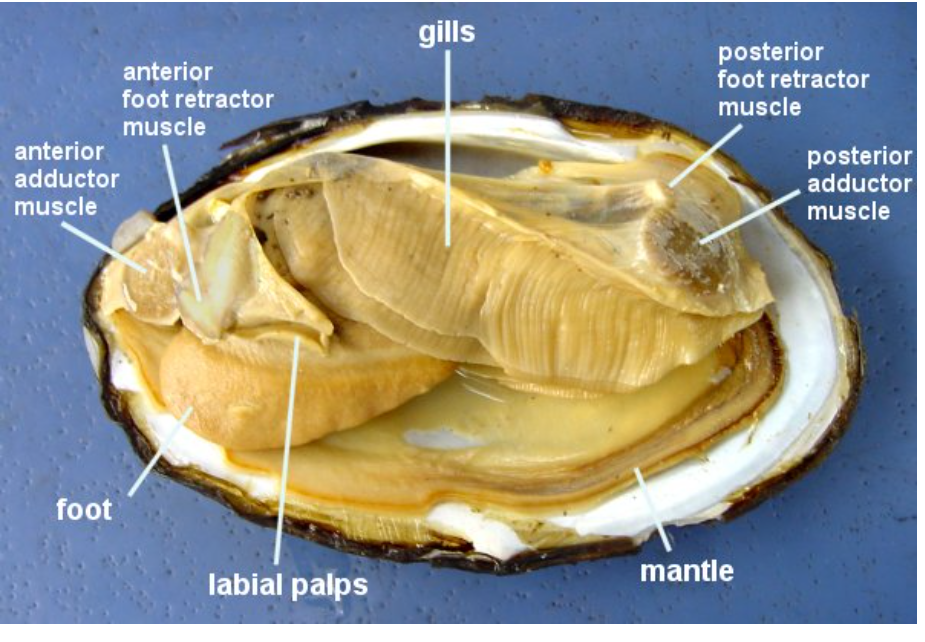
For a freshwater clam label the foot, siphon, gills, mantle and abductor muscles. Then label the ventral/dorsal sides and the anterior/posterior sides

What is the difference between an open and closed circulatory system? Give an example of each from this lab
Open circulatory blood may be directly open to the environment at places such as the digestive tract
A closed circulatory system consists of the heart that pumps blood into the vessels to reach the tissues and organs
Examples: Earthworm (closed) (Annelid) and Squids (Cephlapods) (open)
Correct phylogenetic pathway towards Molluscs
Bilateral symmetry → protostomes → lophotrochozoa
What is metamerism? Do all annelids display this?
Repetition of body parts
Yes all display
Earthworm cross section intestine, nerve chord, dorsal vessel, nephridium, coelom, longitudinal/circular muscles, epidermis

Chelicerata class and label the chelicerae, cephalothorax and abdomen
Class Merostomata

What are the broad taxonomic differences between lophotrochozoans and ecdysozoans
Lophotrochozoans: Distinct larval stage
Ecdysozoans: Molt to grow
Why are horseshoe crabs relevant to human health?
Their blood is used to test for the presence of toxins and bacterial infections in humans. Horseshoe crab blood contains limulus amebocyte lysate (LAL) which coagulates around gram negative bacteria. It is used to safety check vaccines, implants, etc. which are used in medicine
Under the abdomen of the horseshoe crab are plate like structures called operculum that differentiate in function. If you lifted them up, what would they reveal? What are the functions of the two different types?
5 sets of book gills. These are used for reproduction and respiration respectively.
Name the similar respiratory structures that spiders have (in comparison to horseshoe crab)
Spiders have book lungs which are similar in appearance to book gills. Book lungs, however, are internal whereas book gills are exposed to the environment directly
What would you see under a microscope if you scrape a microscope slide with your skin and out immersion oil on it?
Face mites
What about a crayfish gill makes it ideal for gas exchange?
High surface area to volume ratio

Crayfish dissection


More crayfish photos

Two types of swimming methods seen in crustaceans
Swimmerets, tail flapping, or paddles that help make power strokes
Daphnia use their legs to move water across their mouths for feeding and use their antennae for locomotion in quick bursts
Three differences between centipedes and millipedes
Centi: dorsoventrally flattened, one leg per segment, less segments
Mili: round, two legs per segments, more segments
Mechanical mechanism insects use to avoid hybridization with similar species
“lock and key” the parts need to fit
Chemical mechanism insects use to avoid hybridization with similar species
Mates rely on pheromones to detect consepecific mates
Behavioral mechanism insects use to avoid hybridization with similar species
Certain species have unique courtship displays
A waxy outer cuticle and the ability to fly allow insects to be very successful. Briefly describe how those two characteristics contribute to insect success
Outer waxy cuticle prevents drying out while flying helps evade predators and occupy a new niche
Lepidoptera common name and characteristic
Butterflies and moths
Largely characterized by flattened hairlike scales which cover their bodies and wings
Hymenoptera common name and characteristic
Wasps, bees, ants, etc
Hindwings are connected to forewings by a series of hooks
Coleoptera
Beetles
Their forewings are hardened into a wing case which covers their hind wings
Diptera
Flies. Their hindwings have evolved away from flight and are used as mechanosensory organs called halteres which allow for advanced flight maneuvers
Grasshopper diagram. Label forewing, hindwing, mesothorax (thorax), metathorax (abdomen), prothorax (head), sternum, tergum (tergite), tympanum, palps, ovipositor, and spiracles

Annelida segmentation, body covering and main body cavity M.E.W
Metamerism, external and internal serial repetition
Epidermis
Well defined coelom
Annelida appendages, circulatory system, respiration and excretory organs E.C.T.P
Epidermal setae, parapodia
Closed
Through skin, gills in parapodia
Pair of nephridia for each segment
Annelida sense organs, method of growth, division of animal kingdom T.G.L
Tea tile organs statocysts, palps, antennae, photoreceptors
Gradual increase in size, also adding segments
Lophotrochozoan
Anthropods segmentation, body covering and main body cavity S.E.R
Segmented body in functional groups called tagmata
Exoskeleton
Reduced coelom, most of body is hemocoel
Anthropods appendages, circulatory system, respiration, excretory organs J.O.B.M
Jointed appendages often showing specialization
Open, dorsal contractile heart
Body surface, gills, trachea or book lungs
Maxillary, antennal or coxal glands. Insects/arachnids have malpighian tubules
Anthropods sense organs, method of growth, division of animal kingdom W.M.E
Well developed eyes and antennae
Molting
Ecdysozoan
Phylum Arthropoda 7 E.E.J.F.S.S.G
Ecdysozoan
Eucoelomate
Jointed appendages
Fusion of segments: tagmatization
Specialized appendages
Support and protection: striated muscle and chitinous exoskeleton
Gas exchange: gills, a very effective tracheal system
Subphylum Chelicerata 9 (3 are classes)
Class Merostomata (horseshoe crabs)
Class Pycnogonida (sea spiders)
Class Arachnida (spiders, ticks, scorpions)
Named for chelicerae: pair of appendages anterior to mouth
No antennae
Cephalothorax
Unsegmented abdomen (except in arachnida)
Chelicerae, pedipalps
Respiration: book gills, book lungs
Class Crustacea G.C.2.1.B
Gill breathers
Carapace body covering
2 pair of antennae and maxillae
1 pair of appendages/body segment
Biramous
Class Miriapoda 6 (2 orders)
Order Diplopoda (millipedes)
Order Chilopoda (centipedes)
Uniramous appendages
1 pair of antennae, mandibles, and 1-2 pairs of maxillae
Trachea
2 tagmata
Subphylum Hexapoda 5 (1 class)
Class insecta
2 pairs of wings (except flies)
3 pairs of jointed legs
3 tagmata (head, thorax and abdomen)
Young insect with gills is convergent evolution NOT homologous to crustaceans