Emotion and Motivation
 Call Kai
 Learn
 Practice Test
 Spaced Repetition
 Match
 Flashcards
 Knowt Play
1/17

There's no tags or description
Looks like no tags are added yet.
18 Terms
Emotion
a state of arousal involving facial and bodily changes, brain activation, cognitive appraisals, subjective feelings, and tendencies towards action, all shaped by cultural rules
physiological changes
cognitive processes
cultural influences
Primary emotions
(very biologically based) Universal, found across all cultures
Surprise
Disgust
Happy
Sad
Anger
Fear
Contempt
Secondary emotions
Vary across cultures and individuals; develop with cognitive maturity (very rooted in our upbringing)
One may feel ashamed for feeling sad or angry about something
Loneliness, embarrassment, guilt, shame
Facial feedback
facial expressions can signal to the brain how to feel/directly influence emotional state, rather than just reflect what they already feel
Individual influence
Ex: the physical act of smiling can make a person feel happier
Pen in mouth experiment
Mona Lisa Half Smile for patients with bipolar disorder
Darwin’s Theory
Part of why we show our emotions on our face is because they express something to others that we need help
adaptive; a way to prompt for support and help
Babies facial expressions show if they are hungry or tired (survival value) so that parents know what they need
Babies mimic facial expressions of parents/adults (rarely see sadness in 1st year of life)
Mood contagion
Our facial expressions can generate emotions in others
Influence on others/mimic picture of facial expression activates an emotional response
Ex: when you bring a smile, it makes someone else feel happy
Slow pathway of fear
Sensory info → thalamus → cortex (processes info) → amygdala
Fast pathway of fear
Sensory info → amygdala (skips the cortex)
Cognitive appraisals
One’s interpretation of a situation
Feelings differ based on how we interpret a situation
Ex: Not everyone who was invited shows up - feel sad bc interprets ppl don’t like you or feels happy bc grateful for the ppl who are there
Can change how we feel about smth by changing the way we interpret it (reappraisal) - basis for cognitive therapy
Emotional regulation
Managing one’s emotions - usually in attempt to turn negative emotions into positive ones
Behavioral - doing certain behaviors like rewarding oneself, playing music, watching TV, distracting oneself, taking meds, running, exercise
Cognitive - telling ourselves things in our mind… try not to think abt it, reappraisals (change one’s emotional experience by changing the meaning of the situation)
Display rules
Norms taught by culture and family on how, when, and where it is appropriate to express emotion
Norm that men should not be seen crying in the U.S. (sign of weakness)
Emotion work
Using facial expressions to hide/supress how they truly feel to appear a certain way in public
Ex: appearing happy at the grocery store by smiling even though grieving inside
Hedonic principle
The notion that people are motivated to experience pleasure and avoid pain (Aristotle)
Motivation
A process that causes movement either toward a goal or away from an unpleasant situation
Food, love, sex, achievement
Maslow’s Hierarchy of Needs
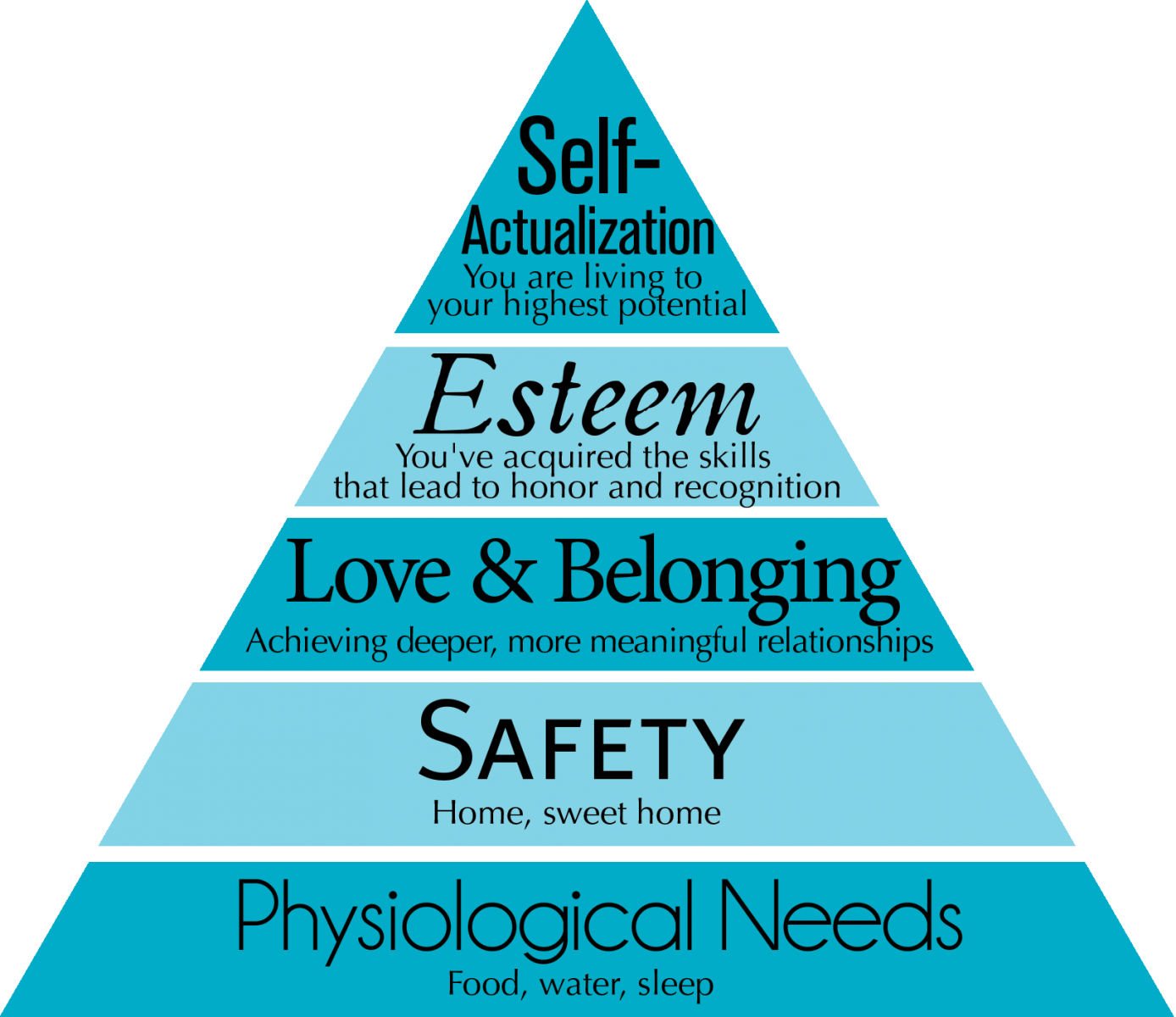
Passionate/romantic love
A turmoil of emotions and sexual passion
Does not last, peaks
Mother/child love shows same response in brain scan
Purpose of this type of love is evolutionary (survive and produce offspring)
Companionate love
based on affection and trust
steadily goes up over time/exponential in couple