Chapter 3.4: Calculating Quantities of Reactant and Product
 Call Kai
 Learn
Learn Practice Test
 Spaced Repetition
 Match
Match Flashcards
 Knowt Play
1/9

10 Terms
Convert masses to moles if necessary, then use the numbers of moles in the equation’s atom groups as numbers in a conversion factor.
How would I find the amount of a substance needed to react or form, given the amount or mass of another substance in the reaction?

Limiting reactant
The reactant that is all used up before all the excess reactant can form more products
Can be found by determining which reactant forms less product

Excess reactant
The reactant that has amounts left over due to a limiting reactant stopping the reaction prematurely
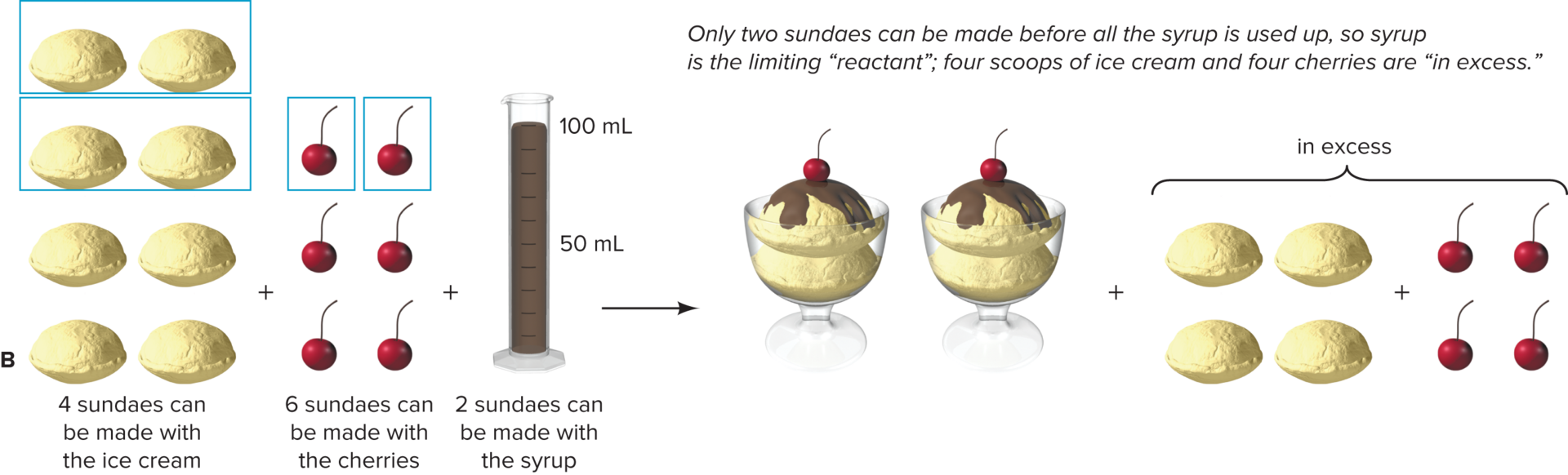
Convert masses to moles if necessary, and then determine how much product each reactant would be able to produce.
The reactant that forms less product is the limiting reactant.
How would I find the limiting reactant in a chemical equation?
Subtract the reacted amount of excess reactant (after reacting with the limiting reactant) from the given amount of excess reactant.
How would I find out the leftover amount of excess reactant in a chemical equation?
Theoretical yield
The amount of product calculated from the molar ratio in the balanced equation, reduced in reality by side reactions, premature stoppages, and physical losses

Side reactions
Reactions that form a different product than the intended main product
Actual yield
The amount of product that is actually obtained after losses during a reaction
Percent yield
The actual yield over the theoretical yield, expressed as a percentage
Atom economy
The mass of atoms in the product over the mass of atoms in all reactants; this is used to optimize synthesis pathways for efficiency