Biology CH 9 Cell Communication
 Call Kai
 Learn
 Practice Test
 Spaced Repetition
 Match
 Flashcards
 Knowt Play
1/45

There's no tags or description
Looks like no tags are added yet.
46 Terms
Intercellular signaling (EXAM)
Between Cells
Intracellular signaling (EXAM)
Within a cell
Ligands (EXAM)
Signaling molecule (widely variable)
Receptor (EXAM)
Protein that specifically recognizes a ligand
Target cell (EXAM)
Cell with appropriate receptor

A cell only responds if it have the appropriate ______
Receptor

Four categories of signaling (EXAM)
Autocrine, signaling across gap junctions, paracrine, endocrine

Paracrine (EXAM)
Local signaling: a cell release a signal that acts on nearby cells. Examples include synaptic signals and neurotransmitters

Paracrine- Nerve Cells
Neurotransmitter is related into the synaptic cleft and binds receptors on the post synaptic cleft. The single is rapidly terminated by removal/degradation of the neurotransmitter

Endocrine (EXAM)
Long distance signaling: hormones travel through the bloodstream to distant target cells. Typically produce a slower response with a long lasting effect (eg. Hormones)
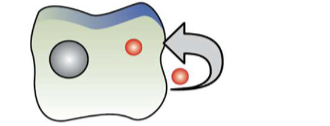
Autocrine (EXAM)
Self signaling: A cell releases a signal that can bind receptors in itself. The signal and target cell can be the same or similar to each other. Ex. Cell death signaling (apoptosis)

Direct signaling across gap junctions (EXAM)
Gap junctions directly connect the cytoplasm of adjacent cells, allowing ions and small molecules to pass between them. A cell targets a cell connected by a gap junction, ex include Calcium ions (CA2+) or cyclic AMP (cAMP) between adjacent cells in cardiac muscle tissue m
QUIZ: Match Each type of cell signaling with the description that best explains how the signal is transmitted
Endocrine
Hormones travel through the bloodstream to distant target cells.
QUIZ: Match Each type of cell signaling with the description that best explains how the signal is transmitted
Autocrine
A cell releases a signal that binds to receptors on itself
QUIZ: Match Each type of cell signaling with the description that best explains how the signal is transmitted
Direct Signaling (gap junctions)
Adjacent cells exchange ions or small molecules through connections between their cytoplasm
QUIZ: Match Each type of cell signaling with the description that best explains how the signal is transmitted
Paracrine
A cell releases a signal that acts on nearby cells
QUIZ: Which type of signaling involves a cell releasing a ligand that binds to receptors on neighboring cells within the same tissue?
Endocrine

Cell Surface Receptors (EXAM)
Ion channel-linked receptor, G protein coupled receptor, Receptor tyrosine Kinase
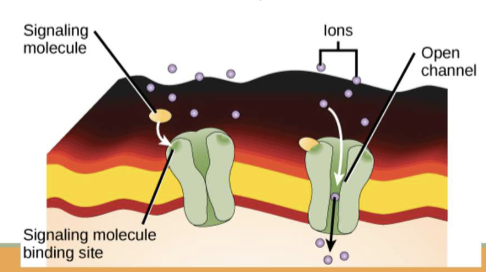
Ion channel-linked receptor EXAM)
open a channel for ions (e.g., ACh receptor).
Ligand binds —> channel opens —> Ions cross the membrane. The open pore allows ions to flow into/out of the cell
Ion Channel Linked Receptor example
Ex. Nicotinic Acetylcholine receptor (nACHR) at the neuromuscular junction
ACh Released → Binds nAChR → Na+ enters muscle cells → muscle contraction
QUIZ: A receptor that opens a pore in the plasma membrane allowing Na+ ions to enter the cell after acetylcholine binds is classified as:
Ion channel linked receptor
G protein-coupled receptor (GPCR) (EXAM)
activate G-proteins that trigger secondary pathways (e.g., cholera toxin modifies G-protein signaling).
Ligand binds GPCR,
G protein exchanges GDP for GTP
Activated G protein regulates an enzyme or ion channel

When G protein signaling goes wrong: Cholera
Water borne bacterium vibrio cholera produces a toxin, choleragen, that binds to cells lining the small intestine. Toxin modifies the G protein, which remains active. Increase in cAMP, chloride increases, water is lost, causing diarrhea
QUIZ: During lecture, we discussed how Vibrio cholerae produces a toxin that interferes with normal G protein signaling in intestinal cells.
The toxin modifies the G protein so that it remains continuously active. What is a consequence of this disruption?
The amount of cAMP increase, leading to increased chloride secretion and water loss into the intestine
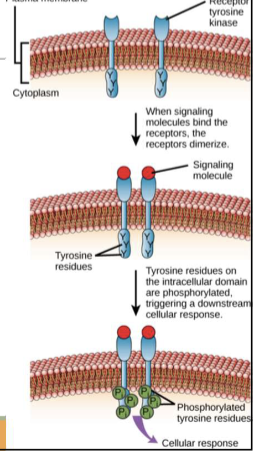
Enzyme Linked Receptor (EXAM)
activate enzymes (e.g., receptor tyrosine kinases, EGFR).
Receptor tyrosine kinases (RTKs) span the plasma
membrane and have an intracellular enzyme
domain.
•Ligand binding causes two receptors to dimerize.
•The receptors autophosphorylate tyrosines on
each other, activating a signaling pathway and
cellular response.
•Phosphatases remove the phosphates, helping
terminate the signal.

Enzyme Linked Receptor: Receptor tyrosine kinases (RTKs)
span the plasma membrane and have an intracellular enzyme
domain.

Enzyme Linked Receptor: ligand binding causes two receptors to ______ (EXAM)
dimerize

Enzyme Linked Receptor: The receptors _________ tyrosines on each other, activating a ______ _______ and cellular response (EXAM)
Autophosphorylate, signaling pathway

Enzyme Linked Receptor: ________ remove the phosphates, helping terminate the signal (EXAM)
Phosphatases
QUIZ: Match each type of cell surface receptor with the event that occurs following ligand binding:
G protein coupled receptor (GPCR)
Activates a G protein through the exchange of GDP for GTP.
Opens a channel that allows ions to cross the membrane.
Two receptors dimerize and phosphorylate tyrosines on one another.
Activates a G protein through the exchange of GDP for GTP.
QUIZ: Match each type of cell surface receptor with the event that occurs following ligand binding:
Ion Channel linked Receptor
Opens a channel that allows ions to cross the membrane.
QUIZ: Match each type of cell surface receptor with the event that occurs following ligand binding:
Receptor Tyrosine kinase (RTK)
Two receptors dimerize and phosphorylate tyrosines on one another.
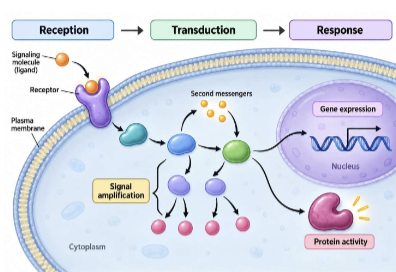
Propagation of the Signal: Signal transduction (EXAM)
ligands bind to a receptor and the signal is transmitted through the cell membrane and into the cytoplasm continuing the signal

Propagation of the Signal: Signaling pathway (EXAM)
Chain of events including second messengers, enzymes and activated proteins that follow ligand binding to a receptor

Propagation of the Signal: Signal Intergration
signals from two or more different cell-surface receptors merge to activate the same response in the cell
Signaling pathway example: Epidermal growth factor receptor (EGFR) definition
A receptor tyrosine insane involved in the regulation of cell growth, wound healing, and tissue repairing
Signaling pathway example: Epidermal growth factor receptor (EGFR) description (EXAM)
When EGF binds to the EGFR, a cascade of downstream events causes the cell to grow and divide
If EGFR is activated at innapriopriate times, uncontrolled cell growth (cancer) may occur
QUIZ: Epidermal growth factor (EGF) normally binds to its receptor (EGFR) and initiates a signaling pathway involved in cell growth, wound healing, and tissue repair.
What could happen if EGFR becomes continuously activated, even when the cell does not need to grow or divide?
The cell could undergo uncontrolled growth and division, potentially contributing to cancer

Methods of Intracellular Signaling: Phosphorylation (EXAM)
A phosphate group (po4^-3) is added to resides of the amino acid serine, threonine, and tyrosine
Methods of Intracellular Signaling: Kinase (EXAM)
The enzyme the transfer of a phosphate group

Second Messengers (EXAM)
Small molecules that propagate a signal after it has been initiated by binding of the singling molecule to the receptor

Example of Second Messengers (EXAM)
Formation of cyclic AMP (cAMP). cAMP serves as a ______ ______ to activate or inactivate proteins within the cell
Cell Death: Apoptosis (EXAM)
Cell signals are terminated by degradation of ligands or by other signals. Ex. Phophatases: enzymes that remove the phosphate group attached to proteins by kinases. (Another example mentioned is the tissue between the toes in mouse embryo, which will eliminate before the mouse reaches its full gestation)
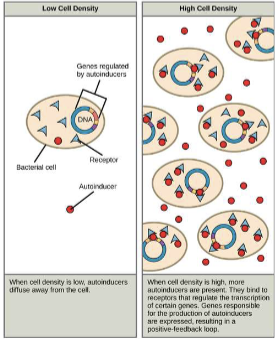
Signaling in single celled organisms: bacteria
In bacteria, population density is often the key factor for signaling

Signaling in single celled organisms: quorum sensing (EXAM)
Bacterial signaling that utilizes auto inducers
QUIZ: Which type of bacterial communication was first discovered in the symbiotic bacteria of the Hawaiian bobtail squid?
Quorum Sensing