Week 7: Direct forms of dispossession: Climate change
 Call Kai
 Learn
Learn Practice Test
 Spaced Repetition
 Match
Match Flashcards
 Knowt Play
1/19

There's no tags or description
Looks like no tags are added yet.
Name | Mastery | Learn | Test | Matching | Spaced | Call with Kai | Chat |
|---|
No analytics yet
Send a link to your students to track their progress
20 Terms
Weather
The mix of events – such as sun, rain, fog, snow, etc – that happen each day in our atmosphere.
Weather constantly changes as a result of air pressure
(high pressure = sunny, clear; low pressure = rainy, cloudy and windy)
Though weather is constantly changing, its foundational patterning is localized and generally predictable (e.g., rain shadow, Great Lakes, etc)
Climate
The average weather pattern in a place over several decades is called climate.
el nino, la nina
lake snow/ rain effect
chinook winds
seasons
humidity
Climate change
Climate refers to any long-term significant change in the “average weather” of a region or the earth as a whole
Different environments affected disproportionately
More extreme and unpredictable weather events: droughts, storms, winds, shifting currents
Arctic temperatures predicted to increase by as much as 8 degrees Celsius
What is causing climate change?
Earth’s atmosphere contains more greenhouse gas molecules than ever before
Infrared energy emitted by the surface ends up being absorbed [trapped] by the atmosphere
Extra energy radiates back down to the surface
Earth's surface temperature rises.
Climate Change impacts for Indigenous peoples and ecologies
Indigenous Knowledge is key for survival and wellness of People in their local ecosystems/ ecologies
Indigenous livelihoods operate in relation to their natural resources, many of which are directly affected by climate change
Indigenous people inhabit economically and politically marginal areas in diverse, but fragile ecosystems
Changes in weather can have significant effects on varying ecosystems
These changes are often not predictable
They make IK difficult to practice
Climate change and colonization
Richest 10% account for >50% carbon emissions
Abilities to use/harness IK transformed by colonial rules and governance, among many other transitions of power
Overwhelming poverty among Indigenous people
Limited to marginal lands and islands
The Atolls: South Pacific
A ring-shaped coral reef, island, or series of islets. The atoll surrounds a body of water called a lagoon
There are four atoll nations in the world (the Marshall Islands, Tuvalu, Kiribati, and the Maldives)
These nations are home to more than half a million people, arguably the most vulnerable on the planet to climate change
A predicted __________ temperature rise could literally wipe many countries “off the map”.
point-eight-degree
Climate change in the Pacific islands
Relocation is an economic problem
But also considerable social, cultural and spiritual costs
Leave the graves of ancestors
Leaving traditional fishing grounds
Leaving sources of identity and livelihood
Others?
The significance of “land and place” to Pacific people cannot be understated
The long-term effects of displacement and replacement can be severe
New evidence: Atolls growing over time (good news!)
A new study released late 2020 examined the evolution of Jeh Island (part of the Marshall Islands)
Evidence of 13% growth in land mass from 1943 – 2020
Build up of sediment from the nearby coral reef is contributing to atoll growth
Problem
Climate change/ bleaching is damaging coral reefs
Healthy coral reef essential for growth of atolls
Climate change will both raise sea levels and damage the reefs
How will climate change affect Australia?
Climate change in Australia is caused by global greenhouse gas emissions
Climate change is causing Australia to become hotter, and more prone to extreme heat, bushfires, droughts, floods and longer fire seasons.
Australia fires 2019-2020 (most intense fires ever recorded on that continent)
33 people died (including nine firefighters)
3094 houses were destroyed and.
17 Million hectares of land was burned.
[Conservative estimates] project losses > one billion mammals, birds and reptiles combined.
Loss of insects was reported to be in the ‘hundreds of billions’.
Cause of the fires: lighting
Root cause: warming climate
cultural burning
Aboriginal people have long been practicing “cultural burning” – it is a practice to control/ manage fire, but also support local ecologies, add nutrients to soil, encourage rain, and feed mammals
"It's the concept of maintaining country - central to everything we do as Aboriginal people. It's about what we can give back to country; not just what we can take from it."
Climate change in the Arctic
Traditional livelihoods in the Arctic are threatened by melting ice shields and permafrost
In a single Inuit dialect, there are > 100 words for snow and ice
Hunting and fishing strategies depend on stable ice
Homes built on ice/ permanently frozen ground
Travel/ safety depends on solid ice
Polar bear, seal, other food items affected
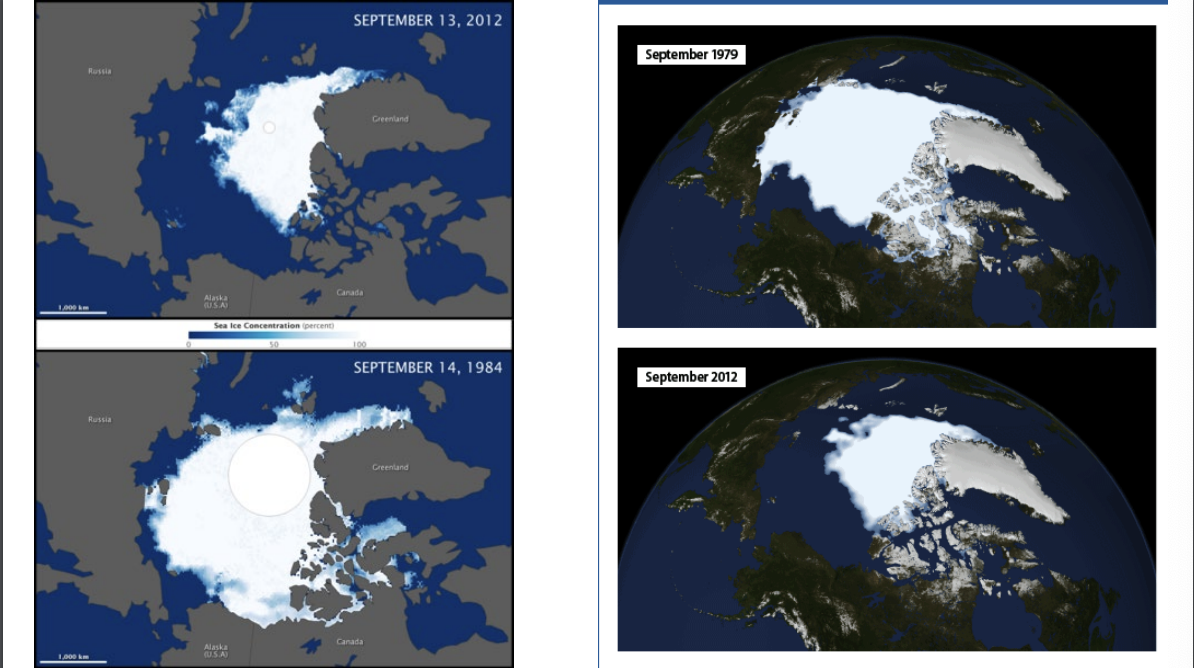
The global effect of polar ice cap melting
Polar ice caps are melting as global warming causes climate change
Arctic sea ice is declining at a rate of almost 13% per decade
Over the past 30 years, the oldest and thickest ice in the Arctic has declined by a stunning 95%
Worst case estimates predict the Arctic could be ice-free in the summer by 2040
Sea ice loss has far-reaching effects around the world (i.e., temperatures, coastal communities, food, shipping, wildlife, permafrost)
Alpine/Mountain Systems – Glacial Retreat
Alpine systems are also disproportionately warming
Predicted to increase by as much as 5-6 degrees Celsius in the 21st century
Glacial retreat was one of the first phenomena to draw our attention to global warming
Consequences of glacial retreat
Significant shifts in plant ecology in alpine areas
Upward movement on mountains of tree line and alpine plants
Plants at the highest elevations are being outcompeted
Endangered animals such as snow leopard, mountain sheep affected as foods move upward
Resource harvesting becomes more tedious, less predictable and more dangerous
Other consequences of glacial retreat?
Tibetan and Andean highlanders depend on Alpine flora and fauna for medicines, food, grazing and hunting
Water access in future?
Food access?
Medicines?
Urbanization?
Reliance on new foods?
Ecological grief: mental health impacts of changing/deteriorating quality of land
“When we talk about climate change, we’re really talking about the outputs of a global capitalist system premised on settler colonialism and resource extraction. What’s hiding under climate change that we never talk about, and who does that silence protect?” [Ashley Cunsolo, Dean, Memorial University]
Reasons to be hopeful?
Indigenous connection place, including IK, serves an anchoring role in resilience to climate change
Deep links to place create moral relationships of responsibility to protect and care for the environment
This way of knowing provides the foundation for the other resilience factors by shaping belief systems, identity, language, knowledge, and livelihood practices
Sovereignty, power, social justice, development, and history are critical for restoring Indigenous identities and wellness; and abilities to care for the land