Anthro Test 2 - 10/29/26
 Call Kai
 Learn
 Practice Test
 Spaced Repetition
 Match
 Flashcards
 Knowt Play
1/93

There's no tags or description
Looks like no tags are added yet.
94 Terms
Situational Negotiation of Identity
People may have different identities depending on the contexts (ex. in Brazil, people may have identified as white before, but then idenify as white to apply for a job that is looking for diversity hires)
Ethnic group
Members share beliefs, values, habits, customs, norms bc of their common background
Ethnicity
Identification with/feeling part of an ethnic group + exclusion from other groups.
Social organization of cultural difference
contructed and contested
Status and Identity
cultural differences - ethnicity, class, region, religion, etc
Status: position an individual occupies in a society, can shift based on context
Ascribed Status
social status based on limited choice
few statuses are absolutely ascribed bc ppl modify how their gender/race is perceived
Achieved Status
Social status attained thru choices/actions/efforts/talents/accomplishments
ex. doctor, student, criminal
Stratification
minorities occupy subordinate positions within social hierarchy & therefore have less power/wealth
Seen in unemploymnt rates, poverty is racialized/ethnicized
Racial Classification
assigning humans into categories based on common ancestry
Study of human bio variation 2 approaches: racial classification (not used anymore?) & explanatory approach (understanding specific biological diffs)
Asssumption that an ethnic group has a biological basis which = race
Race
Ethnic group assumed to have a biological basis
Supposed to reflect shared genetic material/ancestry—> but early scholars instead used phenotypes/skin color (problematic & inconsistent)
Socially constructed, NOT biologically distinct, —> but real consequences, cultural (not bio) differences, racism embedded in institutions, causes inequality
Race ≠ ethnicity: arbitrary in the US, eg. hispanics (ethnicity) can be any race
Brazil: more flexibility of racial identity, more of an achieved status, less emphasis on ancestry, more abt skin tone
Racism
discrimination against an ethnic group assumed to have a biological basis
Phenotype
expressed physical characteristics of an organism
Genotype
my genes are blue <3
Hypodescent
automatically places children on mixed marriages into the group of the minority (one drop rule)
rule of descent: assigns social identity at birth based on ancestry
gov can play a decisive role in defining, assigning legal racial/ethnic identities
Hafu
Japanese descriptions for biracial Japanese
not whole, incomplete, less than
Adaptive Strategy
A society’s main system of economic production
Accelerated human population growth —> formation of larger more powerful social and political systems
Ex. Food production: plant cultivation and animal domestication
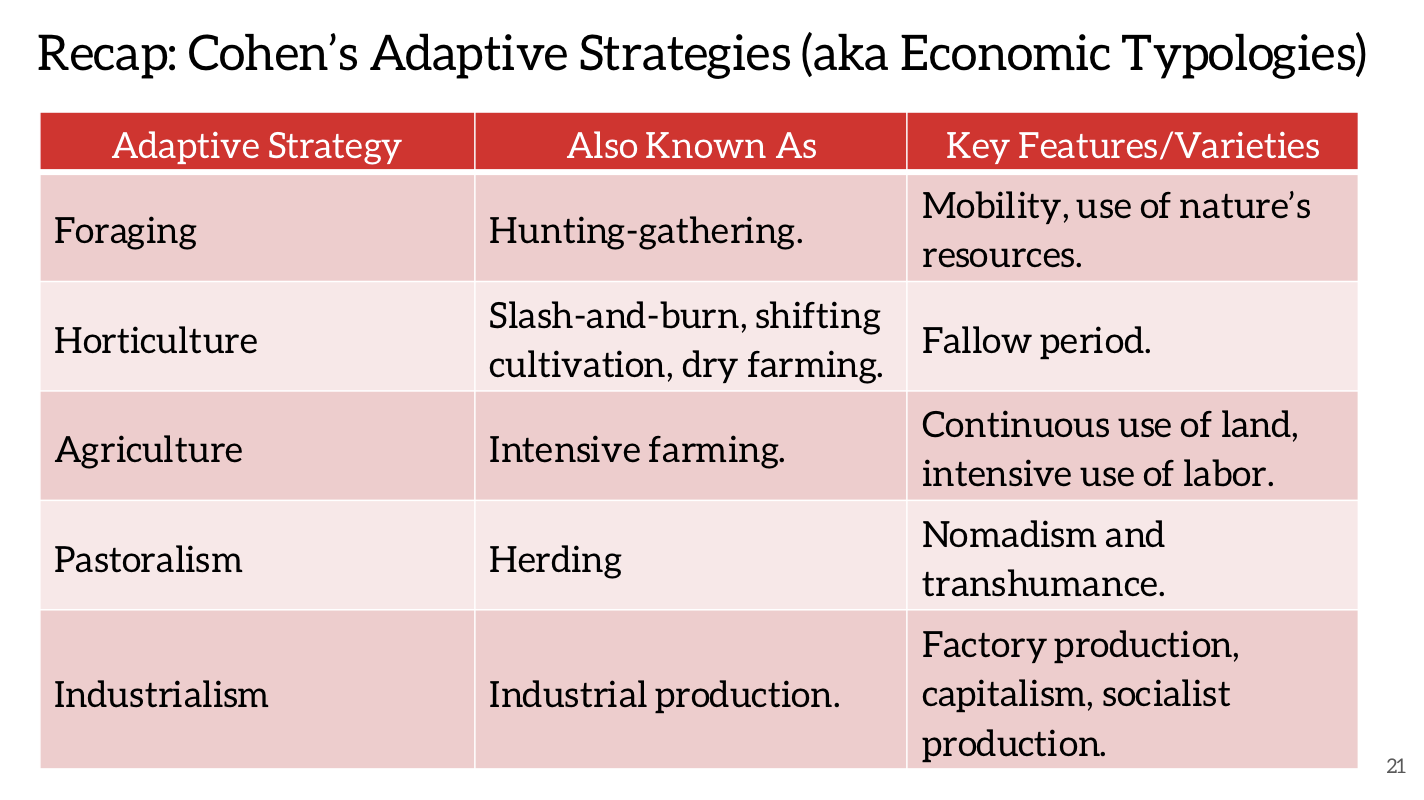
Yehudi Cohen’s Typology
foraging, horticulture, agriculture, pastoralism, and industrialism
Foraging
Hunting/gathering/fishing
small social groups, band-organized societies, sharing resources, immediate food consumption, egalitarianism, decision making by mutual consent, no fear of scarcity, assumptions of abundance,
Band
basic social unit among foragers, <100 ppl, may split up seasonally, flexability & mobility, dont inherit $ or status, no leadership, few status disinctions (maybe age, gender, personal achievements if anything and its small)
foraging bands lacked formal law but had methods of social control
Horticulture
Baby agriculture: simple tools, non intensive, fallowing, not permanent, slash and burn/shifting farm plots while village stays in place, can support large permanent villages,
Agriculture
Continuous & intensive cultivation using land and labor, domesticated animals, irrigation/terracing sometimes, greater long term yield and more dependable, densly populated areas, cultivation continuum,
Cultivation Continuum
Continuum of land and labor use that ranges from horticulture to agriculture
Intensification
intense cultivators typically sedentary and specialized focusing on few caloric staples, reduced ecological diversity, reduced risk w a stable/long-term crop, but a failed stable crop = famine. Meanwhile horticulturalists reduce risk by having diversity and not putting all their eggs in one basket
Pastoralism
Herding focused on domesticated animals (cattle, sheep, goats, camels, yaks) to protect them and ensure reproduction —> herders get food & other products
Pastoral nomadism: annual movement of an entire pastoral group w herds
Tanshumance: part of the group moves w the herd, most stay at home
Modes of Production
way of organizing production
Economy
system of the production, distribution, and consumption of resources
Economics
study of resources
Means of Production
land, labor, tech, and capital:
Alienation
Industrial econs: worker manufactures a product —> perceives the product as belonging to someone else
NOT in Nonindustrial societies: relations of productions, distribution, etc are social relations with economic aspects
Economizing
rational allocation of scare means/resources to alternative ends
bc wants are infinite and means are limited, we must utilize available resources efficiently
maximize profit
Alternative Ends
we put a portion of our scarce resources toward building funds
subsistence fund: working for sustenance
replacement fund: maintaining tech and items essential to production
social fund: helping friends, relatives, neighbors,
ceremonial fund: covering expenditures on ceremonies
rent fund: rendering resources to an entity poltiically/economically superior
Karl Polanyi’s 3 Principles that Guide Exchange
market principle / redistribution / reciprocity
all can be present in a society but 1 usually dominates
Market Principle
buying, selling, valuation based on supply and demand, capitalism, governs distribution of the means of production, bargaining to maximize profits, short and quick offers/counteroffers
Redistribution
chiefdoms, flow of goods from local level, into a center, and back out thru redistribution, tithing in many religions
Reciprocity
trading btw social equals, often egalitarian societies
3 kinds
Generalized Reciprocity
exchange btw closely related ppl - parents buy u a present
most widespread
Balanced Reciprocity
exchange btw more distant partners, if other party doesnt reciprocate than the relationship may be strained - u buy dinner for the group but friends never offer to pay
Negative Reciprocity
potential hostile exchanges among strangers, try to maximize profit, immediate
Coexistence of Exchange Principles
US is market exchnage, but we also have redistribution thru taxes and gov, reciprocity thru various forms, etc
Potlatch
Gift giving ceremony, create alliances, promote altruism, show off, distribute wealth, prestige to whoever organized the potlatch, its a cultural adaptation to alternating periods of local abundance and shortage/poverty, used as a substitute for war, bring ppl together
Kula
Practiced by Trobriand
Items exchanged, they risk everything to go (possible ship wrecks, being eaten,), only important men go, maintain chain of relationships that spreads far to make a complex network, value of shells for history as they’re passed from person to person to give prestigious ppl more prestige, have to give it on so that they’re name can be spread on to the history of the shelll and passed on
Trobriand Islands
practice kula
Hegemony
subordinates comply by internalizing rulers’ values and accpeting naturalness of domination
“The Political”
“individuals or groups that manage the affairs of public policy
auhtority as the formal, socially approved use of power
Sociopolitical Organization
preferred in discussing the exercise of power and regulation of relations among groups and their reps
Tribe
food-producing society with a rudimentary political structure
Chiefdom
differential access to resources and permanent pollitical structure (between a tribe and a state)
State
formal gov structure w socioeconomic stratification
Ju/’hoansi or San people
San linguistic group
sedentism increased recently, links btw foraging economies and other aspects of bands
foraging group, few rules, if you were hungry you could eat, used to wo what they wanted and travel if they wanted to travel, but after white ppl took over, they’re forced to stay in one spot and there’s disease and not enough food and they only eat one thing,
The Inuit
everyone had access to resources needed to survive, no notion of private ownership, primarily hunting/fishing, some men had 2-3 wives (prestige) and fought over women, song battles
Tribal Cultivators
typically horticultural/pastoral econ, organized into villages/descent groups, lack stratification and formal gov, village heads/big men/pantribal leaders,
Yanomami
village fissioning/members leaving happens from time to time, village head, prone to outside attacks, outsiders are vectors of disease
The Head Man / Village Head
has limited authority (only to influence and persuade), lead by example, act as a mediator is disputes, must be more generous than his tribe, members can leave if they’re dissatisfied, leadership is a burden and great responsibility
“The Big Man”
similar to village head, but authority is regional (1+ village), common to south pacific
Kapauku Papuans
Big man (tonowi) as a key political figure w status achieved thru hard work, amassed wealth (pigs and native riches), distinguished thru generosity, eloquence, bravery, fitness, supernatural powers,
Kawelka
community w big men, uses persuasion,
Moka
competitive gift exchnage where status comes from giving wealth away, “I have won. I have knoecked you down by giving so much",” money (from selling coffee) and pigs, pau shells, big men compete and if they fail, ppl will shame him, leading is not for money or pride, but an obligation forcing big man to lead and give a lot
Pantribal Sodalities
age sets move thru age grades: group of boys born during a 4 year period thruout their life
in some areas, they are secret societies made exclusively for men or women,
relationships across communities so when travel they can seek out members of their age set
Maasai
linguistic group, pastoralists, polygyny (2+ women share a husband), bride price, patrilineal clans, socially organized by age sets
warrior age grade is most important, in some areas,
Qashqai and Basseri
Chiefdoms organization
A permanent political structure (permanent office that endures across generations), hereditary leader, social ranking (based on access to resources), but lacking class divisions,
Chiefdoms/states are ideal types: they’re examples that accentuate social contrasts that are easier to study
chiefs: important role in production, distribution, consumption of resources etc, recieves first fruits and then redistributes it by hosting feasts
Early (or Archaic) States
drew a firmer line btw elites and masses, marriage within one’s social group
State Systems
Autonomous politcal unit encompassing many communities within its territory, having a centralized gov w power to collect taxes, draft men for work or war, decree and enforce laws
typically large and populous
population control: citizenship categories, census, borders, administrative subdivisions,
judiciary, enforcement, fiscal support
Status Systems
Chiefdoms: social status based on seniority of descent, intricately calculated, (eldest of an eldest of an eldest of an eldest)
Early Archaic states: firmer lines btw elites and masses, marriage witin social grouo
Social Stratification
key feature of a state
three dimensions: econ status/wealth, political status/power, social status/prestige, respect, approval
emergence of this: early states had contrasts on wealth, power, prestige, btw superordinate (upper elites w privileged access to valued resources) and subordinate (lower underprivileged limited by privileged group) groups
Social Control
beliefs, practices, institutions involved in maintenance of any norms and regulation of any conflict to we can have appropriate and inapproriate behaviors, includes informal/social/subtle aspects and formal'/gov/public aspects
Resistance
To curb resistance: hegemony, fear, stigma, shame, gossip, make subordiantes feel that they’ll eventually gain power, separate or isolate ppl & supervise closely, geographic/lingustic/ethnic separation,
resistance most likely when ppl can assemble
Weapons of the Weak
Public transcript: open public interactions btw oppressed and oppressor “ok prof, I’ll learn these key words”
Hidden transcript: critique of oppressor out of sight of oppressor in small every day acts "this prof is crazy and these keywords are unreasonable” —> can be expressed at certain times
Shame and Gossip
Igbo Women’s war: women resisted British men by censoring and shaming then with song and dance
Structural Violence
Social institution/structure causes real harm to ppl by not meeting their needs
ex. minorities’ lives are sometimes shorter bc they’re disadvantaged, dont get proper medical care, dont get paid enough to live healthily
easy to naturalize
Prevention through Deterrence
leads migrants into lethal terrain

Bands, tribes, chiefdom, state

Holmes v De Leon in border crossing
Religion
Anthony fc wallace: belief and ritual concerned w supernatural beings, powers, forces
Emile Durkheim highlighted religious effervescence - collective emotioal intensity generated by worship
Sire Edward Burnett Tylor: religion evolved so ppl could explain things, and will decline as science better explains them
Religion is a cultural universal
Religion + social control
religion affects actions, can instill hatred or fear, offeres rewards and punishments for behaviors, codes of ethics/morality
religions of stratified state societies vs religions in less marked social contracts
all societies shave religious figures
Polytheism vs monotheism
belief in multiple gods who control aspects of nature vs belief in a single all powerful God
Shaman
Rituals
formal, sylized, repetitive, sterotyped, behavior based on liturgical order, convey info about participants and culture, social acts
Rites of Passage
associated with transitions
3 phases - separation(withdraw from society), liminality (in between), incorporation (reentry w new status)
Liminality
in between phase of a rite of passage
humility, poverty, equality, obedience, sexual abstinence, silence
incomplete/interrupted rite could cause u to be labeled as dangerous
lion king v hunger games
Communitas
Social aspect of collective liminality, an intense feeling of social solidarity
Descola’s model of religion and nature
These things as “relational ontologies” or ways of being in the world
Interiority: is it like a human soul on the inside?
Physicality: has a body/substance like mine?

Animism
Belief in spiritual beings
Achuar
Totemism
Arrente
Analogism
Mexica
Naturalism