6. Molecular pharmacology, pharmacodynamics & receptors
 Call Kai
 Learn
 Practice Test
 Spaced Repetition
 Match
 Flashcards
 Knowt Play
1/32

There's no tags or description
Looks like no tags are added yet.
33 Terms
Receptor concept
The molecular action of a drug/bioactive can often be explained by-, and predicted from a receptor concept
Receptors are mostly normal regulatory structures playing a role in the physiology of the organism
Natural ligands: neurotransmitters, hormones, or other signaling molecules
Drugs just bind by coincidence or by design to these receptors
Receptors: macromolecules including
Enzymes
Transporters & ion channels
Structures on cell membranes
Transcription factors
Nucleotides
What are the four receptor types & interactions
Agonist/antagonist = agonist produces effect/antagonist prevents an agonist from binding = no effect.
Ion channels = blockers (block ion channel) or modulators = transform ion channel to increase/decrease permeability
Enzymes = inhibitor/false substrate. Inhibitor = normal reaction inhibited. False substrate = abnormal metabolite produced
Transporters = inhibitors/false substrates. Inhibitor = transport blocked. False substrate = Abnormal compound accumulated.
Ion channels
Multi-subunit ion channels (=ligand-gated ion channels; also: ionotropic receptors)
Location: cell surface transmembrane
Binding → ion flux → effect on cell excitability
Examples of ligands: acetylcholine
GABA
Glutamate
Glycine

Example Ion channel
Nicotinic ACh receptor
On the ion channel there are two binding sites for ACh.
When ACh is bound, this causes a conformational change
GABA receptor + effect of drugs
Also example of ion channel.
GABA reduces the chance of response to stimulis
This is because when GABA binds, the ion channel opens
Allows Cl- to enter cell causing greater negative charger
During action potential you need the charge to become positive, so if resting potential is more negative than usual = harder to depolarize.
Certain medicines (enzodiazepines) make it easier for GABA to bind. Make receptor more sensitive
They act allosterically on the receptor (So drug doesn’t bind to active site but binds to allosteric site)
Examples
Diazepam
Oxazepam
Lorazepam
Protein kinases
Location: cell surface transmembrane
Examples of ligands;
Growth factors, insulin
Peptide hormones

Transcription factors
Location: cyptolasm
One of the most important targets for today’s drugs
Very large family of regulatory proteins
Agonists bindings leads to a cell signalling cascade involving many chemical mediators
Examples:
Steroid hormones
Thyroid hormone
Vitamin D

Example vitamin D
Example of transcription factors
In the DNA we have vitamin D responsive elements
The DNA is in the nucleus but the vitamin D outside
The vit D goes into the nucleus, forms a complex with a vitamin D receptor.
This complex can bind to the vitamin D responsive elements.
This leads to the expression of target genes and hence proteins
G-protein coupled receptors
Location: cell surface, 7 transmembrane
One of the most important targets for today’s drugs
Very large family (~950 genes in human genome) of regulatory proteins (including olfactory, taste, light, endogenous compounds)
Agonist bindings leads to a cell-signalling cascade involving many chemical mediators
Central mechanism GTP-GDP conversion
Example of ligands:
Acetylcholine
Several a- and B-adrenergic cathecholamines
Eicosanoids

Molecular mechanism GPCR
An antagonist binds to the receptor. This causes GDP on the alpha subunit to be replaced by GTP
Beta gamma subunit binds to target 2 and alpha subunit binds to target 1.
At some point GTP is hydrolyzed into GDP so that effect stops.

cAMP system
Intracellular ‘second messenger’ system
Activated G-protein → activates adenylyl cyclase → ATP cAMP → activates protein kinase A
G protein that activate cyclic AMP (cAMP) formation are known as stimulatory G-protein (Gs)
Example: adrenalin, glucagon
Formation of cAMP explained
Epinephrin binds to receptor protein
This activates G-protein causing one of the three subunits to dissociate from the G-protein
The subunit that dissociates carries GDP which is replaced by GTP when activated.
The subunit then binds to adenylyl cyclase.
Adenylyl cyclase, when activating, catalyzes the formation of cAMP from ATP.
The cAMP then binds to a protein kinase A which then activates phosphorylase that turns glycogen into glucose
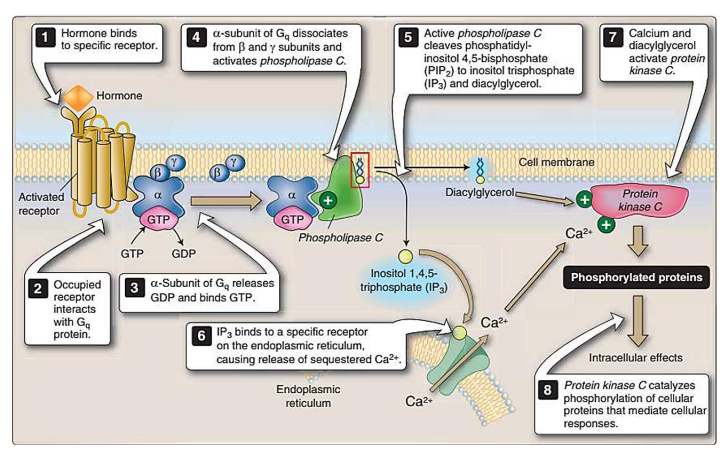
Phospholipase C pathway
Starts with hormone binding to receptor. This complex binds to G-protein
As a result GDP is replaced with GTP
alpha subunit of G dissociates from beta and gamma subunits and activates phospholipase C
Active phospholipase C cleaves phosphatidyl-inositol 4,5-bisphosphate (PIP2) to inositol triphosphate (IP3) and diacylglycerol
IP3 binds to a specific receptor on the endoplasmic reticulum, causing release of sequesteral Ca2+
Calcium and diacylglycerol activate protein kinase C
Protein kinase C catalyzes phophorylation of cellular proteins that mediate cellular responses.
How is the GPCR signal regulated?
GTP activated alpha-subunit has intrinsic GTPase activity
GTP → GDP + P
Inactivates alpha subunit
→ re-association with bg-subunits
Phosphodiesterase (PDE) hydrolyzes cAMP → AMP
Without these mechanisms, we would not be able to turn off receptor signals
Receptor desensitization
Happens in drug addicts
Some receptors are phosphorylated via specific receptor kinases
The phosphorylated receptor may then bind to a protein b-arrestin that promotes removal of the receptor from the membrane by clathrin-mediated endocytosis
Gs and Gi proteins
An inhibitory Gia, when it binds GTP, inhibits Adenylate cyclase
The stimulatory Gsa, when it binds GTP, acivates Adenylate cyclalse
Different effectors & their receptors induce Gia to exchange GDP for GTP than those that activate Gsa
They may act simultaneously
What is asthma and what are its pharmacological targets?
Asthma in brief: recurrent and reversible airway obstruction
Inflammatory changes in the airways
Bronchial hyper-responsiveness
Attack in two phases
Pharmacological targets
Reduction of inflammatory response
Bronchodilation
Pharmacological treatment asthma
B2 - adrenergic agonists relax smooth muscle
Short acting (salbutamol, terbutaline) or long acting (salmeterol, formoterol etc)
Usually given as local formulation (inhaler)
Use depends on type of asthma, often combined with glucorticoids
Sometimes: muscaranic receptor antagonists (ipratropium)
Not that common anymore: PDE inhibitors (theophylline)
PDE breaks down cAMP which normally gives bronchodilation. Therefore PDE inhibitors will prevent bronchodilation
cannabinoid receptors
Important endogenous regulation system
Two G-protein coupled receptors described so far (CB1 and CB2)
Many endogenous and exogenous cannabinoids
Specific transporters
Range of effects of cannabinoids
Appetite stimulation
Anti-inflammatory
Hallucinogenic euforic
Anti-tumor
Psychosis risk
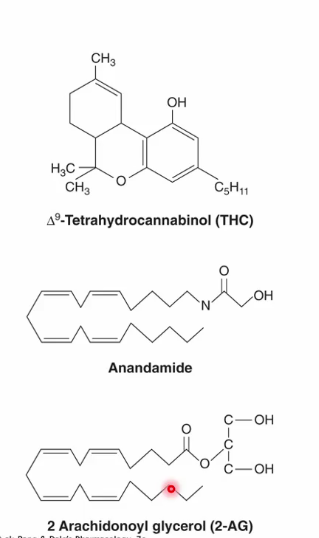
Endogenous CB ligands: endocannabinoids
We have our own endocannabinoid system (ECS)
The ECS is a highly important regulation system in our body (metabolism, immune defense, pain)
Endocannabinoids are formed from fatty acids
This is an important system for food intake
Initial hypothesized role of ECS in obesity
Stimulation with EC → increased food intake
CB1 stimulation increases differentiation and lipogenesis in pre-adipocytes
Plasma levels of EC’s are increased in obese human subjects and in animal models of diet-induced obesity
CB1 mouse is protected from diet-induced obesity
Can we treat/prevent obesity if the ECS is inhibited?
Effects and side effects of CB1 blockers
Good effects:
Weight loss
Decrease HbA1C
Increase Adiponectin
etc.
Side effects: joy of eating removed = more depression and anxiety = more suicide
Two-state receptor model
Every now and then spontaneously, the system goes from resting state to activated state
This spontaneous activation is what we call intrinsic activity
When in activated state, response is created.
Agonists shifts equilibrium to active state R*

Agonist/antagonist working shown in two-state receptor model
Agonist
Drug binds to receptor = occupation, governed by affinity (higher affinity = stronger binding)
Activation governed by efficacy
Antagonist
Binds to receptor and forms a complex
Does not make equilibrium shift to activated state
= no response
But by binding to receptor prevents agonist from binding

What is efficacy?
What is the maximum response?
What is potency?
At which concentration do you achieve EC50?
Full versus partial agonists
Full agonist: a ligand that binds to a receptor and shifts the equilibrium toward thea ctivate state, producing the maximum possible biological response
Partial agonist = A ligand that binds to the exact same active site on the receptor but elicits only a sub-maximal biological response, even when given at high concentrations that occupy 100% of the receptors.
Ligand b is partial agonist with the same affinity as the full agonist

What happens with the repons when you mix a full and partial agonist?
The response will be somewhere between a and b (can have inhibitory effect)
Competition for Receptors: Both the full and partial agonist compete to occupy the same active binding sites on the receptors.
Sub-Maximal Activation: Receptors bound by the partial agonist only produce a fraction of the maximum signal (e.g., around 50% response).
Competitive Inhibition: While a receptor is occupied by the partial agonist, the full agonist is physically blocked from binding to that site. Because the full agonist cannot occupy 100% of the available receptors, it can no longer produce its 100% maximal effect Emax

Competitive vs non-competitive antagonist
Competitive: binds at the same binding site as agonist
Non-competitive: binds at different binding site as antagonist
Graphs for reversible vs irreversible antagonism

What are reversible and irreversible antagonism?
Reversible: The antagonist binds to the receptor, but the interaction is non-covalent and dynamic—meaning the antagonist can associate and dissociate from the binding site
Is surmountable = if you add a sufficiently high concentration of the agonist, the agonist statistically outcompetes and displaces the antagonist from the receptor active sites
Graph: the concentration-response curve shifts to the right. A higher concentration of agonist is required to produce the same biological response
Irreversible: The antagonist forms a covalent bond to the receptor, preventing it from dissociating
Unsurmountable: Because the antagonist does not let go of the receptor, increasing the agonist concentration cannot push the antagonist off the obund sites.
Graph: The curve flattens, maximal achievable response is permanently reduced because a fraction of the total receptor population is rendered permanently inactive
Reversible vs irreversible agonist
1. Reversible Agonists (Typical Agonists)
Binding Nature: Almost all natural neurotransmitters and conventional drugs (e.g., adrenaline, acetylcholine) bind reversibly through non-covalent interactions[3].
Dynamic Equilibrium: Reversible agonists undergo continuous association and dissociation with the receptor[2][5].
Surmountability: Because binding is dynamic, a reversible agonist can compete with and displace a reversible competitive antagonist if the agonist concentration is sufficiently increased[1][2].
Signal Termination: The biological response turns off naturally as the drug dissociates from the receptor and is metabolized or excreted[6][7].
2. Irreversible Agonists
Binding Nature: An irreversible agonist forms a covalent bond (or has extremely slow dissociation) with the active site of the receptor[1].
Persistent Activation: Once attached, it continuously drives the receptor into the active state without letting go[1][5].
Receptor Desensitization: Because the receptor is continuously stimulated without a break, the cell rapidly initiates receptor desensitization[8]. The receptor becomes phosphorylated and internalized (broken down via endocytosis), effectively removing it from the cell membrane[7][8]. Paradoxically, prolonged exposure to an irreversible or long-acting agonist often leads to a loss of responsiveness (tolerance) due to receptor downregulation[8].