Microbio Chapter 1
 Call Kai
 Learn
Learn Practice Test
 Spaced Repetition
 Match
Match Flashcards
 Knowt Play
1/82

There's no tags or description
Looks like no tags are added yet.
Name | Mastery | Learn | Test | Matching | Spaced | Call with Kai | Chat |
|---|
No analytics yet
Send a link to your students to track their progress
83 Terms
Importance of microorganisms
- most populous/diverse
- found everywhere!
- recycling
- photosynthesis
- production of food, beverages, antibiotics, and vitamins
- cause disease
Microorganisms
- organisms and acellular entities too small to be clearly seen by the unaided eye
- generally
Cellular
LIVING
- Fungi
- Protists
- Bacteria
- Archaea
Acellular
NON-LIVING
- Viruses
- Viroids
- Satellites
- Prions
Prokaryotic cells
lack a true membrane-delimited nucleus
Eukaryotic cells
have a membrane-enclosed nucleus, more complex morphologically
Three domain system
based on a comparison of ribosomal RNA genes, divides microorganisms into:
- Bacteria
- Archaea
- Eukarya
Domain Bacteria
- single-celled
- cell wall w/ peptidoglycan
- lack a membrane-bound nucleus
- live everywhere and in extreme environments!
- Cyanobacteria (produce significant amounts of oxygen!)
Domain Archaea
- unique rRNA gene sequences
- lack peptidoglycan in cell walls
- unique membrane lipids
- unusual metabolic characteristics
- live in extreme environments
Protists
unicellular and sometimes colonial eukaryotic organism that lack cellular differentiation into tissues
Fungi
Viruses
an infectious agent having a simple acellular organization with a protein coat and a nucleic acid genome, lacking independent metabolism, and multiplying only within living host cells
Viroids
an infectious agent that is a single-stranded RNA not associated with any protein; the RNA does not code for any proteins and is not translated
Satellites
Subviral infectious agents composed of DNA or RNA encapsulated with the aid of an unrelated helper virus.
Prions
an infectious agent consisting only of protein
Criteria for living organisms
1) cells and organization
2) response to environmental changes (irritability/sensitivty)
3) Growth/development
4) Biological evolution
5) Energy use and metabolism
6) regulation and homeostasis
7) reproduction
Central dogma of biology
DNA-transcription-RNA-translation-protein
RNA
believed to be the earliest molecule because it has the ability to form peptide bonds and perform cellular work/replication
Photosynthesis
the trapping of light energy and its conversion to chemical energy, which is then used to reduce CO2 and incorporate it into organic molecules
Cyanobacteria
a large group of gram-negative, morphologically diverse bacteria that carry out oxygenic photosynthesis
Universal phylogenetic tree
A phylogenetic tree that considers the *evolutionary relationships* among organism from all three domains of life: Bacteria, Archaea, and Eukarya.
Last Universal Common Ancestor (LUCA)
the most recent organism to which all extant organisms are related
Endosymbiotic Hypothesis
The hypothesis that mitochondria, and related organelles, and chloroplasts arose from bacterial endosymbionts of ancestral eukaryotic cells
Horizontal gene transfer
the process by which genes are transferred from one mature, independent organism to another
strains
a population of organisms that descends from a single organism or pure culture isolate
Eukaryotic microbes
reproduce isolated populations
Biovars
variant strains of microbes characterized by biological or physiological differences
Morphovars
A variant strain of a microbe characterized by morphological differences
Serovars
a variant strain of a microbe that has distinctive antigenic properties
Microbiology
the study of microorganisms
Francesco Stelluti
observed bees and weevils between 1625-1630

Robert Hooke
published drawings of the fungus Mucor in his book, Micrographia, in 1665
Antony van Leeuwenhoek
(1632-1723) first person to observe microorganisms accurately
- was not a scientist- he was a hobbyist!
Spontaneous generation
idea that living organisms can develop from nonliving or decomposing matter
Biogenesis
Aristotle (384-322)
History of Animals- organisms arise from elements and pneuma of material
Elements- earth, air, fire, and water
Animating force
Francesco Redi (1626-1697)
Discredited spontaneous generation
- showed that maggots on decaying meat came from fly eggs

John Needham (1713-1781)
Proponent of spontaneous generation
- experimented with cooked meat from which life arose

Lazzaro Spallanzani (1729-1799)
Reproduced Needham's experiments, but sealed the flasks

Anaximenes' (585-528) air
living things need oxygen in order to survive
Franz Schulze (1815-1873)
Reproduced Needham's experiments, passing air through a strong acid which kills most organisms
- critics suggested that acid 'altered' the air
Theodor Schwann (1810-1882)
Reproduced Needham's experiments, passing air through a heated glass tubing
- Critics suggested that Heraclitus ( 535-475) fire 'altered' the air
Heinrich Schroder and Theodor von Dusch
reproduced Needham's experiments, filtering air through cotton plug
John Tyndall
- Demonstrated that dust carries microorganisms
- showed that if dust was absent, nutrient broths remained sterile, even if exposed to air
- exceptionally heat-resistant forms of bacteria
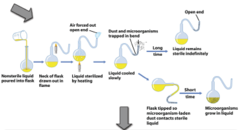
Louis Pasteur
- Father of microbiology
- Swan-neck flask experiments (result: no growth of microorganisms- disproved spontaneous generation)
- Germ theory of fermentation
- germ theory of disease
- Pasteurization!
- rabies vaccine
Ferdinand Cohn
Heat-resistant bacteria could produce endospores
4 bodily humors
Believed to be the cause of infectious diseases
- Yellow bile
- Blood
- Black Bile
- Phlegm

The plague of Athens
- Killed 1/4 of Athens population: led to their defeat against Sparta
- Thucydides: writes about the symptoms
- Survivors became immune and cared for the ill
Roger Bacon
believed disease was caused by "invisible" beings
Girolamo Fracastoro
proposed that epidemic diseases are caused by transferable particles or "spores," which were more of a chemical than a biological form
Oliver Wendell Holmes
discovered the transmission of venereal diseases by midwives
Ignaz Semmelweis
Pioneered obstetrical procedures which reduced infections
Agostino Bassi
showed a disease of silkworms was caused by a fungus
M.J. Berkeley
demonstrated the Potato Blight of Ireland was caused by a water mold
Heinrich de Bary
showed that smut and rust fungi caused cereal crop diseases
Joseph Lister
- provided indirect evidence that microorganisms were the causal agents of disease
- developed an antiseptic surgery system which led to fewer postoperative infections
Robert Koch
- established the relationship between Bacillus anthracis and anthrax
- taught by jacob henle
Koch's 1st postulate
the microorganism must be present in every case of the disease but absent from healthy organisms
Koch's 2nd postulate
the suspected microorganism must be isolated and grown in a pure culture
Koch's 3rd postulate
the same disease must result when the isolated microorganism is inoculated into a healthy host
Koch's 4th postulate
the same microorganism must be isolated again from the diseased host
Limitations of koch's postulates
- some organims cannot be grown in pure culture
- ethical limitations
- molecular/genetic evidence could replace/overcome these limits
Koch's work led to discovery or development of:
- Agar
- Petri dishes
- Nutrient broth and nutrient agar
- methods for isolating microorganisms
Charles Chamberland
- Developed porcelain filters to study tobacco mosaic disease
- discovered that viruses are smaller than bacteria
Pasteur and Roux
incubation of cultures for long intervals between transfers caused pathogens to lose their ability to cause disease (termed attenuation)
Pasteur + coworkers
Developed vaccines for chicken cholera, anthrax, and rabies
Immunology
the study of a host's defenses to a pathogen
Edward Jenner
Father of immunology
- discovered small pox vaccine
- immunized James Phipps for cow pox in 1796
Emil von Behring and Shibasaburo Kitasato
developed antitoxins for diphtheria
Elie Metchnikoff
discovered bacteria-engulfing, phagocytic cells in blood
Basic aspects of microbiology
concerned with individual groups of microbes, microbial physiology, genetics, molecular biology and taxonomy
Applied aspects of microbiology
concerned with practical problems - disease, water, food and industrial microbiology
Paul Ehrlich
Chemotherapeutic agents- Salvarsanis used to treat syphilis instead of arsenic and mercury
Alexander Fleming
discovered the first antibiotic, penicillin
Molecular and Genomic methods
Led to a second golden age of microbiology
Medical microbiology
diseases of humans and animals
Public health microbiology
control and spread of communicable diseases
Microbial ecology
concerned with the relationship of organisms with their environment
Agricultural Microbiology
concerned with the impact of microorganisms on food production
Industrial microbiology
-Penicillin and other antibiotics
-Vaccines, steroids, alcohols and other solvents, vitamins, amino acids, enzymes, and biofuels
Microbial physiology
studies metabolic pathways of microorganisms
Microbial genetics
molecular biology concerned with the understanding of genetic information
Microbes
model system of genomics