ASVAB prep - Mechanical Comprehension - Machines
 Call Kai
 Learn
Learn Practice Test
 Spaced Repetition
 Match
Match Flashcards
 Knowt Play
1/67

There's no tags or description
Looks like no tags are added yet.
68 Terms

Which of the following is an example of a Class 2 Lever?
Bottle opener.
On a bicycle there are 30 teeth on the gear sprocket connected to the pedals, and 10 teeth on the sprocket connected to the rear wheels. If you pedal the bike 12 times, how many times will the rear wheel turn?
36 times.
If you use a lever to lift a 200 pound weight with an effort of 40 pounds, what is the mechanical advantage?
5

The well pictured below uses what type of simple machine to raise and lower a bucket?
Wheel and axle.
If a wedge is made longer while its height stays the same, how does this affect the input force needed to split an object?
The input force required decreases because mechanical advantage increases.
The smaller gear has 8 teeth, and the larger gear has 16 teeth. When the larger gear makes 12 revolutions, how many revolutions will the smaller gear make?
24
Two gears are connected and the smaller gear drives the larger gear. The speed of rotation will _________ and the torque will _________.
Decrease, increase.
Which mechanical components are typically used between a wheel and an axle to reduce friction?
Bearings.
The sprocket on a bicycle is MOST SIMILAR to which of the simple mechanical devices listed below?
A gear.
What is the point at which the lever pivots?
The fulcrum.

Which of the following is an example of a Class 1 Lever?
Pliers.

How much force is needed to lift the 10 kg weight?
5 kg.
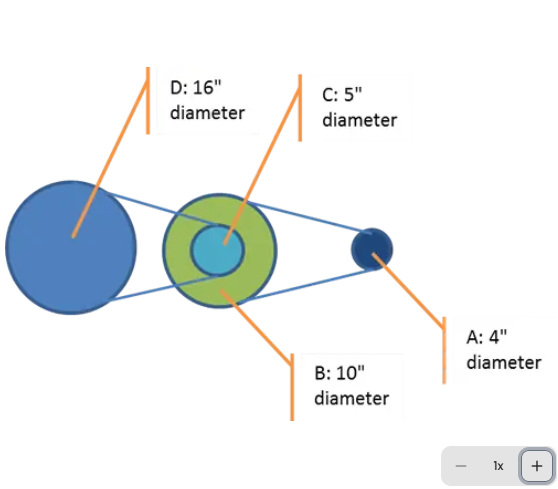
In the pulley system below, how fast does pulley D rotate, if pulley A rotates at 100 rpm?
12.5 rpm.
An axe is an example of what type of simple machine?
Wedge.
Which of the following is NOT a type of simple machine?
Spring.
A shovel is an example of which class of lever?
Third.
If a large gear drives a smaller gear, which of the following will NOT occur?
A change in gear ratio.
A wedge converts force applied to its blunt end into force _________ its inclined surface.
Perpendicular to.
An elevator is MOST SIMILAR to which of the following mechanical devices?
A crane.
Which of the following is the BEST example of an inclined plane?
A slide.
Simple machines are useful in that they _________.
Reduce the effort needed to accomplish a task.
A truck’s wheel with a diameter of 18 inches moves another wheel with a diameter of 9 inches. What is the mechanical advantage of the system?
2:1
How is a wedge different from an inclined plane?
A wedge is used in motion.
Jeremy chucks a baseball as far as he can. His arm is operating as a _________.
Third-class lever.
A lever _________.
Multiplies force and changes direction.
A pump is typically used to accomplish which of the following tasks?
To move liquids uphill.
What is the advantage of a single pulley?
It changes the direction of the effort.
A perfectly efficient machine _________.
Converts all the power applied to it into outputted force.
Which of the following wedges generates the greatest amount of force?
11" long and 4" high.
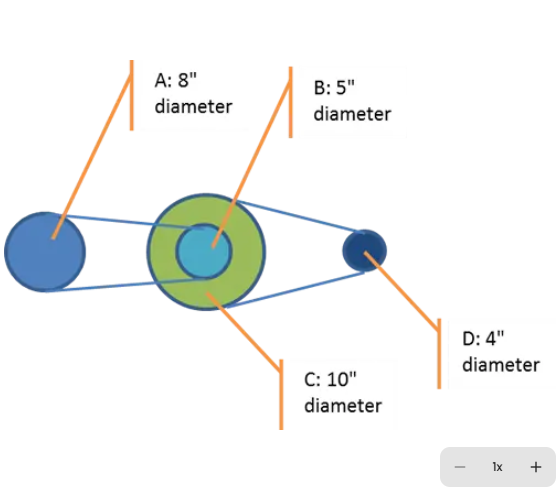
In the pulley system below, how fast does pulley D rotate, if pulley A rotates at 50 rpm?
200 rpm.
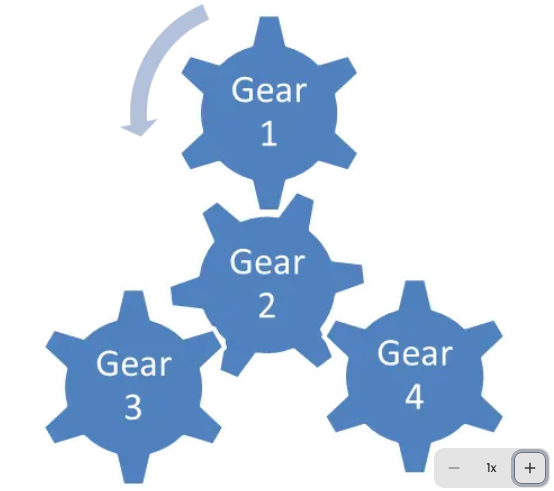
In the figure below, if gear 1 turns counterclockwise (as shown by the arrow), which of the gears will also turn in the same direction?
3 and 4
Gears are used to _________.
Change both rotational speed and direction of force.
At minimum, how many pulleys are there in a block and tackle system?
Two.
On what simple machine does a typical elevator rely?
Pulley.
When a machine compounds the force you use, it gives you a(n) _________.
Mechanical advantage.

What type of simple machine is pictured below?
Second-class lever.
The wheel of a car has a diameter of 16 inches and moves a smaller wheel of 4 inches. What is the mechanical advantage gained by the system?
4:1
Which of the following is a simple machine?
All of the answers.
Which type of simple machine is a screw?
Inclined Plane.
If an inclined plane has a length of 5 meters and a height of 2 meters, what is the mechanical advantage of the inclined plane?
2.5
How does a third-class lever differ from a first-class lever in terms of mechanical advantage?
Mechanical advantage less than one.
How does the principle of torque affect the work of a gear train system?
Relates to rotational force.
In a block and tackle system with 6 supporting ropes, if the input force is 50N and the resistance force is 300N, what is the mechanical advantage of the system?
6
If a block and tackle system has 4 pulleys, what is the ideal mechanical advantage of the system?
4
What is the purpose of a third-class lever in a human arm, such as when lifting a weight with a bicep?
To increase the distance of movement.
What is the formula for calculating the ideal mechanical advantage of an inclined plane?
Lenght / Height
If a screw has a pitch of 1.5 cm and the screw is turned 10 complete revolutions, how far will the screw move along its axis?
15 cm.
What is the mechanical advantage of a first-class lever with the fulcrum placed at a distance of 4 meters from the effort and 2 meters from the resistance?
2
What is the significance of gear ratio in determining the output speed of a gear train?
Affects the output speed.
What role does an inclined plane play in making work easier?
It reduces the input force required.
In a gear train where the driver gear has 10 teeth and the driven gear has 50 teeth, what is the gear ratio when the gears are meshed?
5
Why is a lubricant important in the operation of gears in a gear train system?
Reduces friction and wear.
How does a wedge work to perform a task by separating objects?
By concentrating force over a small area.
What is the purpose of using a compound gear train over a simple gear train?
Offers greater flexibility.
If a lever has a mechanical advantage of 2 and the effort arm is 4 meters, what is the load arm length?
2 meters.
Which type of gear train results in an increase in torque and a decrease in speed?
Reduction gear train.
If a lever has an effort arm of 3 meters and a load arm of 1 meter, what is the mechanical advantage of the lever?
3
Which of the following examples demonstrates the use of a first-class lever?
A seesaw.
When using a wheel and axle system, how does the applied force on the wheel enhance the output force on the axle?
By increasing the torque through the radius difference.
Which type of lever is used in a wheelbarrow to lift heavy loads with minimal effort?
Second-Class Lever.
When does a second-class lever provide the greatest mechanical advantage?
Load closer to the fulcrum.
In a gear train, if the driver gear rotates clockwise, what would be the direction of rotation for the driven gear if it has more teeth than the driver gear?
Counter-clockwise.
Which of the following statements best describes the primary advantage of using an inclined plane as a simple machine?
It allows you to lift an object with less force but over a longer distance.
How does a gear train with a lower gear ratio impact the overall speed of the system?
Increases speed.
How does a fixed pulley change the direction of applied force when lifting an object?
By redirecting the applied force vertically.
In a gear train, the driven gear has one-fourth as many teeth as the driver gear. If the driver gear rotates 200 revolutions, how many revolutions will the driven gear complete?
800 revolutions.
How does the placement of the load and effort differ in a first-class lever under equilibrium?
On opposite sides of the fulcrum.
What impact does adding more pulleys to a block and tackle system have on its mechanical advantage?
Increases the mechanical advantage.