7. Noncomitant Deviations - Clinical Binocular Vision Fall 2026
 Call Kai
 Learn
 Practice Test
 Spaced Repetition
 Match
 Flashcards
 Knowt Play
1/245

There's no tags or description
Looks like no tags are added yet.
246 Terms

Comitant vs Noncomitant
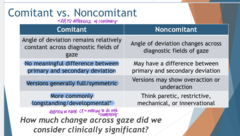
Angle of deviation remains relatively constant across diagnostic fields of gaze
Comitant
Comitant vs Noncomitant
Angle of deviation changes across diagnostic fields of gaze
Noncomitant

Comitant vs Noncomitant
May have a difference between primary and secondary deviation
Noncomitant

Comitant vs Noncomitant
No meaningful difference between primary and secondary deviation
Comitant
Versions generally full/symmetric
Comitant
Versions may show overaction or underaction
Noncomitant
Think paretic, restrictive, mechanical, or innervational
Noncomitant
More commonly longstanding or developmental related
Comitant
Does changes in deviation on distance vs near CT indicate a noncomitant deviation?
No
How much change across gaze did we consider clinically significant?
>5 pd
What are the common causes of Noncomitant Deviations in adults?
-Trauma
-Vascular
-Neoplasm
What are the common causes of Noncomitant Deviations in children?
-Congenital
-Trauma
-Acute Viral Infection
Can adults have congenital non-comitant deviations?
Yes -- children grow up into adults with noncomitant congenital problems
The diagnostic evaluation of a deviation will depend on what factors?
-Age
-Time of onset
-Characteristics of the deviation (Myogenic, Neurogenic?)
Complete loss or impairment of the motor function
Paralysis or palsy
Affected with or pertaining to a paralysis
Paralytic
Slight or incomplete paralysis
Paresis
Pertaining to or affected with paresis
Paretic

Paretic vs Nonparetic
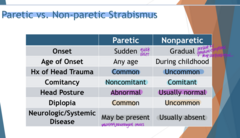
sudden onset
Paretic
Paretic vs Nonparetic
gradual onset
Nonparetic

Paretic vs Nonparetic
Age of onset = childhood
Nonparetic

Paretic vs Nonparetic
Age of onset = any age
paretic

Paretic vs Nonparetic
Hx of head trauma uncommon
Nonparetic

Paretic vs Nonparetic
Hx of head trauma common
Paretic

Paretic vs Nonparetic
Comitant deviation
nonparetic

Paretic vs Nonparetic
noncomitant deviation
Paretic

Paretic vs Nonparetic
Head posture is normal
Nonparetic

Paretic vs Nonparetic
Head posture is abnormal
paretic

Paretic vs Nonparetic
Diplopia uncommon
nonparetic

Paretic vs Nonparetic
Diplopia common
Paretic

Paretic vs Nonparetic
Neurological/systemic disease usually absent
nonparetic

Paretic vs Nonparetic
Neurological/systemic disease may be present
paretic

How can weakness of a paretic muscle become increasingly comitant over time?
1) Weakness of a paretic muscle
2) OA of the direct antagonist
3) Contrature of the direct antagonist
4) Deviation spreads into all DAFs
5) Becomes increasingly comitant

What is the effect of a noncomitant deviation (d/t paretic muscle) becoming increasingly comitant over time?
Deviation that used to look very different in different gazes will look increasingly similar over time
Characteristics of Recent Deviation
-(+) diplopia
-Noncomitant deviation
-No amblyopia present
-Marked abnormal head position
Characteristics of a Longstanding Deviation
-Usually no diplopia
-Comitancy may have spread
-May have slight anomalous head posture
-Old photos show anomalous head posture
-May have amblyopia
What is pattern strabismus?
A specific subtype of a non-comitant deviation
What patterns are typically associated with the term pattern strabismus?
A and V pattern
___% of strabs have an A or V pattern strabismus
30
When is a pattern strabismus seen?
-May be seen on versions
-Detected on ACT
What is the most common pattern strabismus?
V-eso
What is the least common pattern strabismus?
A-exo
X, Y, and λ patterns are ___
rare
In order to classify a deviation as A, V, X, Y, λ -- the deviation needs to be ____ pd difference in multiple gazes
5
What are the 2 major causes of pattern strabismus?
-Peripheral (Mechanical)
-Central (Neural)
What are some of the causes for peripheral (mechanical) pattern strabismus?
-Oblique muscle dysfunction
-Horizontal muscle dysfunction
-Cyclovertical muscle dysfunction
-Muscle pulley dysfunction
-Orbital abnormalities
What are some of the causes for central (neural) pattern strabismus?
-Loss of Fusion
-Supranuclear anomalies
-Vestibular anomalies

Describe an A Pattern Strabismus
-More Eso, Less Exo on Upgaze
-More Exo, Less Eso on Downgaze
Describe a V Pattern Strabismus
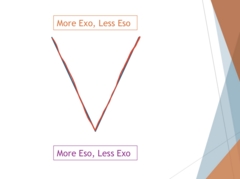
-More Exo, Less Eso on Upgaze
-More Eso, Less Exo on Downgaze
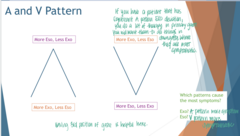
Which pattern will cause more symptoms for an Exo patient?
A pattern
**More exo at near. Patient is already Exo

Which pattern will cause more symptoms for an Eso patient?
V pattern
**More eso at near. Patient is already eso

Describe an X Pattern Strabismus
-More Exo, Less Eso on Upgaze
-No deviation in primary gaze
-More Exo, Less Eso on Downgaze

Describe an Y Pattern Strabismus
-More Exo, Less Eso on Upgaze
-No deviation in primary gaze
-No deviation in down gaze

Describe an λ Pattern Strabismus
-No deviation in upgaze
-No deviation in primary gaze
-More exo, less eso in downgaze
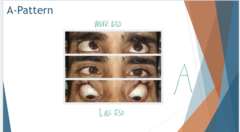
A-Pattern (Pic)
**More Eso in upgaze, Less eso in downgaze
A-Pattern (Pic)

How does an A pattern esotropia usually present?
Will present with chin elevation

Some cases of A pattern ET are d/t what?
overaction of the SO

A pattern XT are usually ______
symptomatic
**XT that is more exo in downgaze

A pattern XT usually presents how?
with chin depression

What is an A pattern XT usually d/t?
overaction of SO

V Pattern (Pic)
**more exo on upgaze; more eso on downgaze
V Pattern (Pic)

V Pattern ET are typically (asymptomatic/symptomatic)
symptomatic -- Eso that is more eso in downgaze

V Pattern ETs will typically have what presentation?
Chin depression to put eyes in upgaze
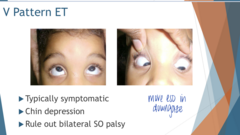
When a V pattern ET presents, what do you have to rule out?
Bilateral SO palsy
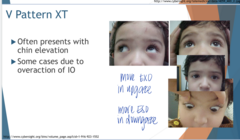
V Pattern XT will typically have what presentation?
Chin elevation to put eyes in downgaze
What are some cases of V pattern XT d/t?
Overaction of the IO
Y pattern is a ____ of V pattern
subtype
What is a Y pattern deviation?
Horizontal deviation remains stable from midline downgaze to primary position; relative divergence seen on upgaze
What is an A pattern deviation?
Horizontal deviation remains stable from the midline upgaze to primary position; relative divergence seen on downgaze
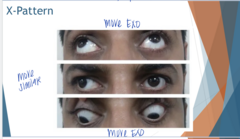
X Pattern (Pic)
X Pattern (Pic)

What is the effect of patients putting their chin down?
Putting eyes in upgaze

What is the effect of patients putting their chin up?
Putting their eyes in downgaze
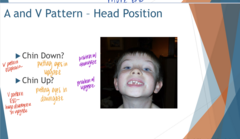
What patients will likely want to put their chin down?
-Eyes in upgaze
-Eso with V pattern strabismus
-Exo with A pattern strabismus

What patients will likely want to put their chin up?
-Eyes in downgaze
-Exo with V pattern strabismus
-Eso with A pattern strabismus
Can EOM dysfunction be associated with pattern deviations?
Yes
Are EOM deviations synonymous with pattern strabismus?
No
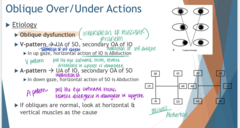
What is the etiology of Oblique muscle Over/Under actions?
-Oblique dysfunction
-V Pattern
-A Pattern

When a V Pattern strabismus is present, what is the EOM dysfunction that could be present?
Underaction of the SO, Secondary overaction of the IO

When an A Pattern strabismus is present, what is the EOM dysfunction that could be present?
Underaction of the IO, Secondary overaction of the SO

In up gaze, what is the horizontal action of the IO?
Abduction

In down gaze, what is the horizontal action of the SO?
Abduction

If the oblique muscles are normal, what should you look at as the cause of a deviation?
horizontal and vertical muscles

Describe primary overaction of the inf oblique
Overelevation in Adduction

Primary Overaction of Inferior oblique will be (unilateral/bilateral)
can be either -- bilateral is more common

True or False:
Primary overaction of the inf oblique can be asymmetric when bilateral
true
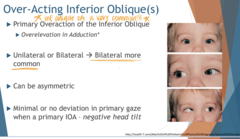
In primary gaze, what is the deviation of an overacting inf oblique muscle?
Minimal to no deviation in primary gaze

Will there be a head tilt present with an IO overaction?
not in primary gaze

On version testing, what will be the presentation of an overacting inf oblique muscle?
-R hyper on L gaze
-L Hyper on R gaze
Is a primary inf oblique overaction associated with a SO palsy?
No
What is an inf oblique overaction associated with a SO palsy?
Secondary overacting inf oblique
What is a Secondary overacting inf oblique associated with?
Contralateral Sup rectus palsy
What is the cause of an overacting inf oblique muscle?
Unknown -- idiopathic
What is an overacting inf oblique muscle commonly associated with?
infantile ET
Is diplopia usually present with an overacting inf oblique muscle??
No
What are the DDx of an overacting inf oblique muscle?
-DVD
-Secondary overaction of IO d/t paretic SO
-Secondary overaction of IO d/t contralateral SR paresis
-Duane retraction syndrome
-Contralateral IR muscle restriction
-Skew Deviation
-Craniofacial syndromes

Over-Acting Inf Oblique Muscles (Pic)
**Os to the nose
Over-Acting Inf Oblique Muscles (Pic)

Over-Acting Inf Oblique Muscles (Pic)
Over-Acting Inf Oblique Muscles (Pic)
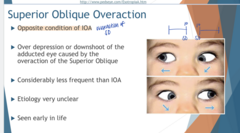
Superior oblique overaction presentation?
Over depression or downshoot o the adducted eye caused by the overaction of the superior oblique
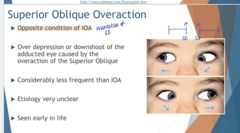
Which is more common?
Overaction of SO or IO
Overaction of IO

What is the etiology of an overaction of the SO?
Unknown