Chem Fall Midterm
 Call Kai
 Learn
Learn Practice Test
 Spaced Repetition
 Match
Match Flashcards
 Knowt Play
1/127

There's no tags or description
Looks like no tags are added yet.
Name | Mastery | Learn | Test | Matching | Spaced | Call with Kai | Chat |
|---|
No analytics yet
Send a link to your students to track their progress
128 Terms
sustainability
meeting the needs of the present without compromising the ability of future generations to meet their own needs
Green Chemistry
approach to the way that products are made
aims to reduce or eliminate the use or generation of hazardous substances
Goals of implementing green chemistry:
improved resource use
Increased energy
Reduced human health & environmental hazards
12 principals of Green Chemistry
Waste prevention
Atom Economy
Less Hazardous Chemical Synthesis
Designing Safer Chemicals
Safer Solvents
Design for Energy Efficiency
Use of Renewable Feedstocks
Reduce Derivitives
Catalysis
Design for Degration
Real-time Analysis for Pollution Prevention
Inherently Safer Chemistry for Accident Prevention
Catalyst
Speeds up the rate of a chemical reaction without itself undergoing a reaction
Benefits of green chemistry
Energy opimization: reduced temperature
reusable products
Direct Synthesis routes, reduced intermediate products and waste
Faster reaction time
Solvent
substances are dissolved in solvents, which are usually liquids to form solutions
uses of solvents
dissolving solutes
making solutions of certain concentration
effeciently mixing a reaction
controlling amount of energy (heating or cooling)
Isolating + purifying product form unwanted by products
How to know if someting is “Green”?
metrics or calculations to quantify, efficiency, waste produced, how hazardous, renewability
compare processes to determine which is greener
What is effeciency in chemistry
higher effeciency - least steps required to form a specific product
Biproducts
elements produced that are not the desired product
often waste products
can be toxic
How to find overall reaction from elementary steps:
take elementary steps - cancel out molecules on each side
write remaining molecules = overall reaction
What are Green Chemistry Metrices
metrics used to quantify efficiency or environmental performance of chemical process
Atom economy
ratio of the total molar masses of atoms in the desired product to the total molar mass of the atoms in the reaction

What is this equation for and what does each part represent
% Atom economy
M of desired product
Sum of M of reactants

calculate % atom economy
92.370%
Reaction mass efficiency
ratio of mass of the desired product to the total mass of all reactants used
Goal of reaction mass efficiency
All atoms forn the reactant materals to be incorperated in the final desired product, with the best possible yield
Equation for Reaction Mass Efficiency (RME)

E-Factor
ration of the total mass of waste to the mass of desired product
Goal of E Factor
reduce waste - excess reactants, solvents and byproducts

What is this equation for and what are each elements
E factor
Numerator: Sum of Mass of reactants and inputs (solvents, catalysts and other inputs) - Mass of desired product
Denominator: mass of desired product
m1, m2 - mass of solvents
m solvents - mass of solvents
m catalysts - mass of catalysts
m3 - mass of desired product
Value of % atom economy that is considered more green
larger value, 100%
Value of RME that is considered more Green
Large RME, as close to 1 as possible
Value of E factor that is considered more Green
as close to 0 as possible
Life Cycle Analysis
evaluates environmental impac of a product, process or service, including all inpusts and outputs across its entire life cycle
What does the International Organization for Standardization do?
Technology, scientific testing, working conditions, societal issues
International Organization for Standardization Life Cycle Analysis methods
Climate issues
Environmental toxicity
Human toxicity
Resource consumption
Climate issue
potential for global warming, acidification. ozone depletion, smog formation
Environmental tocxicity
potential for eutrophication, persistance, bioaccumulation, ecotoxicity
Human toxicity
potential Carcinogenicity, toxicity by ingestion or inhalation
Resource consumption
potential for abiotic depletion
Summarize components of Green Chemistry
System thinking: - how different parts of system interact + influence others
ex. society, economy. environment
Life Cycle assessment: - inputs and outputs across life cycle
Ex. climate issures, enviromental toxicity, human toxicity, resource consumption
Green Chemistry metrices: - consider efficiency of product w/ respect to byproducts + waste
ex. %atom economy, RME, E factor
UN Sustainable Goals
17 goals to achieve world peace and prosperity
each has targets + indicators to monitor progress
Electromagnetic Spectrum
range of all types of electromagnetic radiation, organization by frequency, wavelength or energy

electromagentic spectrum

Important equations to know about electromagnetic spectrum
c- speed of light in a vaccum
v - frequency (Hz)
E - Energy (J)
λ - wavelength (nm = 10^-9 m)
Subatomic particles found in atom
proton (+)
neutron
electron (-)
Who theorized quantun theory
Max Planck
Quantum theory (Max Planck)
Energy is quantized (discontinuous)
Photon is a discrete packet (quantum of energy
E= hv
helped discover Photoelectric Effect

E - Energy (J)
h - Plank’s constant (6.626 X 10⁻³⁴ Js)
v - Frequency
Photoelectric effect
when light of a specific wavelengt, hits a material (ex. metal plate) causing it to emit electrons
energy is quantized
Who discovered photoelectric effect
Heinrich Rudolf Hertz - 1887
Albert Einstein (1905) - Nobel Prize (1921)
When will a photon be ejected (photoelectric effect)
Ephoton > Ethreshold
Ethreshold - (Φ) Energy threshold that must be reached for a photon to be ejected
number of e ejected from on photon (threshold reached)
1
What happens if Ephoton > Φ
excess evergy goes toward the kinetic energy
Equtions for Ephoton
KEelecton- Kinetic energy of electron
u - velocity of ejected photoelectron
m - mass of ejected photoelectron (9.109 × 10⁻³¹kg)

Energy transmission in hydrogen
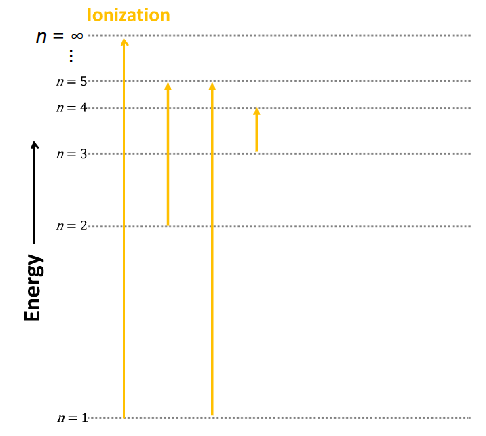
Emission
higher orbital lever → lower orbital level
exicted state → lower state
light emited after passig through a material
M* -> M + hv

Absorption
lower orbital lever → higher orbital level
lower state → excited state
light absorbed when passig through a material
M + hv → M*
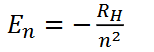
Equation for energy at a specifc energy level
n - energy lever
RH = 2.179 × 10⁻¹⁸J
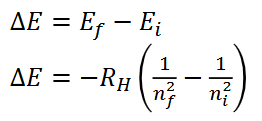
Equations for a change in energy
RH = 2.179 × 10⁻¹⁸J
Energy of poton equation
always positive


Suns Emission Spectrum
large spectrum of light
mostly UV and infrared light
Types of UV rays emmited by the sun
UVA
UVB
UVC
Which UV Rays reach earth
UVA
UVB
UV radiation and inteaction with atomsphere
mostly absorbed in atosphere
some reach earth (UVA and UVB)
body’s response to UV Radiation
produce melanin (dark pigment) to filter UVA Radiation
Chronic exposure to UV rays can lead to…
skin cancer
cataracts
genetic mutations
Electronic transitions in a molecule
absorption of light
physical sunscreens
remain on skin surface and reflect UV rays
Chemical Sunscreen
molecules that absorb UV Radiation before radiation reaches dermis (the skin)
Semiconductors
electrons must be excited from low E valence bond → higher energy conduction band
What is wave particle duality in simple terms
waves display particle-like properties
particles display wave like properties
Who discovered wave particle duality
J.J. Thomson
George Thomson
Principal quantum number (n)
orbital energy + distance from the nucleus
larger → further from nucleus + higher E
n = 1,2,3…
Orbital angular momentum quantum number (l)
orbital shape
l = 0,1,2…(n-1)
0 = s, 1 = p, 2= d, 3 = f
# l values = # subshells within a shell
magnetic quantum number
orbital orientation
ml = -l …0…l
# ml values = 2l+1
Electron Spin Quantum Number (ms)
Electrons have spin generating a magnetic field. - Value is + or – 1/2. - Pairs of electrons have no net magnetic field when spins cancel out.
Diamagnetic
All electron spins are paired. - Results in no net magnetic field (repelled by magnetic fields).
Paramagnetic
Contains one or more unpaired electrons. - Results in a net magnetic field (attracted to magnetic fields).
Aufbau Principle
Electrons occupy orbitals so that the atom's total energy is minimized (filling lower-energy orbitals first).
Pauli Exclusion Principle
Every electron in an atom has a unique set of 4 quantum numbers (no two electrons can share the exact same four quantum numbers).
Hund's Rule
Orbitals of the same energy (degenerate orbitals) are occupied singly with parallel spins before any pairing occurs.
Lewis definition of bonding
The transfer or sharing of outer electrons usually to acquire a stable configuration.
Ionic bonding
The transfer of electrons, usually occurring between a metal and a non-metal.
Typical elements involved in ionic bonding
A metal and a non-metal.
Covalent bonding
The sharing of electrons, often to attain an octet of electrons, usually between two non-metals.
Goal of covalent bonding for atoms
Often to attain an octet of electrons.
Elements typically involved in covalent bonding
Two non-metals
Lewis structure representation of electrons and bonds
Shows all electrons as equivalent, with bonds depicted as lines.
Electronegativity (EN)
An atom's ability to compete for electrons in a bond.
Periodic trend for electronegativity
EN increases across a period and up a group.

Element with the highest electronegativity on the Pauling scale
Fluorine (F), with a value of 4.0.
Determining factor for bond polarity
Electronegativity difference
Electronegativity difference threshold for an ionic bond
∆EN > 1.9.
Electronegativity difference range for a polar covalent bond
0.5 ≤ ∆EN < 1.9
Electronegativity difference range for a pure covalent bond
∆EN < 0.5
Polar covalent bonds
Unequal sharing of e-
Indicated by polar arrow and partial charges
Electrostatic Potential Map:
Scale: Blue – positive, red – negative
Shows were electron density is
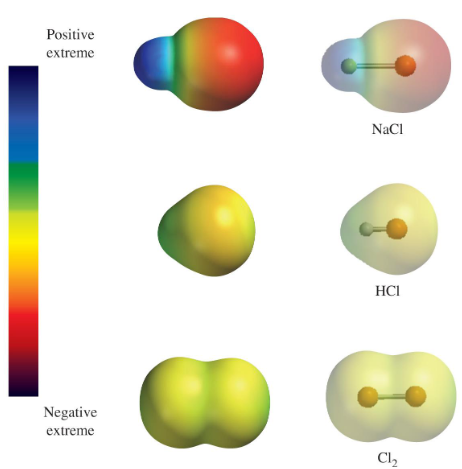
Lewis Structures
Show bonding and non bonding electrons, and formal charges
Complete shells – combination of bonding and non bonding e- pairs (lone pairs)
A complete shell is an octet with the following exceptions
hydrogen is satisfied with 1 electron pair
beryllium can be satisfied with 3 electron pairs
elements in perions 3 and beyond can have expanded octets if involved as a central atom
Steps for drawing a lewis structure
Count total number of valence electrons (add for negative charge, subtract for positive charge).
Draw skeletal structure (least electronegative atom in the center; Hydrogen and Fluorine are always terminal).
Use remaining electrons to complete octets of terminal atoms (or 2 electrons for hydrogen).
Subtract all electrons used and place any remaining electrons on the central atom (can lead to expanded octets).
Calculate formal charges (FC) on each atom:
FC = (Valence e - ½ bonding e - nonbonding e-)
Minimize formal charges by creating multiple bonds using non-bonding electrons (typically happens when neighboring atoms have opposite charges)
Ensure all atoms have an allowed electron count (C, N, O, F must obey octet rule).
Charged molecules: Negative formal charge typically on the most electronegative atom; positive formal charge typically on the least electronegative atom.
Resonance structure
1+ valid Lewis structures that represent the electron bonding of a molecule or ion when a single structure cannot fully capture it (think isotopes for shapes of molecules)
Resonance hybrid
the single, true chemical structure of a molecule or ion that results from combining all valid contributing Lewis structures
charges are an average of all equivalent resonance structures
Average formal charge for an atom
(total charges on an atom)/ total # of that atom
Average bond order
total # of bond orders / total # of places the bond is formed
bond order relates to _____
length of bond
covalent bonf length
approximate distance between 2 nuclei involved in a covalent bond
homolysis
bond dissociation energy