PMQA Post Lab Experiment 3-4
 Call Kai
 Learn
 Practice Test
 Spaced Repetition
 Match
 Flashcards
 Knowt Play
1/101

There's no tags or description
Looks like no tags are added yet.
102 Terms
Capsules
are solid dosage form in which the drug is enclosed within either a hard or soft soluble container or “shell”
HGC
SGC
Classifications of Capsules
Capsules
They are usually formed from gelatin, however, they also may be made from starch or other suitable substances
Gelatin
Common source of capsule shells (from animals)
HPMC (Hydroxypropyl methycellulose)
Vegetable capsules come from plants, with its main component being:
Plate Process
Rotary Die Process
Reciprocating Process
Methods in Filling Soft Gelatin Capsules
Punch Method
Capsule Filler Method
Methods in Filling Hard Gelatin Capsules
Plate Process
Oldest method of commercially preparing SGC
Rotary Die Process
Uses gelatin ribbons brought together by two rotational dies; processed between two rotating dies to form a pocket to later on make a SGC
Punch Method
Method of filling in which the open end of the body of the capsule is repeatedly pressed downward into the powder bed
Capsule Filler Method
Method in which automatic, semi-automatic, and handheld capsule filling machines are used
Soft Gelatin Capsules
Also known as “Pearls” or “One Piece Capsules”
Soft Gelatin Capsules
Capsules that usually contains non-aqueous liquids such as vitamins and oils or others such as suspensions
Hard Gelatin Capsules
Also known as “Two Piece Capsules” or “Dry Filled Capsule”
Hard Gelatin Capsules
Capsules that usually encloses solid and dry substances
Pin Method
Method of Production of Hard Gelatin Capsules
Dipping
Spinning
Drying
Stripping
Trimming (optional)
Joining
Steps involved in Pin Method
000 (largest - suppository) - 5 (smallest)
Hard Gelatin Capsules are available in what sizes?
Large Bolus Capsule
HGC for veterinary use in large animals
Size 00
usually the largest capsule used orally for humans
Size 000
are sometimes used to encapsulate the medication for rectal or vaginal use
moistened with lubricating jelly or water
Before insertion, a size 000 capsule should be
Gelatin
Sugar
Water
Three Main components of HGC
Colorants
Titanium Dioxide
Sulfur Dioxide
Additives to HGC
Titanium Dioxide
Opacifying/Opaquant agent used for HGC
Sulfur Dioxide
Prevents decomposition of gelatin during the manufacturing process
13% - 16%
Percentage of water in HGC
Spansule
HGC with two tapered ends
Pulvule
HGC with one tapered end and one rounded end
Kapseal
HGC with a band in the middle; Tampered and Leak proof
Coni-snap / Snap-Fit / Uni-lock
HGC with a presence of locking grooves
Rectification
Separation
Filling
Joining / Closing
Ejection
Finishing
Steps in Filling HGCs
Rectification
Steps in filling HGC: the empty shells are orientated properly with the bodies facing downward
Separation
Steps in filling HGC: caps are separated from the body
Filling
Steps in filling HGC: dosing of fill material into the body
Lily and Parke Davis Machines
The Model mG2 Machine Automatiche
Zanasi
Hofliger and Karg
(Depends on how many capsules they fill per minute)
Four Common Capsule Filling Equipment
Joining / Closing
Steps in Filling HGC: Cap and filled body are reunited and locked together permanently
Ejection
Steps in Filling HGC: Filled and locked capsules are removed or “Ejected” from the machine
Finishing
Steps in Filling HGC: De-dusting and cleaning of the surface of the capsule
Salt Polishing
Pan Polishing
Cloth Dusting
Brushing
Four Types of HGC Finishing
Salt Polishing
Capsule finishing that is rotated in a polishing pan along with sodium chloride
Pan Polishing
Capsule finishing wherein Polyurethane or cheese cloth is placed in the pan and the liner is used to tap the removed dust and as well as impart gloss to the capsule
Cloth Dusting
Capsule finishing where the capsules are rubbed with cloth by hand
Brushing
Capsule finishing in which the capsules are fed under rotating soft brushes which remove the dust from the capsule shell accompanied by a vacuum
Impriting
Sealing/banding
Locking
Special capsules
Special Techniques for HGCS
Impriting
convenient method for the purpose of product identification and control
Impriting
best performed on empty capsules wherein edible inks are used
Sealing/Banding
Used to give distinctive appearance to the product, permits color coding, prevents capsules from unjoining, and provides tamper-proof feature
Locking
Modification made on one or more of the normal contours of the capsules so that the body is more tightly held
Special Capsules
Special technique for HGC where examples are enteric capsules
density of the powder
The weight capacity for a given capsule size is highly dependent on the
Sucrose
In addition to gelatin, capsule shelld may also contain dispersing agents, preservatives, or hardening agents such as
12-16% or 10-15%
Percetange of water content that must ber present
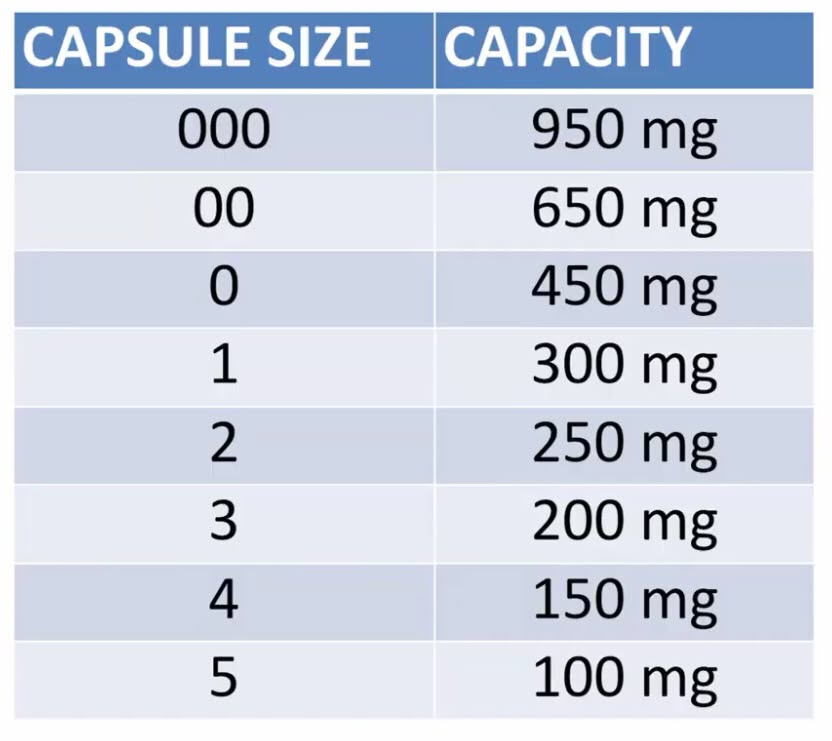
(inversely proportional)
Sizes of Dry Filled Capsules
Causes the shell to become hard and brittle, affecting dissolution and bioavailability.
Proper container: Tight containers that maintain a constant, adequate relative humidity
Capsules supplied by the manufacturer in paper boxes should be transferred to amber glass powder squares or other containers
Effect of lack of moisture in capsules shell
1) Calculate the weight of the powder to be filled into each capsule
= wt of all active ingredients per capsule + wt of any needed diluent
2) A diluent may be needed in the following situations:
If the amount of powder per each capsule is less than the minimum weighable quantity (MWQ) for the balance being used, an inert solid diluent must be added to the active powder ingredients to give desirable weight. Because the smallest capsule sizes numbers 4 and 5, are difficult for some compounders to handle, if the quantity of powder is more than the MWQ, but is so small that a size 4 or 5 capsule shell is needed, diluent may be added so that a larger capsule size can be used
When hand filling capsules, a well-packing diluent may be added to a crystalline or granular powder to improve its ease of packing.
Lactose monohydrate (non-spray-dried variety) and cornstarch are two diluents that work well for this purpose.
When using a capsule-filling machine, an inert diluent may be needed to improve the flow of the powder so that the capsules of uniform weight are obtained. Also, the capsule-filling machine may not have plates for all capsule sizes, therefore it is required to add diluent to commodate capsule sizes available to you.
Selecting a capsule size for encapsulating a compounded powder (for reading)
Lactose monohydrate (non-spray-dried variety) and Cornstarch
Examples of packing diluent
Prepare the powder using the techniques and procedures for particle size reduction and blending. (Trituration and Spatulation)
Place the powder mixture for all capsules on an ointment slab or pad. Using a spatula, arrange the powder into a compact, flat Powder bed of uniform thickness. This is referred as "blocking the powder bed"
It is now a standard procedure to use disposable gloves.
Separate the capsule from the body of the capsule shell and repeatedly press the open end of the body of the shell downward into the powder bed. This is called punching capsules
Procedure for Hand Filling Capsules with dry ingredients (For Reading)
Soft Gelatin Capsule
Are made of gelatin to which glycerine or polyhydric alcohol such as sorbitol has beed added
Methyl paraben and/or Propyl paraben
Examle of preservatives for SGC
Soft Gelatin Capsule
Used to encapsulate and hermetically seal liquids, suspensions, pasty materials, dry powders and eve preformed tablet
Glycerine or Polyhydric alcohol such as sorbitol
Examples of Plasticizers for SGC
Water, Gelatin, Plasticizers
Main components of SGC
Preservatives (methyl paraben and propyl paraben)
Colorants
Opacifying agents
Flavoring agents
Other additives for SGC
4 is to 1, respectively
Methyl paraben and propyl paraben ratio to each other in SGC
Robert Scherer (1933)
Rotary die process was first invented by
1949
Reciprocating die process was developed much later in
Disintegration Test
Dissolution Test
USP Tests for Capsules
Weight Variation
Content Uniformity
Dosage Unit Uniformity Test for Capsules
Elegance
Ease of Use
Portability
Smooth and slippery texture for ready swallowing
The tasteless shell, which masks the unpleasant taste or odor of drugs
Advantages of Capsules
Not used for powders that are highly efflorescent (gives off its moisture) and deliquescent (absorbs water)
Not used for the administration of extremely soluble salts i.e. KCl, KBr, NH4Cl
Limitations of Capsules
Ferrous Sulfate (20% elemental iron)
Talc
Raw Materials used is MO#3
Ferrous Sulfate (20% elemental iron)
Active Ingredient of MO#3; Used in the prevention of Iron Deficiency Anemia
Talc
Diluent of MO#3
Iron is best absorbed when taken on an empty stomach, with water or fruit juice (adults: full glass or 8 ounces; children: half glass or 4 ounces), about one hour before or two hours after meals
However, if stomach upset occurs, lower doses may be given to start with, and the iron can be taken after food
Usually available as extended-release capsules: Swallow whole with full glass of liquid. Don’t chew or crush. Take with or immediately after food to decrease stomach irritation
Dosage Administration of Ferrous Sulfate (For reading)
NLT 3.75g and NMT 4.25g
According to USP: Ferrous Sulfate (capsules) per 100 mL should contain
NLT 0.75g and NMT 0.85g
Ferrous Sulfate as elemental iron: should contain
35 mg of elemental iron (11.6%)
How much elemental (pure) iron should a 300 mg of Ferrous Gluconate should contain?
60 mg of elemental iron (20%)
How much elemental (pure) iron should a 300 mg of Ferrous Sulfate should contain?
100 mg of elemental iron (33%)
How much elemental (pure) iron should a 300 mg of Ferrous Fumarate should contain?
Ferrous Sulfate
Most economically friendly iron salt
Store in cool, dry place away from direct light, but do not freeze.
Not to be exposed to avoid oxidation to ferric state
Storage of Ferrous Sulfate (For reading)
Well-dried bottles preferably sterilized
Container for Ferrous Sulfate
Content of elemental Fe and Ferrous Sulfate
Labeling requirement for Ferrous Sulfate
Feosol
Feosol Caplets
Fergon
Slow FE
Common Brand names of Ferrous Sulfate
Amoxicillin
Cornstarch
Magnesium Stearate
Raw Materials for MO#4
Amoxicillin
API for MO#4; Antibiotic
Cornstarch
Diluent for MO#4
Magnesium Stearate
Lubricant / antiadherent / glidant for MO#4
Amoxicillin
a broad-spectrum antibiotic that belongs to the aminopenicillin class of drugs. It is used to treat a wide range of bacterial infection
Capsule
Tablet
Suspension
Amoxicillin comes in three main oral dosage forms:
Oral
IM
IV
Routes of administration for Amoxicillin
Every 12 hours or twice a day OR most commonly every 8 hours three times a day (should be taken at the same time for the whole duration)
May be taken with food to avoid stomach upset
Administration of Amoxicillin orally (for reading)
NLT 90% and NMT 120% of the labeled amount of amoxicillin
USP for Amoxicillin Capsules should contain
C16 H19 N3 O5 S
Molecular Formula of Amoxicillin
Inhibiting the formation of bacterial cell walls, which causes the bacteria to die.
Amoxicillin is not effective against viral infections like the flu or common cold. It used against bacteria as it works by
Penicillin Binding Proteins (PBP)
Inhibited by Amoxicillin within the Bacterial Cell Wall
Penicillin Binding Protein (PBP)
Proteins essential in the cross-linking of peptidoglycan chains.
Amoxicillin inhibits penicillin-binding proteins (PBPs), preventing the cross-linking of peptidoglycan chains. Without these cross-links, the cell wall becomes structurally weak and unable to withstand osmotic pressure. This causes the bacteria to burst or die.
MOA of Amoxicillin (for reading)
20 - 25°C or room temperature
Keep in a dry place
Protect from moisture and humidity
Protect from direct sunlight
Storage of Amoxicillin Capsules