NSCI Unit 8 - Chemical Senses
 Call Kai
 Learn
 Practice Test
 Spaced Repetition
 Match
 Flashcards
 Knowt Play
1/30

There's no tags or description
Looks like no tags are added yet.
31 Terms
Chemicals that cause Taste
Umami - glutamate
Sour - H+ protons (high acidity)
Bitter - ions K+ and Mg2+, quinine, caffeine
Sweet - sugars, fructose, sucrose, artifical sweeteners (saccharin and aspartame)
Salty - Na+ ions
Papillae
Strutures on the tongue that contain a variety of specialized taste buds
Anatomy and function of papillae, taste buds, and taste receptor cells
Papillae: bumps on the tongue that contain 1-100 tastebuds
Taste bud: a unit of cells (basal and taste receptor) that receive chemical input from food and convert it into an electrical signal that is sent down gustatory axons
Taste receptor cell: Non-neuronal cells that send information to the gustatory axons. Microvilli form the taste pore and detect chemicals dissolved in saliva
Threshold Concentration
The concentration at which a stimulus provokes perception of taste
Explain how threshold concentration influences taste perception
At just above TC, papillae are more specific to one taste
At very high levels above TC, papillae become more generalized
Taste Cell Electrophysiology
Taste receptor cells are most commonly specialists, where they only create APs to one specific taste
Taste receptor cells that respond to multiple tastant chemicals are known as gereralists, but usually still have preferences
Population Coding
Mixture of taste preferences across axons allow for specificity of different tastes, based on which axons send APs and how strongly
Transmitter for sour taste cells
Serotonin
Transmitter for sweet, bitter, umami, and salty
ATP
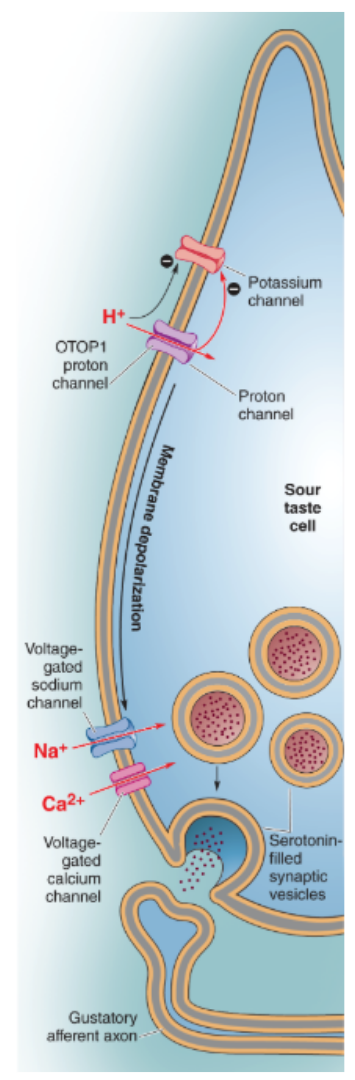
Sour Transduction Pathway
H+ protons enter OTOP1 channel (always open) and close K+ channels
Excess of intracellular K+ causes membrane depolarization
VG Na+ and Ca2+ channels open and allow influx
Vesicle-bound serotonin released onto gustatory axon receptors (afferent)
Salty Transduction Pathway
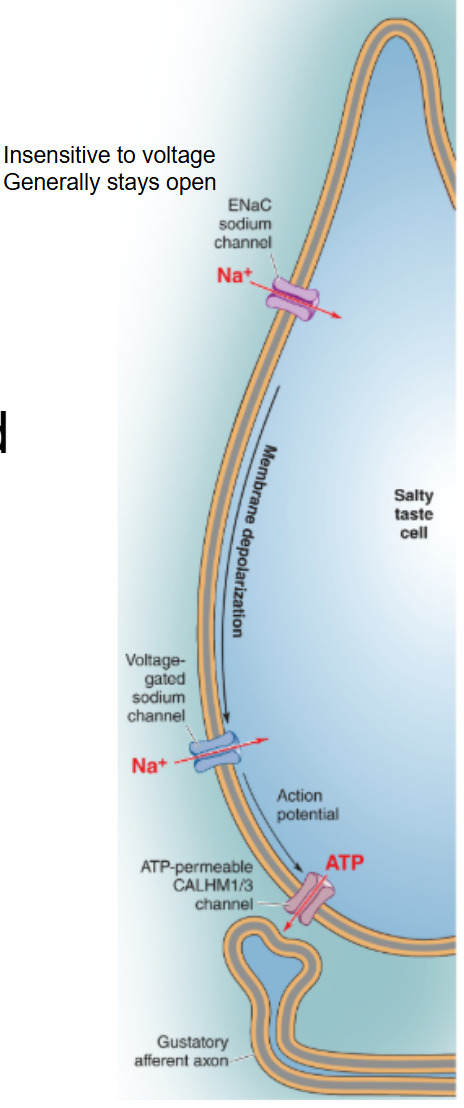
Na+ enters cell through normal concentration gradient
Depolarization of the cell opens VG Na+ channels, causing release of ATP
Bitter, Sweet, and Umami Pathway
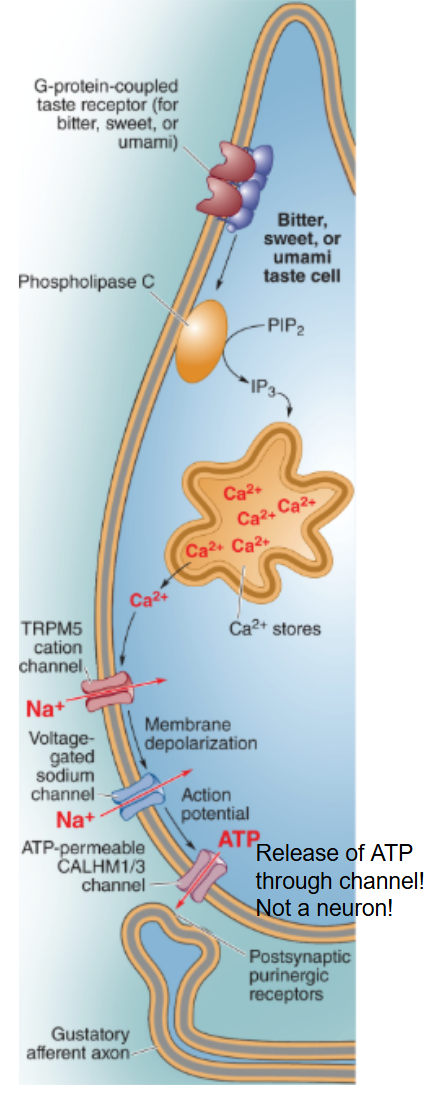
Specific G-protein receives ligand and sends protein to Phospholipase C
Phospholipase C generates IP3
IP3 causes release of Ca++ from cellular stores
TRPM5 Na+ channel opens, cell depolarizes (VG Na+ also opens)
Depolarization leads to ATP channel opening, allowing ATP release onto gustatory axon
Why don’t we confuse bitter chemicals with sweet ones?
Receptor proteins responsible for sweet and bitter flavors are expressed in different taste cells
Each have their own gustatory axons
Individual signals for bitter and sweet are sent on different transmission lines
Describe the gustatory pathway from taste receptor cells to primary gustatory cortex
Taste receptor cell 🡪 gustatory afferent axons 🡪 gustatory nucleus in the brainstem 🡪 VPM of the thalamus 🡪 gustatory cortex (insular cortex)

Gustatory Afferent Axons
X Vagus
IX Glossopharyngeal
VII Facial
Olfaction System Detects…
Chemical odors such as pheromones
Transduction
The process of taking a chemical or physical stimulus and converting it into neuronal impulses
Olfactory Receptors
Specialized neurons that directly interact with odorant molecules
Dendrites extend out and form a knob, from which cilia stem from and collect odorant molecules
Olfaction Pathways
Olfactory receptor cell → olfactory bulb→ olfactory cortex in the temporal lobe (NO thalamus!!)
Olfactory receptor cell → olfactory bulb → olfactory tubercle → medial dorsal nucleus (thalamus) → orbitofrontal cortex

Olfaction Encoding
Olfactory receptor cells are organized into glomeruli in the olfactory bulb based on receptor type
Combination of temporal and population coding allows the brain to distinguish different smells
How do population and temporal coding work together do distinguish odors?
Each odor is represented by a large population of neurons
Neuron responsiveness can be organized into spatial maps
Timing of action potentials contributes an essential code for some odors
Olfactory Temporal Coding
Odors are encoded by the timing of action potentials across the population of olfactory neurons
Possibly encodes the quality of odors
Olfactory Population Coding
Combined population reaction of individual olfactory neurons’ to an odor
Olfactory Epithelium Structure
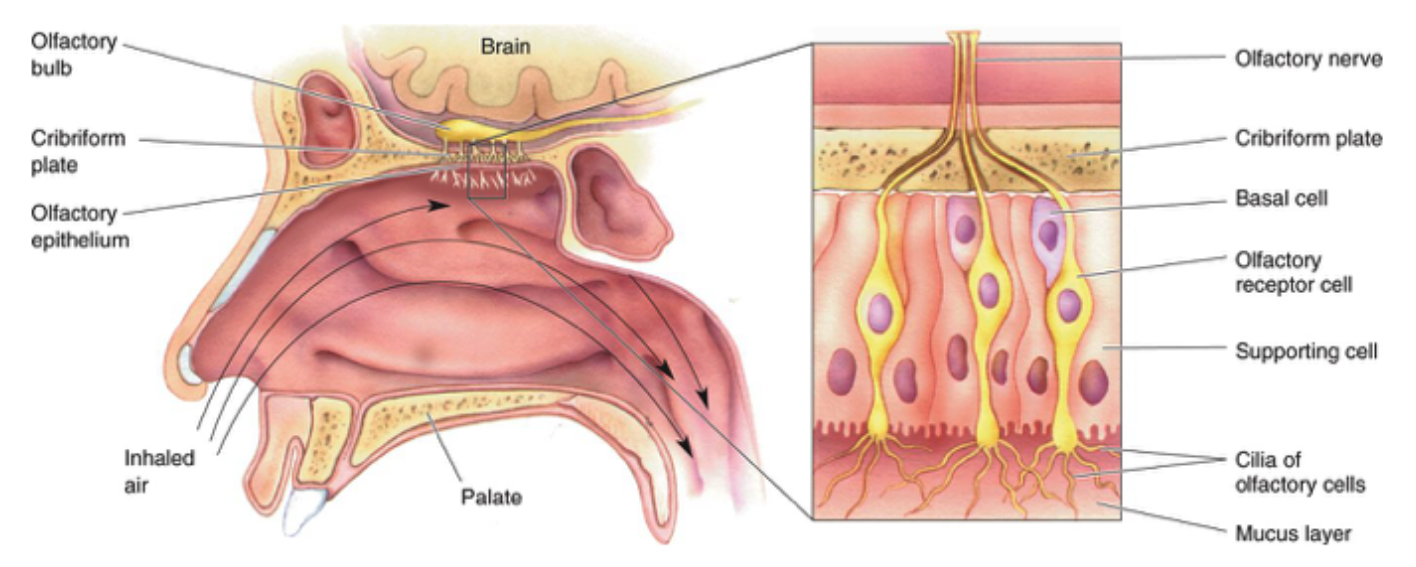
Mucus layer - binding proteins that help concentrate odorants
Cilia of olfactory cells - contains odorant receptors
Supporting cell - similar to glia
Olfactory receptor cell - odor transduction neuron cell
Basal cell - makes new receptor cells
Cribiform plate - bony structure, damage that severs neurons causes anosmia
Olfactory nerve - axons from olfactory receptor cells, afferent info
Describe the neurological and sensory symptoms of COVID-19, including anosmia
Headache, anosmia, confusion, seizure, encephalopathy
60-90% of covid patients reported loss of smell or taste
Anosmia can lead to depression, affects quality of life
Analyze evidence linking COVID-19-induced changes in the olfactory epithelium to anosmia
New evidence points to covid affecting support cells in OE
Cilia retract thus causing anosmia
Discuss the diversity, genomic organization, and expression of olfactory receptor genes
Largest gene family ever discovered
Covers 3-5% of the mammalian genome
Genes found across many different chromosomes
Steps of transduction in an olfactory receptor neuron
Odorants bind to membrane odorant receptor proteins
Stimulate G protein Golf
Activate adeylate cyclase
Form cAMP
Bind cAMP to cyclic nucleotide gated cation channel
Open cAMP gated Na+ and Ca2+ ion channels
Calcium opens Cl- channels (efflux)
Membrane depolarizes causing receptor potential
If receptor potential is large enough it will cause APs in the cell body

What is special about the Cl- channels in olfactory reception?
They cause membrane depolarization by leaving the cell. Unlike most cells, cilia have a high concentration of Cl- in the cell which reverses the expected concentration gradient
Chloride leaves and membrane depolarizes
Olfactory Bulb Structure
Sits above the cribiform plate and contains thousands of glomeruli
Information is further processed from specific olfactory receptor axons to second order olfactory neurons which form Cranial Nerve I
Glomeruli
Cluster of olfactory nerves for a specific odorant receptor cell type
All inputs converge and terminate onto one second-order olfactory neuron
These neurons join together to form the olfactory tract