exam 2 bio review
 Call Kai
 Learn
 Practice Test
 Spaced Repetition
 Match
 Flashcards
 Knowt Play
1/124

There's no tags or description
Looks like no tags are added yet.
125 Terms

conservative model
parental DNA remains together while newly formed daughter strands become paired

semi-conservative
each of the 2 parental DNA strands acts as a template for new DNA to be synthesized so that each newly formed daughter strands is paired with an “old” strand
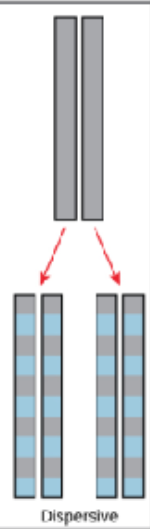
dispersive model
both copies of DNA have double-stranded segments of parental DNA and newly formed DNA interspersed

meselson-stahl experiment
The experiment proved that DNA replication is semiconservative: every time a cell divides, each of the two resulting DNA molecules consists of one strand from the original molecule and one newly synthesized strand
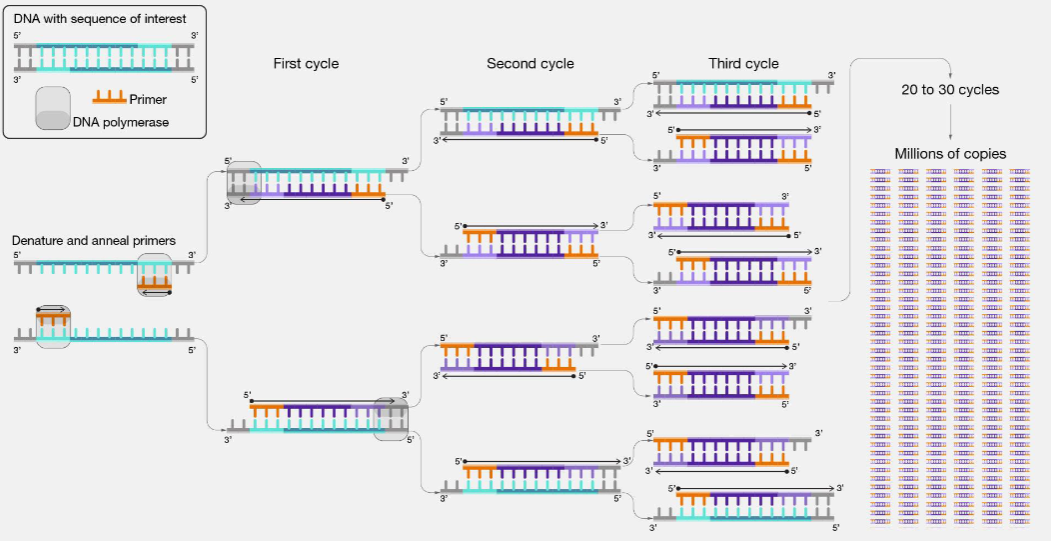
polymerase chain reaction (PCR)
allows scientists to rapidly replicate lots of DNA

gel electrophoresis
allows scientists to determine what DNA was replicated in PCR
where smaller DNA travels further
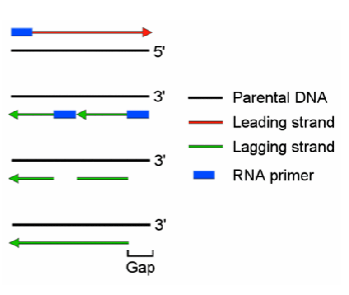
end-replication problem in eukaryotes
loss of genetic information due to RNA primers inability to “clip onto” the lagging strand (lack of space)

telomeres
protective, repetitive, non-coding regions at the end of linear chromosomes; prevents loss of coding regions of DNA during replication and unraveling/sticking of chromosome ends

telomerase
protein found in eukaryotic cells that extend telomeres by writing telomeric DNA
in cancer, egg, sperm, and stem cells
centrifugation
separates heavy from light DNA
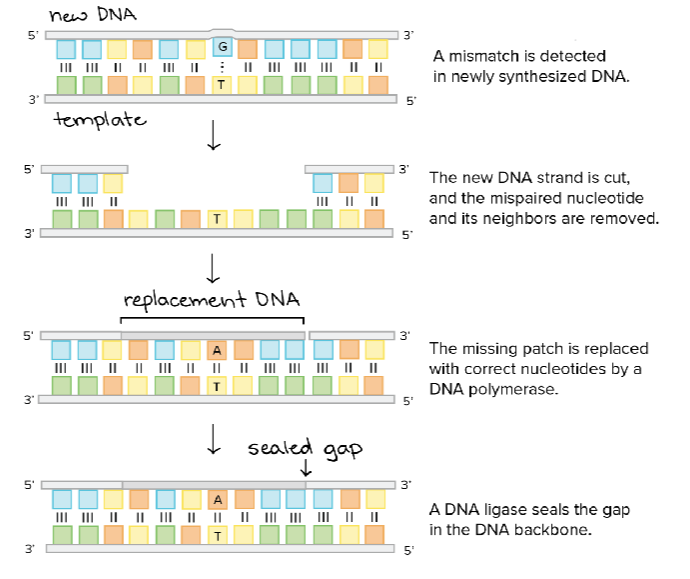
DNA polymerase
“proofreads” the replicated DNA for mitosis
replaces errors
exonuclease activity (nuclease)
removal and replacement of incorrect nucleotides by cleaving the phosphodiester backbone
DNA ligase
seals gaps in DNA backbone

mismatch repair
incorrectly added bases are detected, removed, and replaced

base excision repair
only the damaged base is removed and replaced

nucleotide excision repair
1+ damaged bases are removed and replaced
if errors in replication are not repaired
mutations occur

induced mutation
caused by environment
chemicals, xrays, UV light, lab experiments, etc

spontaneous mutation
naturally caused, randomly occurring

DNA mutations in non-coding DNA
most mutations occur in this type since it makes 97% of our DNA
affects the expression of genes
mutations still occur in coding regions

codon
sequence of 3 nucleotides
represents an amino acid or start/stop signal of protein synthesis
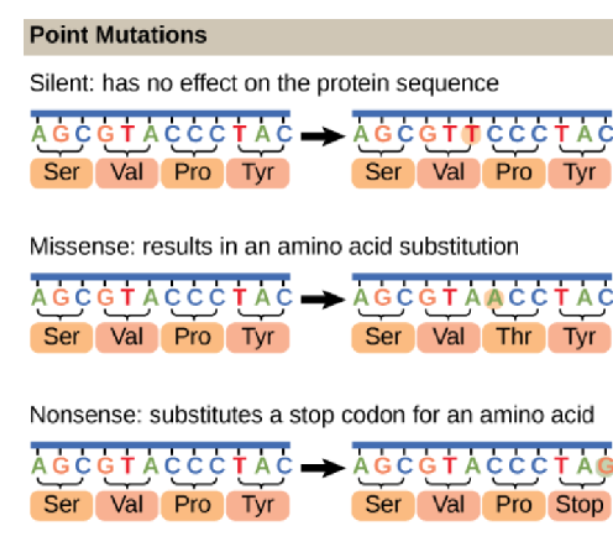
point mutation
change of a single nucleotide for another

missense (point) mutation
one nucleotide change resulting in a different amino acid
sickle cell anemia

nonsense (point) mutation
one nucleotide change resulting in a stop codon (UAA, UGA, UAG)
duchenne muscular dystrophy

silent (point) mutation
single nucleotide change resulting in no change of amino acid

frame shift mutation
addition/deletion of nucleotide(s) that shift all following amino acids making them wrong (frameshift error)
creates new proteins useless to the cell (stop codons)
more severe than point mutations
thalassemia + tay sachs disease

insertion/deletion of whole codons
no frameshift errors; may pose severe effects
spontaneous mutations
result from intracellular processes
meiosis, inherent instability of nucleotide bases, DNA polymerase error, base pair degradation

induced mutations
result from external mutagens
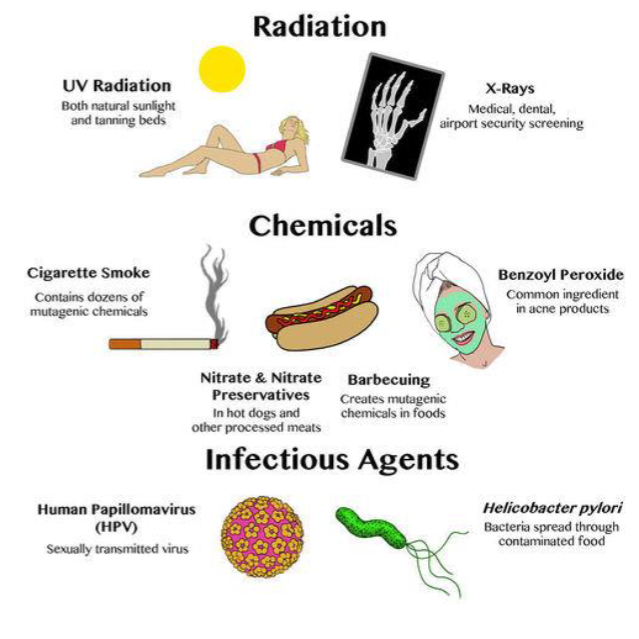
external mutagens
factors that cause permanent change in DNA
radiation, chemicals, infectious agents

DNA mutations are always harmful (T or F)
false, mutations that help organisms adapt will be more common over time

key principles of modern cell theory?
1) All organisms consist of cells. 2) Energy flow occurs within cells. 3) Cells are the basic structural/organizational unit. 4) Hereditary information is passed on. 5) All cells come from pre-existing cells. 6) All cells have the same chemical composition.

three primary functions of cell division?
1) Reproduction (creates new single-celled organisms). 2) Growth & development (from zygote or cuttings). 3) Tissue renewal/repair (replaces worn-out/damaged cells).

Define chromosome
Threadlike structure carrying genetic info/genes

Define plasmid
small, independent loops of non-essential DNA in prokaryotes

Define nucleosome
Eukaryotic structural unit made of DNA wrapped around histone proteins

How do prokaryotic and eukaryotic chromosomes differ?
Prokaryote: Single circular DNA, naked (no histones), plasmids present.
Eukaryote: Linear DNA, associated with histone proteins, no plasmids, 2+ distinct chromosomes

How do prokaryotes reproduce
binary fission
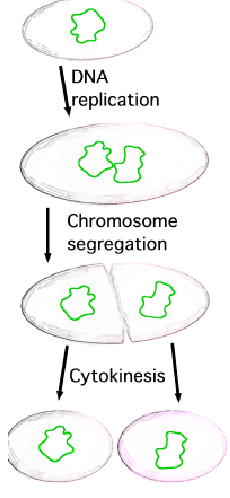
steps of binary fission
circular DNA replicates at origin; cell elongates; chromosomes separate; cell pinches into two identical daughter cells

What is the eukaryotic cell cycle and its general outcome?
The series of events following DNA replication that leads to cell division, producing 2 identical daughter cells (except in meiosis)

What is cell differentiation, and which cells typically divide?
the process where a less specialized cell becomes a specialized cell. Mostly undifferentiated cells (stem cells) divide.

What are the two main phases of the eukaryotic cell cycle?
interphase: Cell growth and chromosome copying (G1, S, G2)
Mitotic (M) Phase: Chromosome separation (mitosis) and physical cell division (cytokinesis)

What occurs during G1, S, G2, and G0 of interphase?
G1: Cell growth & organelle/non-DNA content duplication.
S: Chromosome replication (DNA synthesis).
G2: Cell growth & error checks/repairs on duplicated DNA.
G0: Cell cycle arrest/resting phase.

Define homologous chromosomes
Matched pairs of chromosomes

Define chromatids
Replicated copies of a chromosome

Define centromere
Connection point between sister chromatids where spindle fibers attach

What are the key outcomes and prerequisites of mitosis?
Produces 2 genetically identical daughter clone cells (half original size, then grow). It begins strictly following DNA replication.

What is the condition of DNA during Interphase prior to mitosis?
DNA is fully replicated, loosely coiled, and not visible under a light microscope

What events occur in Early Prophase?
Nuclear envelope disintegrates, chromosomes coil/condense, replicated centrioles move to opposite poles, and astral rays/spindle fibers form.
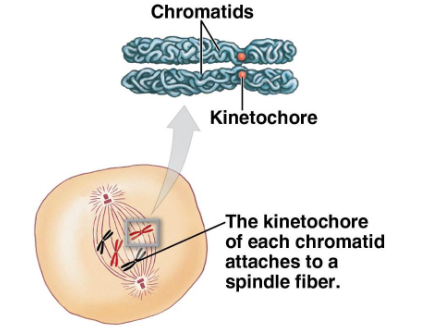
What events occur in Late Prophase? (prometaphase)
Chromosomes are pairs of sister chromatids joined at the centromere; kinetochores on centromeres attach to spindle fibers.

What key event defines Metaphase?
Chromosomes line up along the metaphase plate in the center of the cell

What key events occur during Anaphase?
Centromeres split, sister chromatids separate into individual chromosomes and are pulled to opposite poles along spindle fibers

What key events occur during Telophase?
Cytoplasm constricts (cleavage furrow), nuclear membranes reform, nuclei enlarge, and chromosomes uncoil back into chromatin.

What is cytokinesis and when does it begin/end
Physical division of the cell. Begins with cleavage furrow formation, continues through telophase, and its completion marks the end of cell division.

How does cytokinesis differ between animal and plant cells?
Animal Cells: Form a cleavage furrow using a contractile ring.
Plant Cells: Form a cell plate inside using Golgi vesicles.

What is meiosis and its primary functions?
Sexual cell division forming 4 genetically unique haploid gametes.
Halves chromsome number (2n > n); introduces genetic diversity via random alignment and crossing over
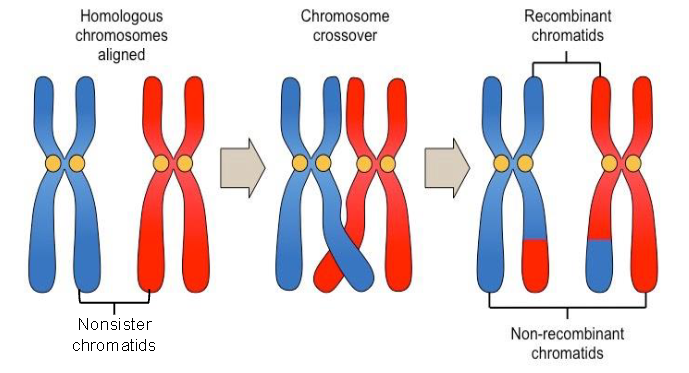
What is crossing over and between what structures does it occur?
Exchange of genetic material between non-sister chromatids of homologous chromosome pairs during meiosis, increasing variability

Define Diploid (2n) and haploid (n) in human contexts
Diploid (2n): normal somatic cell count with 2 chromosome sets (Humans: 2n = 46)
Haploid (n):gamete chromosome count containing one set (Humans: n = 23)

Outline the basic sequence and product of Meiosis.
DNA replicates once before Meiosis I, followed by two consecutive divisions (Meiosis I & Meiosis II) producing 4 haploid daughter cells
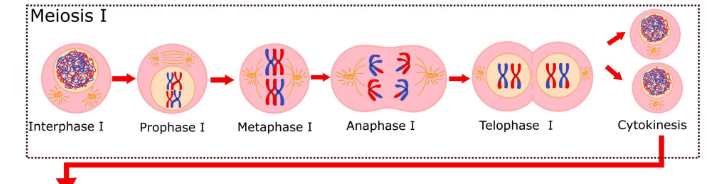
What happens during Meiosis I?
Non-sister chromatids cross over, and homologous chromosome pairs separate, reducing chromosome number from 2n to n

What happens during Meiosis II?
Sister chromatids separate, giving each daughter cell an equal share of unreplicated chromosomes.

What causes Down Syndrome (Trisomy 21)?
Non-disjunction (chromatids failing to separate correctly during meiosis), resulting in an extra copy of chromosome 21

What are the 3 main cell cycle checkpoints
G1 + G2 Checkpoints, M Checkpoint

G1 Checkpoint
Checks cell size, nutrients, social signals, and undamaged DNA.

G2 Checkpoint
Checks faithful chromosome replication, undamaged DNA, and mitosis-activating proteins.

M Checkpoint
Checks that all chromosomes are properly attached to spindle fibers.
what external factors regulate cell growth in vitro (outside living organism) vs in vivo (inside living organism)?
In Vitro: Availability of essential nutrients and density-dependent inhibition (overcrowding prevents division)
In Vivo: Growth factors (e.g., PDGF) and anchorage dependence (cells must attach to a substrate).
Necrosis
Uncontrolled cell death from loss of homeostasis (toxins, hypoxia) without gene coordination

Apoptosis
Programmed, tightly controlled cell death triggered when cells are unneeded or damaged

What are caspases and how are they activated?
Digestive enzymes that cleave specific cytoplasmic/nuclear proteins to cause cell death. Activated from inactive procaspases via a proteolytic caspase cascade.
proteolytic caspase cascade
extra/intra-cellular signals from immune cells / organelle damage that activate procaspases (inactive) into caspases (active)
What happens if a cell passes checkpoints with damaged DNA?
It is either destroyed by the immune system or becomes cancerous.
G1 is the most common point of failure

Tumor Suppressor Genes
Code for proteins that prevent uncontrolled division (e.g., P53, P21, Rb)

Proto-oncogenes
Code for proteins that promote cell division (e.g., Cdk); become cancer-causing oncogenes when mutated
Transformation
A single cell becomes cancerous.
Benign Tumor
Non-invasive mass of abnormal cells staying in one spot
Malignant Tumor
Invasive cells that spread (metastasis) and impair organ function

What structural features distinguish cancer cells under a microscope?
Abnormal chromosome numbers and multipolar or malformed spindle apparatuses.
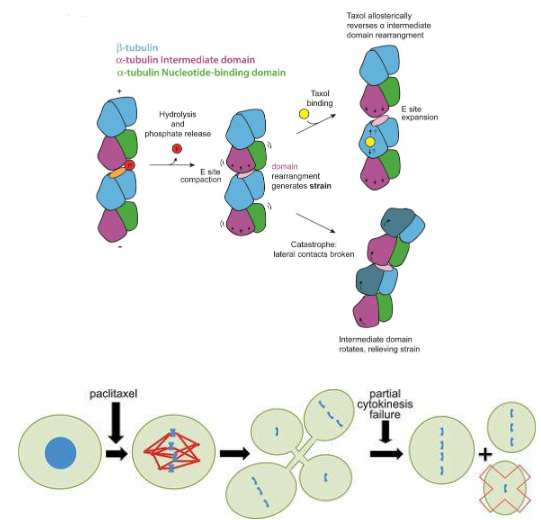
Taxol (Chemotherapy)
Forcibly stabilizes microtubules, preventing spindle breakdown and stopping division.

CAR-T Cells (Immunotherapy)
Patient T-cells are extracted, reprogrammed to recognize cancer, and reinjected
Define DNA replication and state when it occurs in prokaryotes vs eukaryotes
Process of copying the genome. Occurs prior to binary fission in prokaryotes, and during the S phase of interphase in eukaryotes.

What are the 2 basic steps of DNA replication
1) DNA unwinds/strands separate. 2) New strand is synthesized using old strand as template
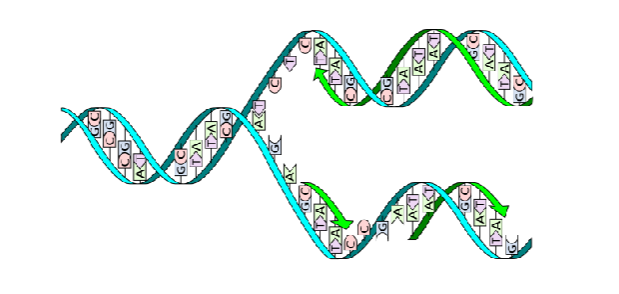
What are the 3 essential ingredients of DNA replication?
Parental template DNA, specialized proteins, and nucleotide triphosphates
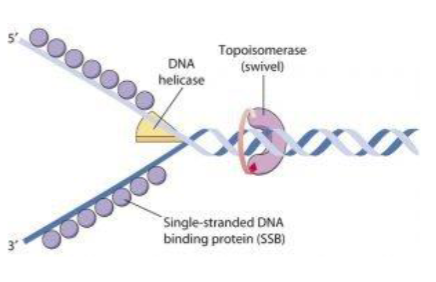
Name the 3 proteins involved in DNA unwinding
Helicase, topoisomerase, Single-Strand Binding (SSB) Proteins

Helicase
Opens DNA double helix by breaking hydrogen bonds.

Topoisomerase
Relieves unwinding strain by cutting and resealing DNA.

Single-Strand Binding (SSB) Proteins
Bind single strands to keep them from rewinding
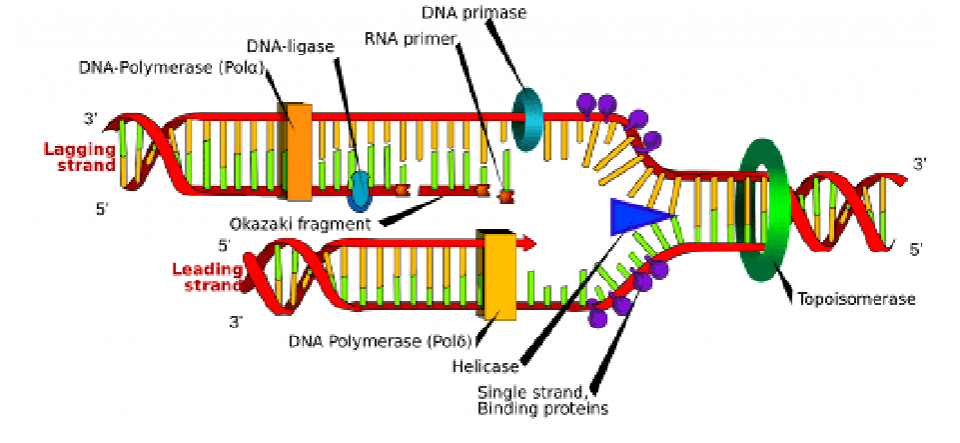
Name the 4 proteins involved in DNA strand synthesis
Primase, DNA Polymerase, Ligase, and Sliding Clamp

Primase
Synthesizes short RNA primers to initiate synthesis

DNA Polymerase
Adds complementary nucleotides (5’ to 3') and replaces RNA primers
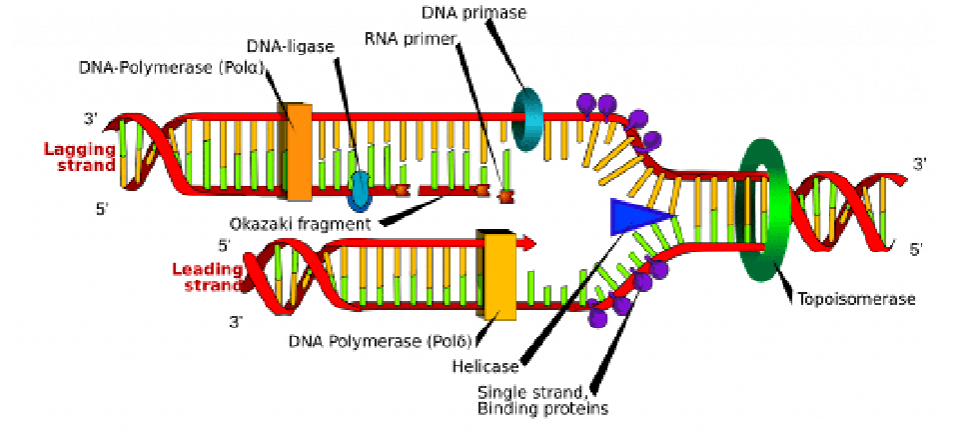
Ligase
Seals gaps/nicks in sugar-phosphate backbone
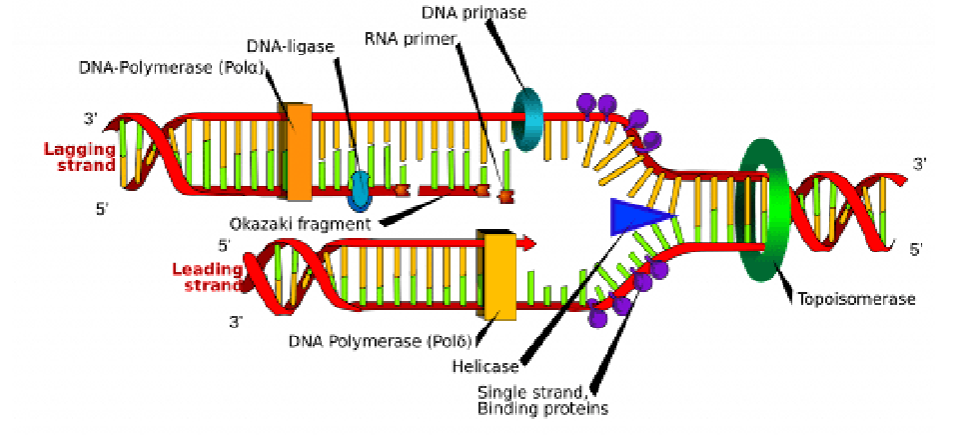
Sliding Clamp
Holds DNA Polymerase in place during synthesis
What bond holds the 2 DNA strands together?
hydrogen bonds
what bond is in the sugar phosphate backbone
phosphodiester bond

Leading Strand
Continuous synthesis toward the helicase (3’ to 5’)
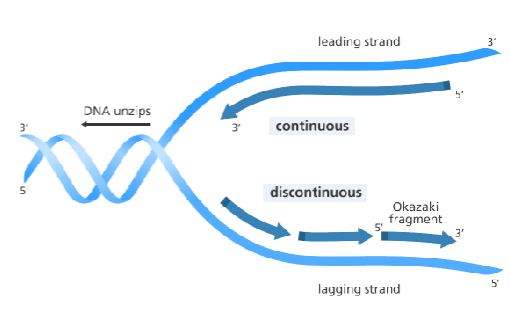
Lagging Strand
Discontinuous synthesis away from helicase (5’ to 3’)

Okazaki Fragments
Short DNA pieces synthesized on lagging strand, later joined by ligase
origin of replication
specific genomic sequence where replication begins

replication fork
unwound “bubble” structure where strands separate and replicate in both directions

Which direction are nucleotides added, by base-pairing, and what bonds form?
Added in 5’ to 3’ direction (A-T, G-C). Hydrogen bonds form between base pairs, and phosphodiester bonds form along the backbone