IAL phy U2 caqs/PP mistakes [2020-jan 2024]
 Call Kai
 Learn
 Practice Test
 Spaced Repetition
 Match
 Flashcards
 Knowt Play
1/64

There's no tags or description
Looks like no tags are added yet.
65 Terms
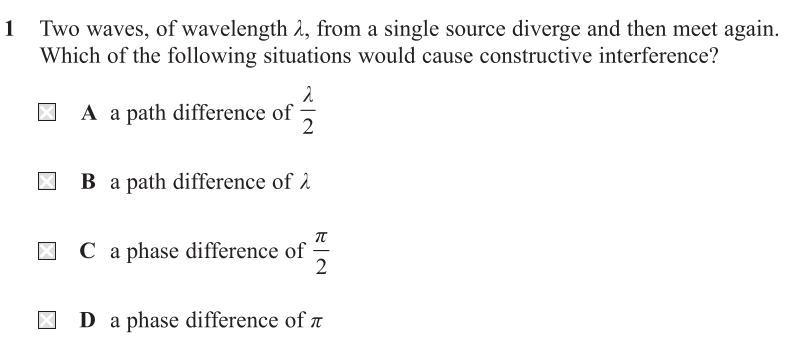
B is correct answer
constructive interference:
path diff = nλ (where n = whole number)
phase difference = 2n(π)
destructive interference:
Path difference = (n +1/2)λ
phase diff = (2n+1)π
NOTE: for phase difference, we need even INTEGER multiples of π,
so phase diff of 0.5π, 3.5π etc give neither constructive nor destructive interference, thats why C is wrong.
(they give partial interference)

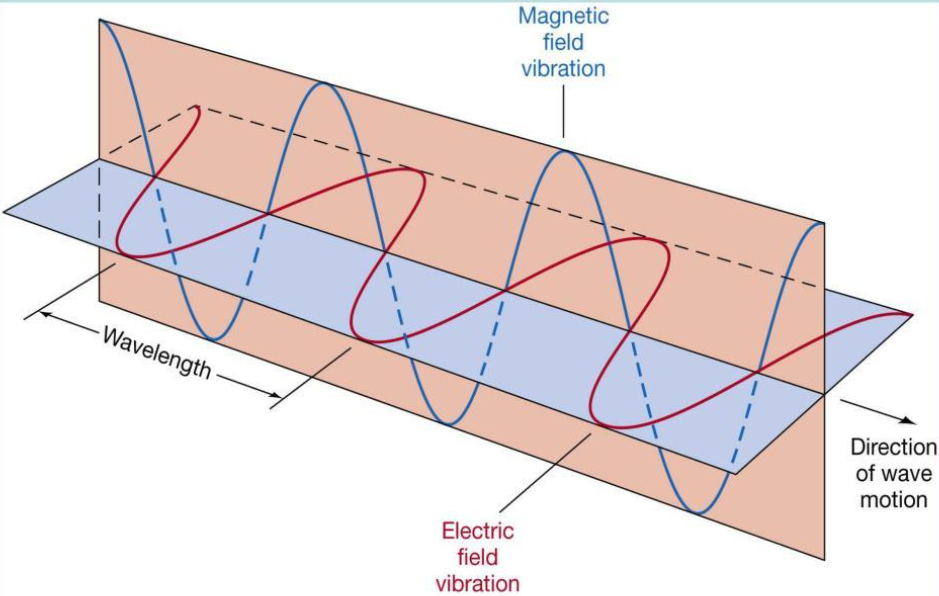
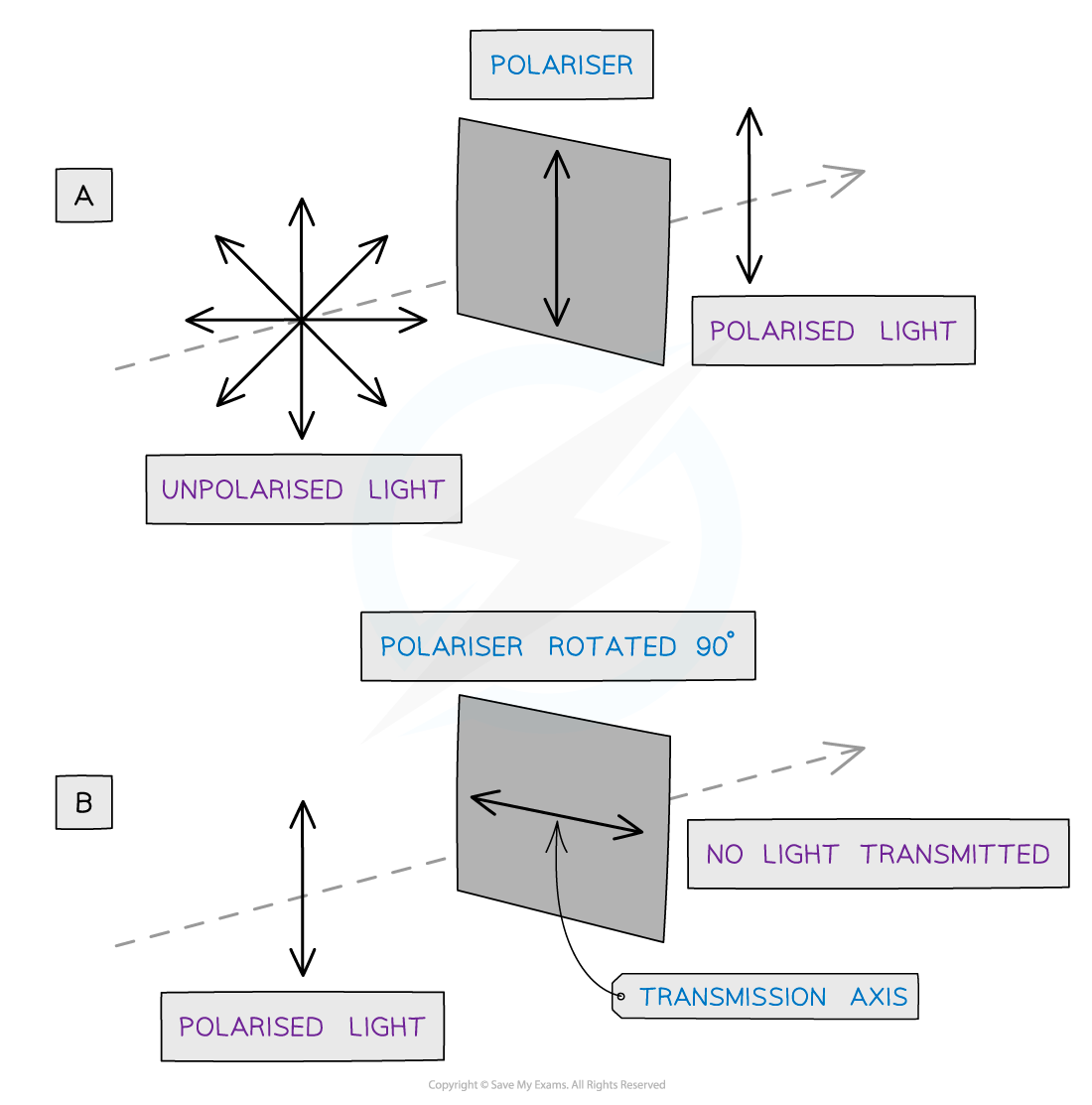
define polarised light
polarised light is when light is restricted so it has oscillations in a single direction which is perpendicular to direction of wave travel
OR in terms of plane:
“ “so it oscillates in a single plane which includes direction of wave travel
NOTE:
say the blue part/plane was flitered, it still wudnt be right to say perpendicular when talking about plane, as the oscilation includes the direction of wave travel
if you talk about the blue and red lines(wave directions), then yes the blue/red wave is perpendicular too direction of wave travel

C is correct answer
in diffraction grating experiment:
-diffraction grating is set upparallel to screen
- diffraction grating is setup perpendicular to light source

- diffraction grating is the square thingy with 1000s of line holes or slits
- - we find theta using trigonometry NOT PROTRACTOR
- distance between the bright dots(maxima) is best measured using a metre rule

in series, voltage is shared so if V2 increases v1 must decrease to yk balance out the ratios of share

Explain how the ultrasound scan of the unborn baby is produced using pulse-echo technique (6marks)
a device/transdurcer is used that produces ultrasound and also detects the ultrasound reflected back
the produced ultrasound is the pulse which is reflected when it hits a boundary, and the reflected ultrasound is the echo
they get reflected due to change in density (like from body fluid to soft tissue)
speed of ultrasound is known and the time taken for pulse to return is measured
the distance from transducer to boundary is found with equation:
s = v x t, but here its 2d = v x t, therefore distance = (vxt) / 2
(the distance is found to create an accurate mapping of the image)
the echoes are converted to electrical signanls and computer uses the echo intensity and time delays to display as an ultrasound scan/image
btw reflected due to change in denisty is cuz of acoustic impedence,a quantity determines how much sound waves are resisted to flow past a medium. but this is not in syllabus so you can ignore it
define work function
minimum energy required to emitt/remove an electron from the surface of a metal
In an experiment involving photocell, the intensity of UV light emitted was increased.
Explain what happened to the reading on ammeter (3marks)
increasing intensity means more photons hit metal surface per second
so more electrons(photoelectrons) are emitted per second
therefore current increases (or reading on ammeter increases)
(as rate of flow of charge increased)


Explain, using Huygens' construction, how diffraction occurs as waves pass through a gap.
[2marks]
in Hyugen's construction, points along the wavefront (called point sources) acts as a source for secondary waves/wavelets
so when waves pass slit they bend and spread out (diffraction)

here you should have figured out that there are sever maximums or maximas, central one being largest and others smaller
these maxima are due to (constructive) interference between the secondary wavelets
dark patches due to destructive interference

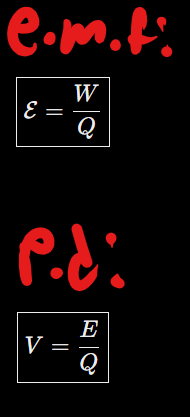
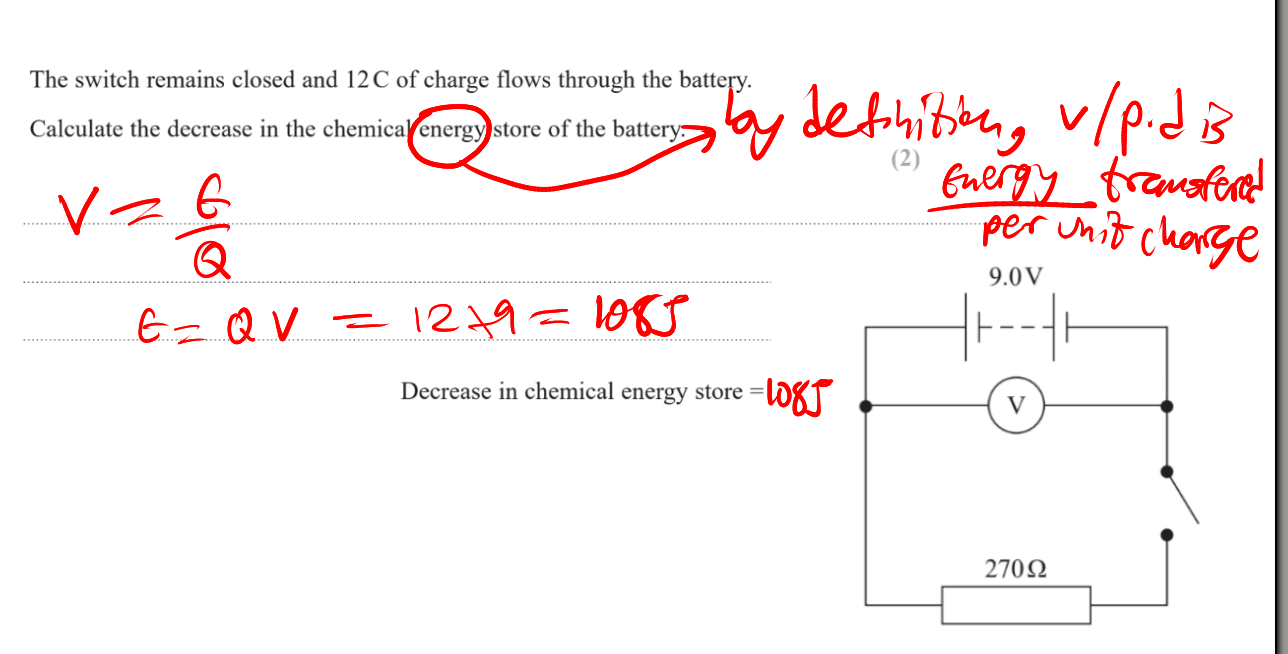
define emf
define potential difference
emf = energy supplied per unit charge by a source
p.d = energy transferred per unit charge between two points in a cicuit

Plot a graph V(y-axis) against I (x-axis)
Determine the gradient from graph
Gradient is −r, so r is - gradient

The calculated value for resistivity of air in lightning channel is 0.2 and accepted value is 1016
Suggest why the value calculated from the data is so much less than the accepted value.
Lightning channel unlikely to have a uniform diameter / CSA
(cuz lightning is non uniform)

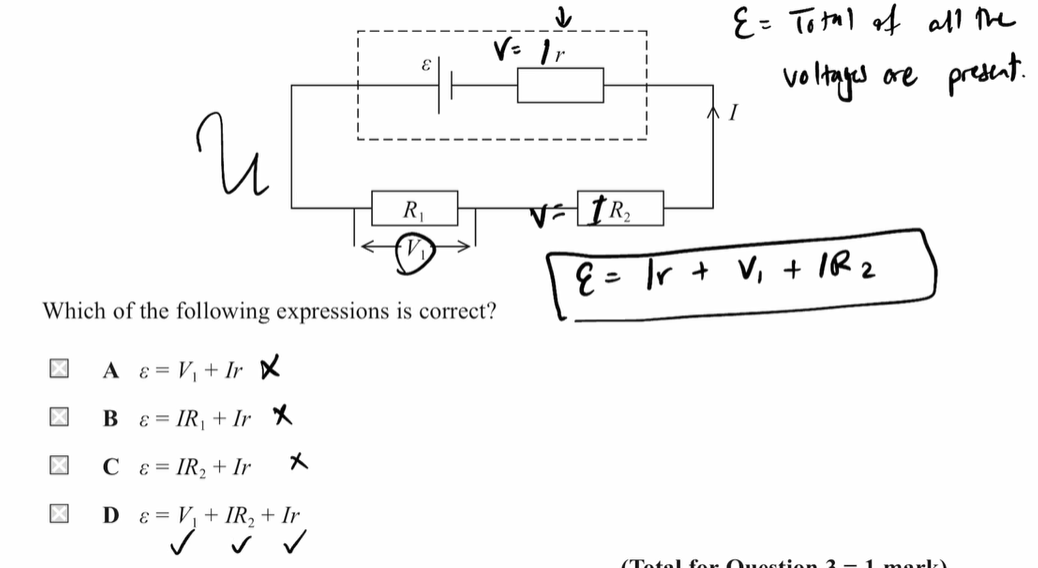
emf is the work done moving a unit charge around the whole circuit
basically emf is the total of all the voltages present
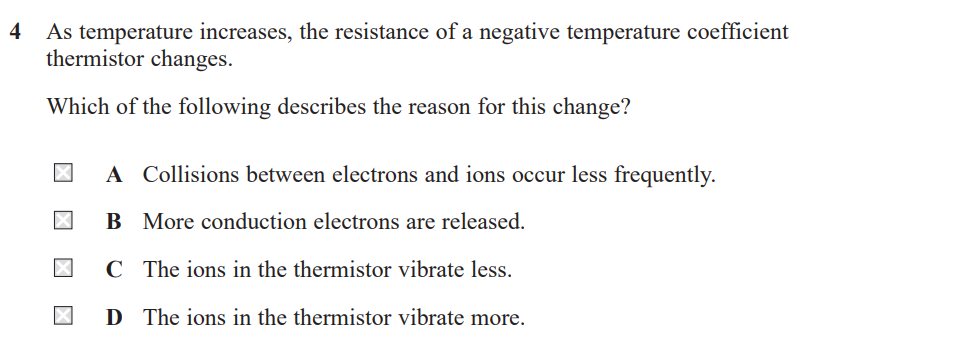
For semiconductors (thermistors):
(1) as temperature increases
(2) number density of charge carriers (electrons) increases
(3) the number of conduction electrons per unit volume increases which results in a decrease in resistance (and resistivity)
btw D is factually correct but B has more priority/effect i.e, as when temperature increases ions do vibrate more but here as it’s semi conductor no. of charge carrier electrons have more effect

A student suggests that the drift velocity will double if the length of wire used in the circuit is halved.
Comment on this suggestion
Halving length will cause resistance to half
it causes current to double
since I = nqvA, the drift velocity also doubles so student is correct


transducer sends ultrasound which is reflected
find the time taken (for signal to return)
Calculate (expected) time taken for pulse to return without air gap & then time taken with air gap
If time for pulse to return (with air gap) < time calculated (without air gap)
air gap is present
Ultrasound is a sound wave with a frequency greater than 20kHz.
The frequency of ultrasound used by the transducer in this method is 5MHz.
Explain why a much higher frequency than 20kHz is needed in this method
[3 marks]
Higher frequency gives smaller wavelength
smaller wavelength allows high level of resolution (detail)
which means small objects can be detected (i.e air gaps)
(with lower frequency like 20KHz, wavelengths would be larger so it may not give sufficient resolution to detect small objects like air gaps or even the air gaps might be smaller than the wavelength)
Explain how observations from the photoelectric effect demonstrate the particle nature of light.
[6marks]
In particle theory/ nature, one photon interacts with one elctron
a minimum threshold frequency is required for electrons to be emitted
[but light as a wave predicted that any frequency of light should eventually eject electrons from a metal if given enough time]in particle nature, electrons are released instantenously
Photon energy is related to frequency, E = hf
Increasing the frequency increases the Ek max of emitted electrons
[Ek = hf - work function]In particle nature, increasing intensity, increases the number of photons incident per second thus increasing number of electrons emmited not Ek max of electron
[ wave nature predicted Higher intensity = more energy transferred/ more Ek max]

Explain why a series of bright dots is seen on the screen after diffraction grating (3marks)
there are bright spots where waves are in phase
(and path difference of nλ)
these waves undergo superposition
and constructive interference occurs
The monochromatic laser is replaced by a source producing a parallel beam of bright white light. Suggest what would now be observed on the screen
[2 marks]
for white light, there will be a bright white spot at the centre(zero order maxima or O)
and on either sides of center a continous spectra of visible spectra (rainbow)


The light is incident along the normal (The angle of incidence is 0°)
draw the blue highlighted arrow, i did black which was wrong for reflected
the blue arrow can continue out of air or undergo TIR


basic trig maths to find angle of incidence, silly mistake

since when filter is rotated intenisty varies, that means oscillation of light is getting restricted to one plane
hence light is polarized and ONLY transverse waves can be polarized
(thus light is transverse)

got everything right except forgot the equation:
Q = ne
where n is number of electrons (or charge carrier)
Q is charge and e is charge of one electron/ elementery charge (1.60 × 10⁻¹⁹ )
so answer is 4.2 × 10¹⁸ electrons in one second


atoms like hydrogen have discrete energy level
only certain energy level transitions are possible so photon with discrete energy and therefore wavelength are emitted


Define coherent/coherence
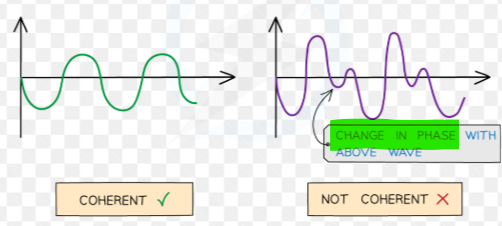
waves which have the same frequency and a constant phase relationship /difference
(Coherent waves are needed to form a stable standing wave)

since their refractive index is similar, there is small change in speed and direction of light
so light is not reflected (or not refracted but transmitted )
(so we can't see it as light is not reflected to our eyes, also there is reflection and refraction but its neglible)

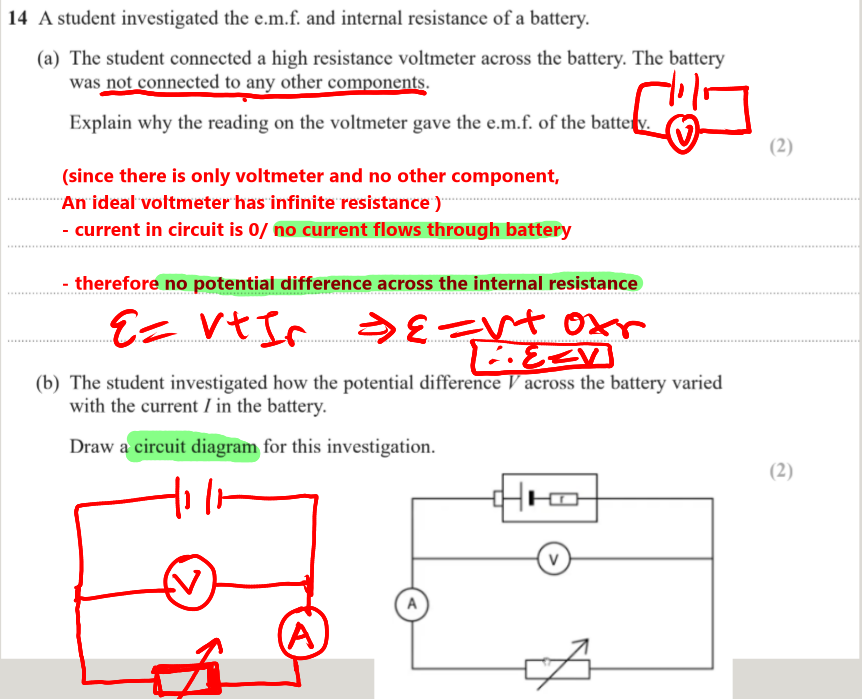
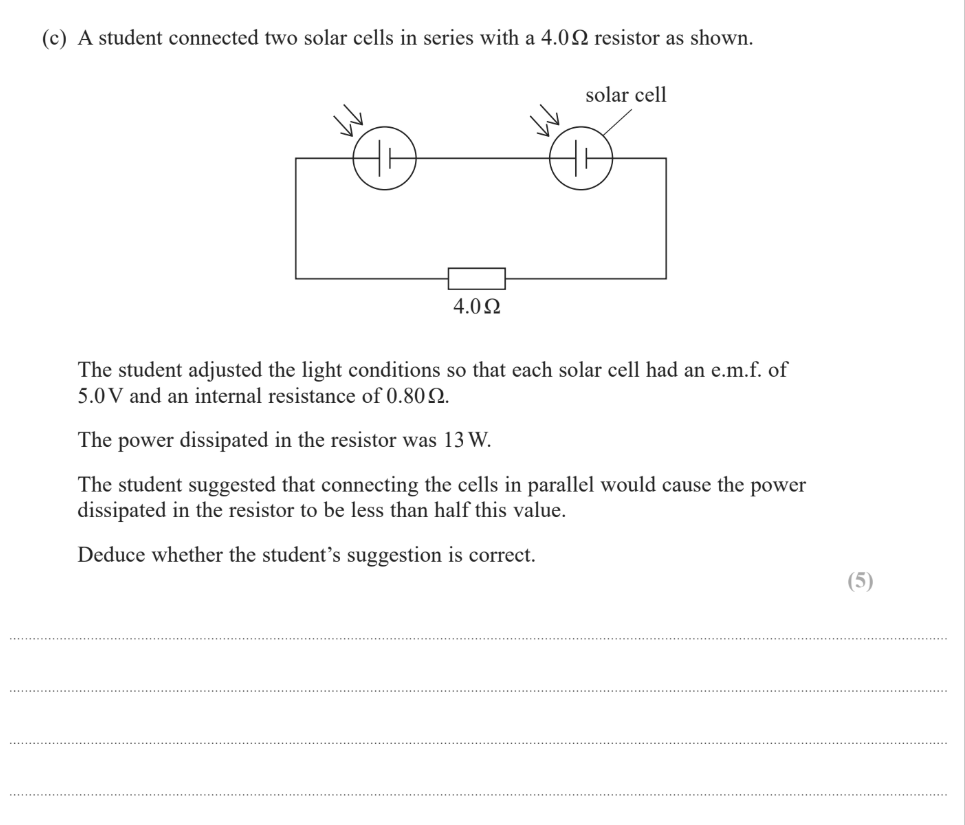
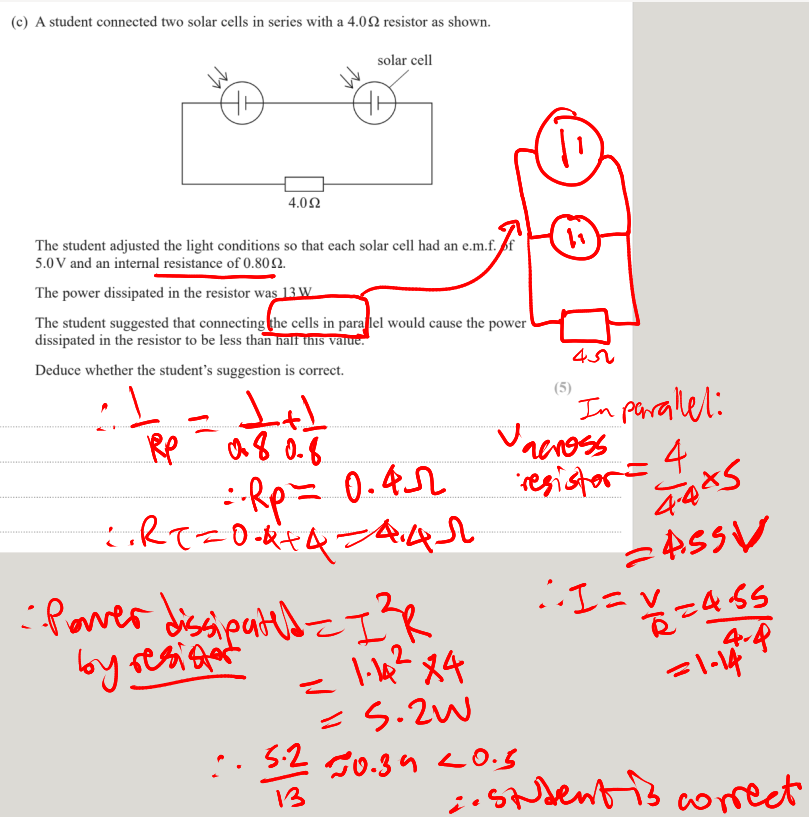
Explain why there is a maximum current that can be supplied by a battery
[2marks]
As the current (in the battery) increases, the p.d across the internal resistance increases
Until the p.d. across the internal resistance equals the e.m.f.
(so current no longer increases, max current has been reached)
[Because r is a constant physical property of the battery, as current I increases, the internal voltage drop (r) must increase]

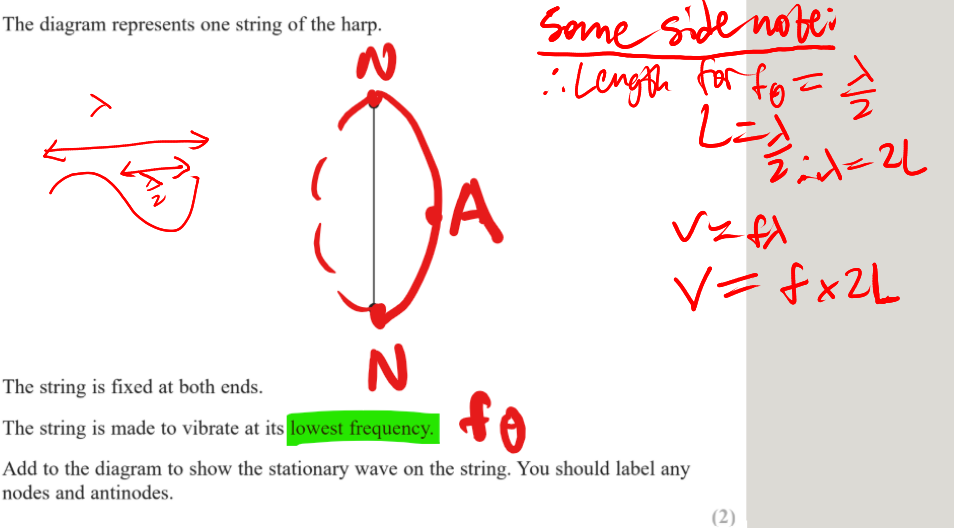
make sure one side is dashed and other is lined
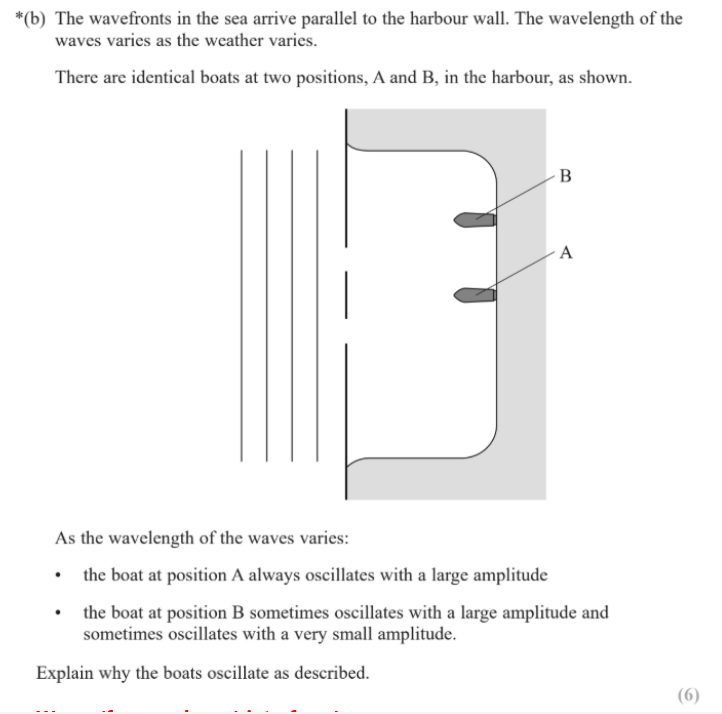
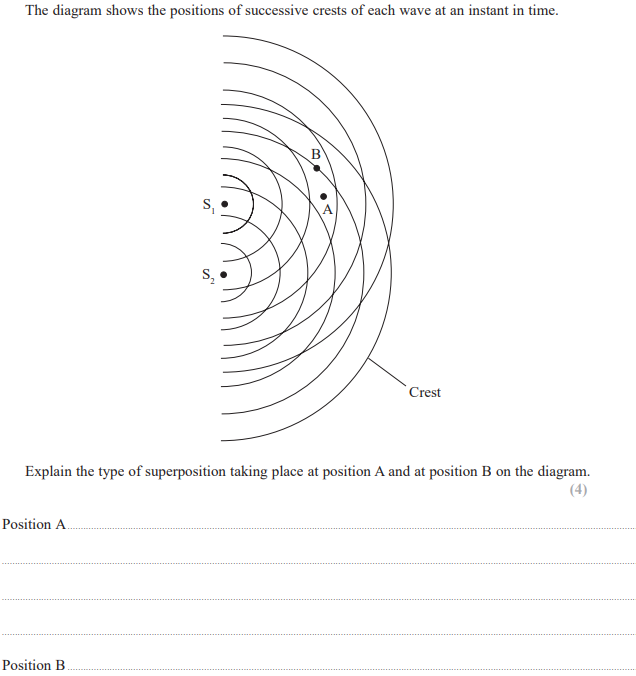
- Waves (from each gap) interfere / superpose
- At position A there is no path difference (or phase difference)
- So constructive interference occurs
(leading to large amplitude oscillations)
- At position B, the phase difference varies with wavelength
- If there is a path difference of odd number of half wavelengths , there
is destructive interference leading to small oscillations
- And if there is path difference of a whole number of wavelengths there
is constructive interference leading to large oscillations
NOTE:
reason why no path diff at A is because the waves travel equal distances from the two gaps to A, so path diff = 0, ive marked it in diagram

Explain why current decreases when temperature of wire resistor is increased [3marks]
increasing temperature increases vibration of lattice ions and electrons
so increases collisions between lattice ion and electrons
thus resistance increases causing current decrease
(btw for thermistor its opposite as its semi conductor so resistance decreases as no. of charge carriers increase, causing current to increase)

main concept to know:
At the threshold frequency/ minimum frequency, Ek max = 0
(as all the Ephoton is used to overcome work function, electrons emitted have 0 Ekmax)
NOTE:
At threshold frequency = e- are just emitted, with zero maximum kinetic energy.
Above threshold frequency = e- are emitted with positive maximum kinetic energy.
Below threshold frequency = no electrons are emitted.

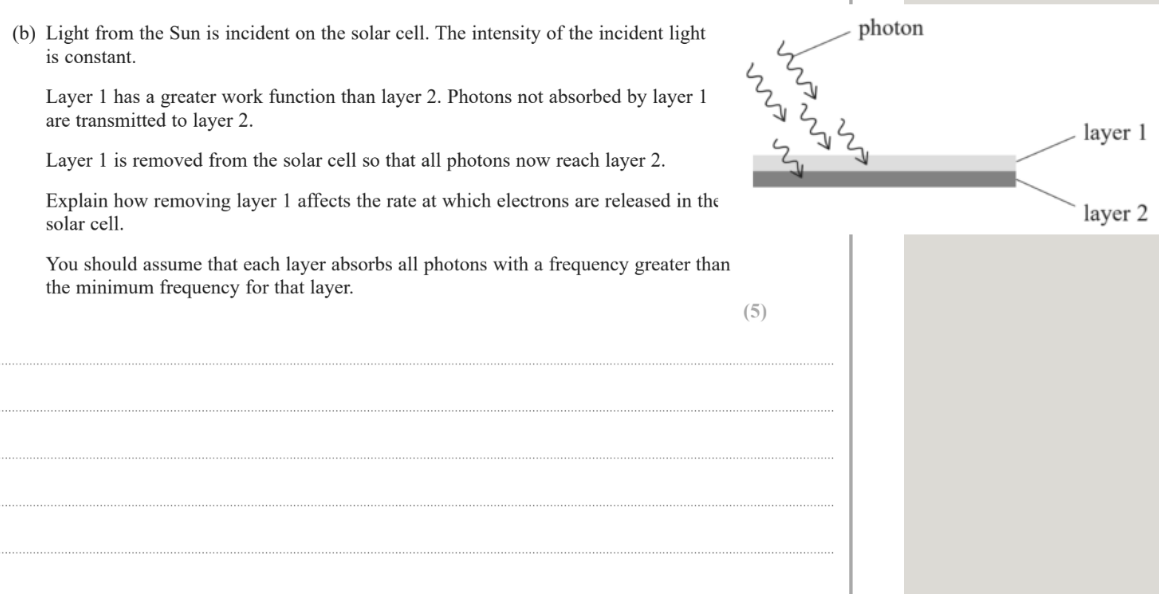
given in Q. that intensity is constant, so number of incident photons on the cell each second is the same
layer 1 has greater work function and so greater threshold frequency, and so can absorb photons with very high frequency and cause e- emission
without layer 1, photons reaching layer 2 have a frequency greater than the threshold and so electrons are still emmited
One photon interacts with one electron
[ the photons layer 1 couldn’t initially absorb due to them being low frequency would be transmitted so layer 2 absorbs them anyways]so upon removal of layer 1, rate at which electrons are released remains the same
NOTE:
If a photon's frequency is below the threshold frequency:
IT IS NOT ABSORBED and e- are not emitted, instead photons are reflected or transmitted

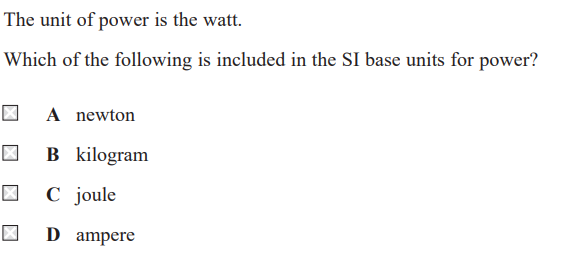


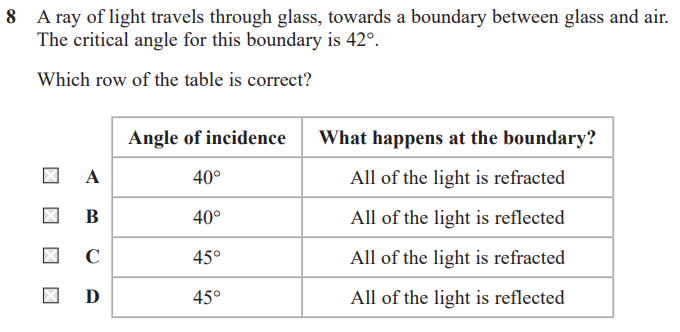
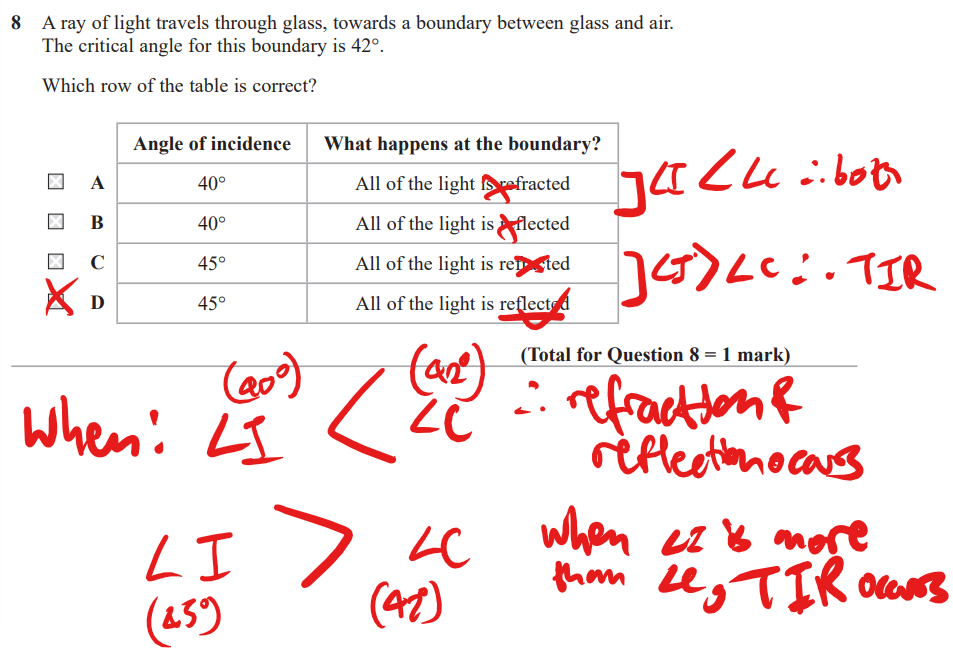
when Angle of incidence > critical angle (∠i > ∠c) = TIR
when ∠i < ∠c = refraction and some reflection
NOTE:
one wave front to another wave front is the wavelength (from the same source)

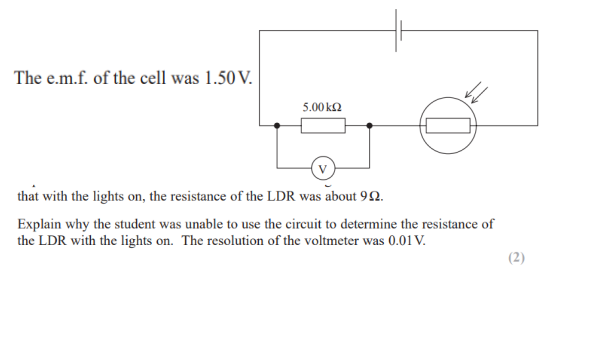
v = IR, so voltage across LDR is needed to determine LDR resistance
the voltmeter can only measure to the nearest 0.01 V, voltage is smaller than the resolution
so such a small voltage can't be measured

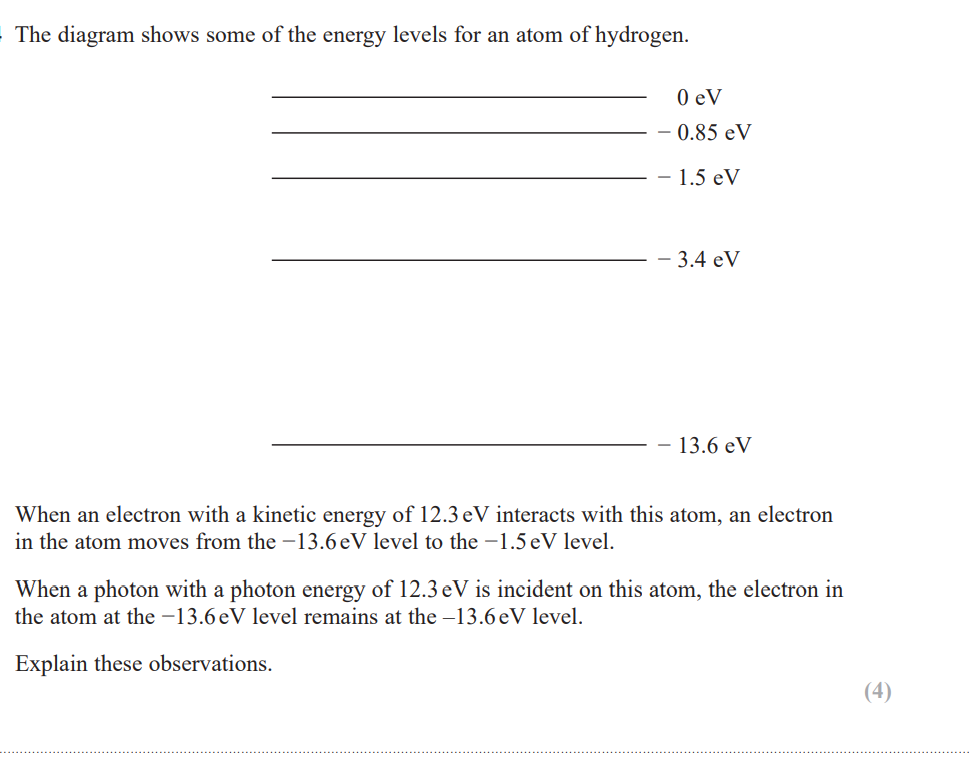
Electron collision:
- when incident electron of 12.3 eV intereacts, an electron from hydrogen atom
move from −13.6eV to −1.5eV which requires 12.1eV
- so incident electron keeps moving with the remaining 0.2eV of K.E left
Photon absorption:
- when a photon interacts with electron, it give all of their energy or none at all
(but e- as mentioned can give some amount and use the rest to move on)
- (since photon energy is 12.3eV ) there is no energy level transition equivalent to 12.3 eV
(transitions are 10.2 eV, 12.1eV etc) so electron stays at same level

define refraction
change in direction of light
due to change in speed
Describe how the teacher can demonstrate that the light from laser is plane polarised (or unpolarised)
[2 marks]
direct the light through polarising filter
the filter is rotated, if there is change in intensity = light is polarised and if
no change in intensity = light is unpolarised
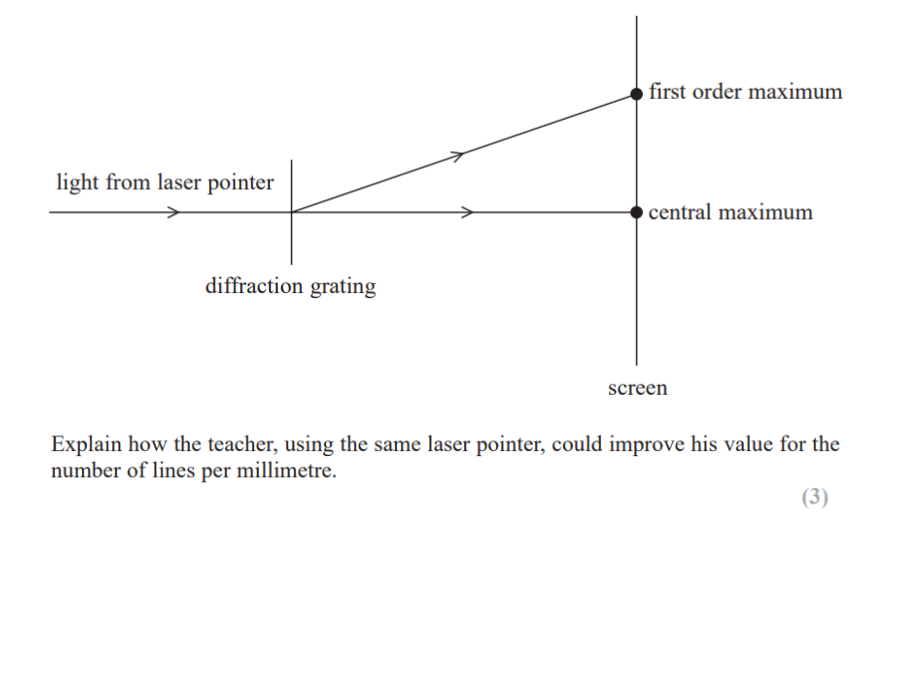
Measure the distance between the two first-order maxima on opposite sides of central maximum,
[this gives a greater measured distance]
increase distance between diffraction grating and screen
increase in measured values means percentage uncertainty is decreased


wave speed is determined solely by the medium—not by the frequency of the source.
so increasing frequenct ahs no effect other than reducing wavelennth, so speed is still same


Here a small increase in pd gave large increase in current, so it is thermistor.
ANS: D
for thermistor rate of increase of current is higher than p.d


From this graph we can see that at the centre of a compression or a rarefaction, the displacement of molecules is zero
so minimum displacement occurs at both rarefraction and compression.
ANS = C

State the purpose of the resistor in a circuit.
to limit current to avoid circuit from overheating



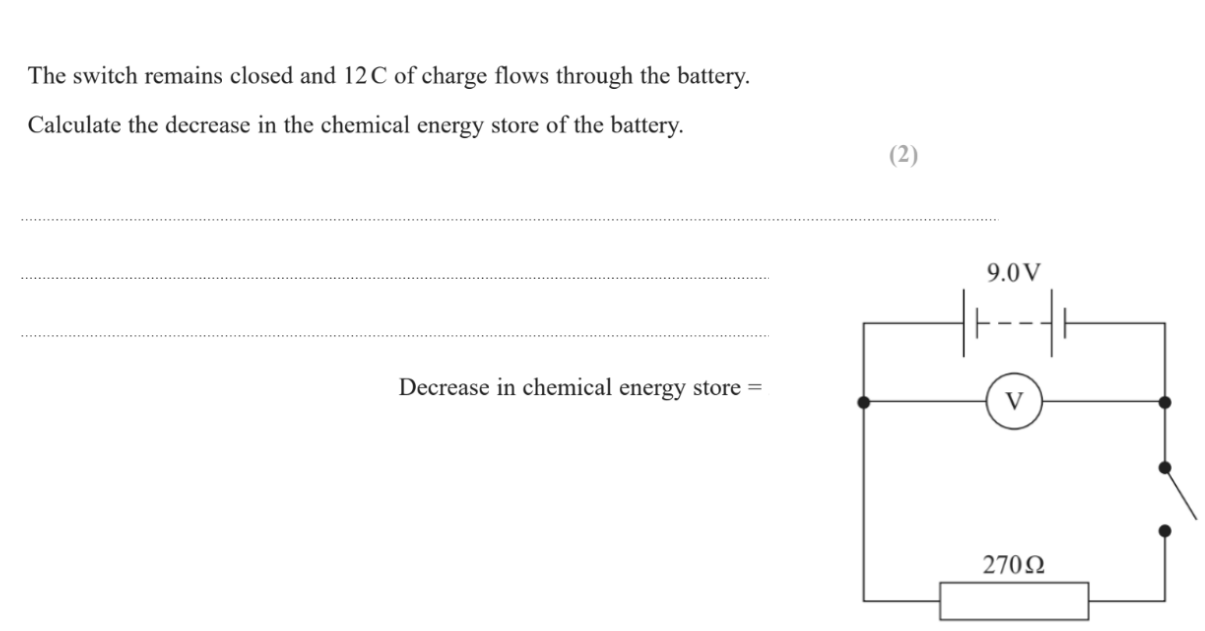
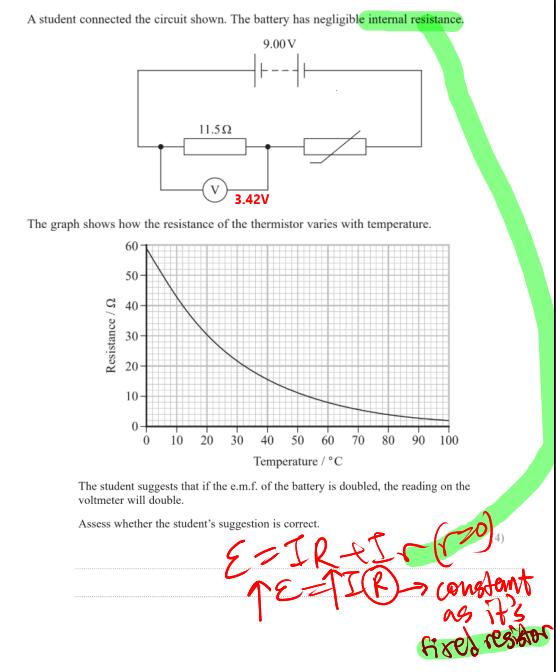
- Increased e.m.f. leads to greater current in circuit
- (more current results in more collision and heating effect)
so temperature of circuit increases
- therefore resistance across thermistor decrease so p.d across is also decreases
- thus reading on voltmeter is more than double, so student is incorrect


do not forget to label BOTH y and x axis.
( i forgot to label y axis……..)
NOTE:
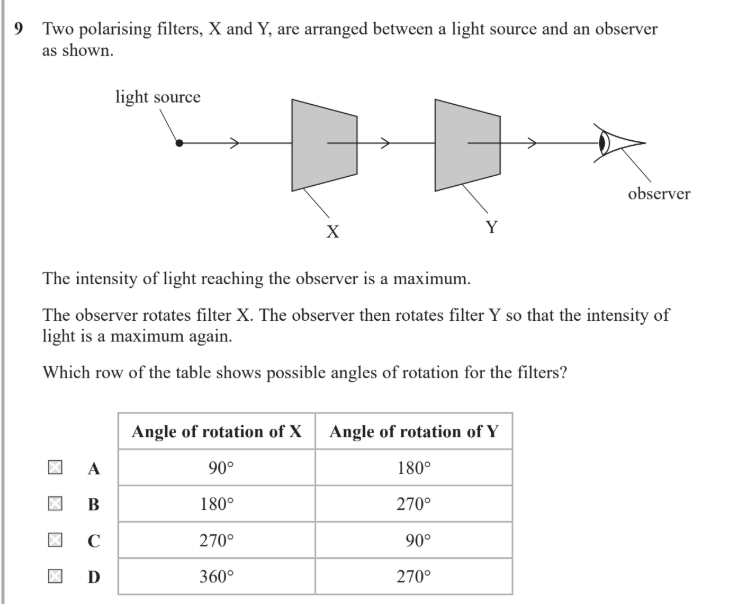
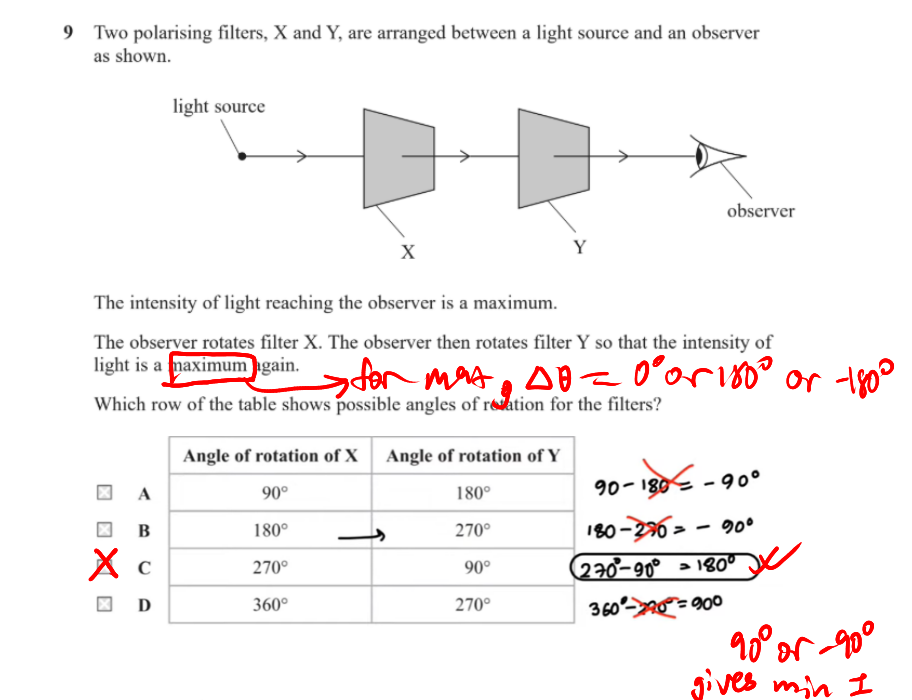
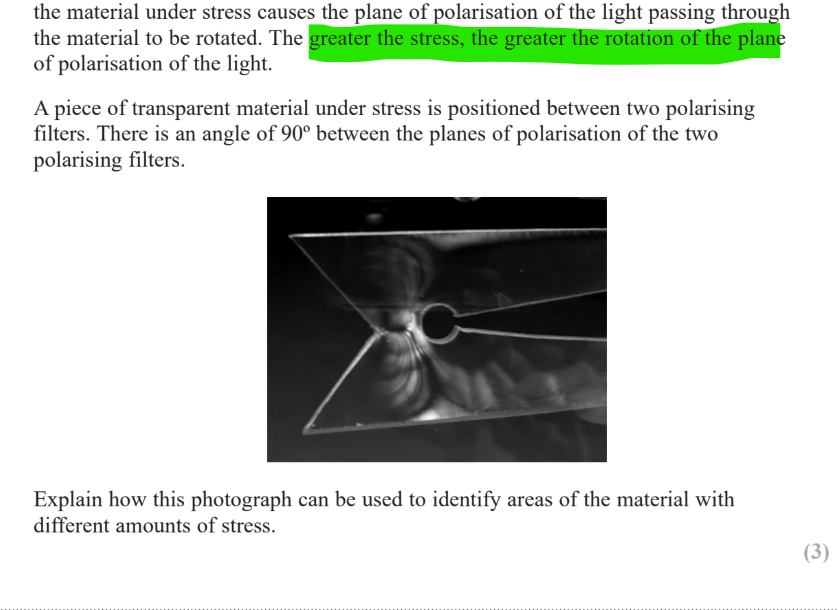
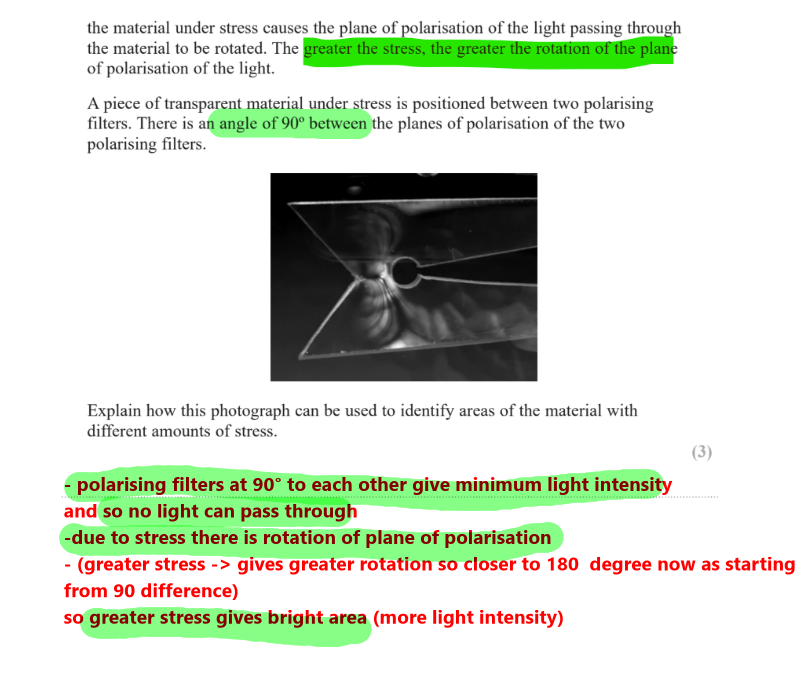
two polarizing filters are oriented with a 90° difference= minimum intensity
when two polarizing filters are oriented with a 180° or 0° difference = maximum intensity


- measure the distance of the microphone from the speaker
- peak aligns with trough, so waves in are in antiphase, so move microphone closer to speaker until waves are in antiphase again
- measure distance between initial and final position of microphone using metre rule to get wavelength
- time period is approx. 5 x the timebase of the oscilloscope
- v = (fλ) = 1/t x λ


we can see in new photo the amplitude of upper trace is greater
so the mic was bought closer to speaker
(remember closer to speaker = greater amplitude as well sound volume is greater)
intensity of sound varies with distance from loudspeaker

