Cell Biology Ch 3. Part 1 (Carbon, Functional Groups & Reaction Concepts)
 Call Kai
 Learn
Learn Practice Test
 Spaced Repetition
 Match
Match Flashcards
 Knowt Play
1/43

There's no tags or description
Looks like no tags are added yet.
Name | Mastery | Learn | Test | Matching | Spaced | Call with Kai | Chat |
|---|
No analytics yet
Send a link to your students to track their progress
44 Terms
What are Organic Compounds?
Molecules based on CARBON
Why is carbon so important?
Each carbon atom can form covalent bonds with up to 4 other atoms
An organic molecule’s structure is based on its…
Carbon skeleton
An organic molecule’s functional properties are based on the “_______ ________” attached to the carbons
Functional groups
What are the 7 Biologically-Important Functional Groups?
Hydroxyl, Carbonyl, Carboxyl, Amino, Sulfhydryl, Phosphate, Methyl
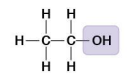
Which functional group is pictured?
Hydroxyl


Which functional group is pictured?
Carbonyl
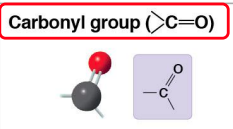

Which functional group is pictured?
Carboxyl


Which functional group is pictured?
Amino


Which functional group is pictured?
Sulfhydryl


Which functional group is pictured?
Phosphate


Which functional group is pictured?
Methyl

What do most macromolecules start out as?
Polymers
What are polymers?
Long chains of smaller molecules (monomers) linked together
What are the smaller molecules called that form polymers?
monomers
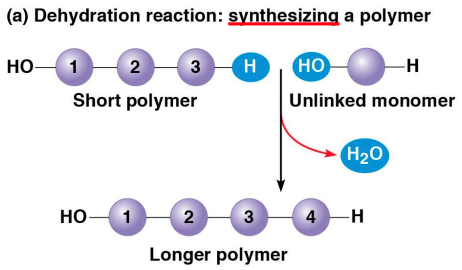
Dehydration reaction: ___________ a polymer
Synthesizing
In a dehydration reaction a covalent bond is
formed
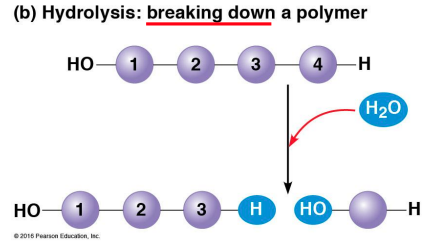
In a hydrolysis reaction a covalent bond is
broken
What are the 4 Major Classes of Biological Molecules?
Carbohydrates, Lipids, Proteins, Nucleic Acids
What are the 3 main types of carbohydrates?
Monosaccharides, Disaccharides, Polysaccharides
What are monosaccharides?
Carbohydrate- Simple sugars, direct source of cellular energy
What are disaccharides?
Carbohydrate- Double sugars, formed from two monosaccharides
What are polysaccharides?
Carbohydrate- Sugar polymers, storage of simple sugars and build cellular structures

Which carbohydrate molecular formula is pictured?
Monosaccharides
Hydroxyl groups (-OH) cause ALL sugars to be ___________
hydrophilic
Monosaccharides can be arranged into 1. _________ structures. 2. _________ and 3. ___________ are both C₆H₁₂O₆ but are slightly different in structure
different, glucose, fructose
Glucose and fructose can be bonded together to make a….
disaccharide
Disaccharides are two monosaccharide pairs linked by a _________
dehydration reaction
Glucose + Fructose = __________
Sucrose
Glucose + Galactose = __________
Lactose
Glucose + Glucose = __________
Maltose
Glucose + Glucose = __________
Maltose
This sugar (disaccharide) is produced by plants and used as table sugar.
Sucrose
This sugar (disaccharide) is produced by mammals-milk sugar.
Lactose
This sugar (disaccharide) is a product of hydrolysis of startch. It’s used in brewing beer, “malted” milk shakes.
Maltose
Polysaccharides are long, branching chains of 1. _____ _____, linked by 2. _______ _______
glucose rings, dehydration synthesis
ADD A CARD(S) FOR SLIDE 10
Starch and glycogen are ________ polysaccharides
STORAGE
Cellulose and chitin are ________ polysaccharides
STRUCTURAL
Starches are found in…
Plants, mostly in roots
Glycogen are found in…
Muscle, liver of animals
Cellulose are found in…
fibers of plant cell walls
Chitin is found in…
“hard parts” of invertebrate animals