Ch 7: Substitution and Elimination Reactions
 Call Kai
 Learn
Learn Practice Test
 Spaced Repetition
 Match
Match Flashcards
 Knowt Play
1/28

There's no tags or description
Looks like no tags are added yet.
Name | Mastery | Learn | Test | Matching | Spaced | Call with Kai | Chat |
|---|
No analytics yet
Send a link to your students to track their progress
29 Terms
intro to alkyl halides
most substrates in substitution and elimination rxn are alkyl halides
-- the substrate(reactant) will be the same
alkyl halides = alkyl chain + halogen
halogen will always be connected to an sp3 carbon

3 types of alkyl halides
1. primary alkyl halide = carbon that is connected to the halogen is only connected to 1 other carbon
2. secondary alkyl halide = carbon that is connected to the halogen is connected to 2 other carbons
2. tertiary alkyl halide = carbon that is connected to the halogen is connected to 3 other carbons
certain alkyl halides are better substrates than others
substitution + elimination reaction
transforms alkyl halides from one functional group to another

substitution reaction
= When one or more atoms replace another atom or group in a molecule
SN2
SN1
alkyl halide + nucleophile --> alkyl halide + functional group
elimination reaction
= breaking apart one molecule
E1
E2
alkyl halide + base --> alkene
leaving group
substituent that can leave as a relatively stable entity
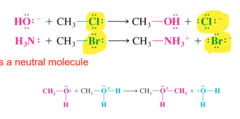
good leaving groups
= conj base of a strong acid --> stable base
Cl-
Br-
I-
H2O

bad leaving groups
= conj base of weak acids
F-
OH-
NH2-
H-
R-
(can convert bad leading groups into good leaving groups)

leaving group summary
1. the stronger the acid the weaker the conj base
2. the weaker the conj base, the better the leaving group
substitution reactions
requires:
-- loss of a leaving group
-- nucleophilic attack
1. concerted mechanism(SN2)
1. concerted mechanism(SN2)
= involves the following to occur at the same time:
-- breaking bond of the leaving group(halogen) -- forming bond to the nucleophile
1 step reaction that involves:
-- nucleophilic attack which causes --> loss of leaving group

(SN2: backside attack)
= nucleophile attacks from the backside
electron density repress the attacking nucleophile from the front side
carbons hinder the backside attack

SN2: energy diagram

SN2: nucleophilicity
strong nucleophile is needed for an SN2 rxn
-- solvent effects the nucleophile
strong nucleophile => fast SN2 rxn
-- anions = strong nucleophiles
-- polarizable atoms = good nucleophiles
-- more strong a nucleophile => more unstable => more reactive it is
(size matters when neutral)
weak nucleophile => slow SN2 rxn
MEMORIZE LIST OF STRONG NUCLEOPHILES

SN2: solvent effects
--> solvent effects nucleoiphilicity => how nucleophile reacts in SN2 reaction
SN2 need polar aprotic solvent because:
polar protic solvent = engage in H-bonding, and stabilize anionic species (such as good nucleophiles)
-- have a hydrogen atom attached to a strong electronegative atom
-- negatively. charged nuclropphiles engage
-- smaller nucleophiles are more effected
aprotic solvents = stabilize both cations and anions
-- in this solvent nucleophiles are less stable and thus more reactive => activation energy is lower => reaction is faster
--
MEMORIZE LIST OF POLAR APROTIC SOLVENT

Substitution Reaction
One group attacks and one group leaves
A leaving group ALWAYS ______
takes a pair of electrons with it
When naming alkyl halides
The halide group is the key substituent we will name and locate.
What is the alpha carbon? What are beta carbons?
Alpha: where the halide group is attached
Beta: the adjacent carbons to the alpha carbon
3 types of alkyl halides:
Primary (1º)
Secondary (2º)
Tertiary (3º)
EVERY nucleophilic substitution reaction will
involve NUCLEOPHILIC ATTACK and the LOSS OF A LEAVING GROUP, but rearrangements and proton transfer are possible
SN2 Stereospecificity
•Stereospecific (product configuration is dependent on starting material configuration): SN2 will have inversion of configuration and reaction proceeds through back-side attack because the nucleophile will encounter a node if it attacks from the front side and will not have a net bond
SN2 Kinetics
Most Reactive (fast)
Methyl, Primary, Secondary, Tertiary
due to steric hindrance
Tertiary substrates typically undergo ____
Primary substrates typically undergo ____
Secondary substrates ________
3º--> SN1
1º--> SN2
2º--> SN2 or SN1 depending on other factors
Weak nucleophiles?
F-, H2O, R-OH
Strong nucleophiles?
I-, HS-, HO-, Br-, H2S, RO-, Cl-, RSH, N(trip bond)C-
Good LG's:
I->Br->Cl->tosylate>water
Bad LG's:
HO
Some SN2 processes are accompanied with extra steps
1. Proton transfer at the beginning of SN2
2. Proton transfer at the end of SN2
3. Proton transfer before and after SN2
1. occurs when the substrate is an alcohol (OH-) (very rare in SN2 reactions)
2. also called Solvolysis--occurs when the nucleophile is neutral (water--H2O)
3. When the nucleophile is the hydronium ion (H3O+)