Exercise 13: Plant & Animal Reproduction, Meiosis, & Development
 Call Kai
 Learn
 Practice Test
 Spaced Repetition
 Match
 Flashcards
 Knowt Play
1/27

Earn XP
Description and Tags
Comprehensive vocabulary flashcards covering Spirogyra reproduction, floral anatomy, double fertilization, bean seed structure, meiosis phases, gametogenesis, early embryonic cleavage, and extraembryonic membranes.
28 Terms
Conjugation (Spirogyra)
A form of sexual reproduction in Spirogyra occurring under unfavorable or stressful conditions (such as drought, nutrient depletion, or extreme temperatures) where adjacent filaments align and exchange genetic material.
Zygospore
A thick-walled, dormant diploid (2n) structure formed by the fusion of protoplasts during conjugation in Spirogyra.
Anther
The male floral organ of the stamen that produces and stores pollen (male gametophytes).
Filament
The slender stalk of the stamen that supports the anther.
Stigma
The sticky receptive surface of the carpel (pistil) adapted to capture pollen grains.
Style
The elongated tube connecting the stigma to the ovary in a flower carpel or pistil.
Ovary (Plant)
The swollen base of the carpel containing ovules, which develops into a fruit following fertilization.
Ovule
A structure inside the plant ovary that contains the female gametophyte and matures into a seed after fertilization.
Syngamy
In angiosperm double fertilization, the union of the first haploid sperm (n) with the haploid egg cell (n) to produce a diploid zygote (2n).
Triple Fusion
In angiosperm double fertilization, the fusion of the second haploid sperm (n) with two polar nuclei (2n) to form a triploid endosperm (3n).
Hypocotyl
The embryonic stem region located below the attachment point of the cotyledons.
Epicotyl (Plumule)
The embryonic shoot and primary leaves situated above the attachment point of the cotyledons.
Synapsis
The physical pairing up of homologous chromosomes during prophase I of meiosis, forming bivalents or tetrads.
Crossing-Over
The reciprocal exchange of genetic material between non-sister chromatids of homologous chromosomes during prophase I of meiosis.
Independent Assortment
The random orientation and alignment of homologous chromosome pairs (tetrads) along the metaphase plate during metaphase I of meiosis.
Spermatogenesis
Male gamete production taking place in the seminiferous tubules of the testes from puberty throughout life, where equal cytoplasmic divisions yield four functional, motile haploid spermatozoa per primary spermatocyte.
Oogenesis
Female gamete production in the ovaries initiated during embryonic development, arrested until puberty, and completed upon fertilization, characterized by asymmetric cytokinesis yielding one large functional ovum and 2 to 3 degenerating polar bodies.
Polar Bodies
Small non-functional cells (typically 2 to 3) produced during the unequal cytoplasmic divisions of oogenesis that eventually degenerate.

Zygote
A single cell with a lifted membrane, which is the fertilization membrane

The Cleaveage Stage (2-8) cells
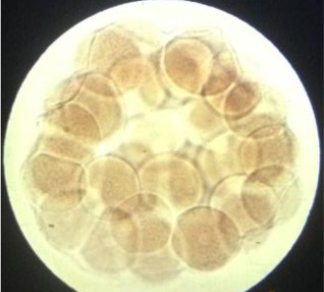
Morula
A solid, mulberry-like sphere of blastomeres produced by early cleavage divisions of the zygote without an increase in overall size.

Blastula
A hollow sphere consisting of a single layer of cells surrounding a central fluid-filled cavity (termed a blastocyst in mammals).

Gastrula
An embryonic stage formed by cell migration and invagination into the blastocoel, establishing the archenteron (primitive gut) and the three primary germ layers.
Ectoderm
The outermost primary germ layer of an embryo that gives rise to the nervous system and the epidermis.
Mesoderm
The middle primary germ layer of an embryo that develops into the muscle, skeleton, circulatory, and excretory systems.
Endoderm
The innermost primary germ layer of an embryo that differentiates into the epithelial lining of the digestive and respiratory tracts.
Larva
A juvenile form of an organism that undergoes metamorphosis to become an adult, typically differing significantly in form and function from the adult stage.
