Niche things to remember
 Call Kai
 Learn
 Practice Test
 Spaced Repetition
 Match
 Flashcards
 Knowt Play
1/29

There's no tags or description
Looks like no tags are added yet.
30 Terms
Hydrochloric acid
HCl
Hydrobromic acid
HBr
Hydroiodic acid
HI
Nitric acid
HNO3
Sulfuric acid
H2SO4
Chloric acid
HClO3
Perchloric acid
HClO4
Roman numerals
Mono = 1
Di = 2
Tri = 3
Tetra = 4
Penta = 5
Hexa. = 6
Hepta. = 7
Octa. = 8
Nona. = 9
Deca. = 10
The chargers to always remember
Remember Ag (transition metal) is always +1
Remember Cd (transition metals) is always +2
Remember Zn (transition metals) is always +2
Remember Al (transtion metal) is always +3
The roman numerals
I = +1
II = +2
III = +3
IV = +4
V = +5
VI = +6
VII = + 7
CCMAA rule for electron configuration
This is the rule for transition metals and it states that for the transition metals:
Cu
Cr
Mo
Au
Ag
the electrons in the last 3 orbitals will jump to the last d orbitals to allow it to be filed with 5 electrons or fully filled with 10 electrons (if it can’t achieve that it will not)
Valence electrons for the transition metals (3-12)
include the electrons in the outermost energy level and the closet d orbital
Exception to ionization energy
This is the amount of energy it takes for an electron to become an ion (so it is an endothermic process), and the more energy it takes the less than an electron wants to give up it’s electrons:
It increases from left to right across a period
it decreases down each period
The exceptions include
Beryllium and boron (as Beryllium has. higher ionization energy) (this is due to it’s filled 2s² orbitals adverse to borons unfilled 2p^1 orbitals, that has more energy because the p can’t penetrate as well)
Nitrogen and oxygen (nitrogen has. higher ionization energy because it configuration of 2p³ allows for less electron-electron repulsion adverse to oxygen 2p^4 allow for more electron electron repulsion)
This occurs for all the element in the 2a and 3a group
This occur for all the element in-group 5A and 6A
Valence bond theory
Remember for this theory when you are trying to figure our the hybridized for an atom, you would count both its lone pairs in the electron group, and when you are trying to find out the electron geometry (apart of the VSPER theory) you would include the loner Paris
Writing lewis structures
Remember that for writing theses Group 15, 16, 17, and 18 have the ability to have expanded octet (but only for nonmetals, and are at and below period 3)
Group 15: Can form 5 bonds (10 electrons)
Group 16: Can form 6 bond (12 electrons)
Group 17: Can form 6-7 bonds (12 - 14 electrons)
Group 18: Can form 6-7 bonds (12 - 14 electrons)
Linear (electron geometry and molecular geometry)
This would have:
2 electron groups
2 bonding groups
0 lone Paris
Its approximate bond angles would be 180

Trigonal Planar
This would have:
3 electron groups
0 lone paris (120 degrees)
Would still be trigonal planar
1 lone pair
Would be bent (<120 degrees)

Tetrahedral
This would have:
4 electron groups
0 lone paris
Tetrahedral (109.5 degrees)
4 electron groups
1 lone paris
trigonal pyramidal (< 109.5 degrees)
4 electron groups
2 lone pairs
bent ( < 109.5 degrees)

Trigonal bipyramidal
5 electron groups
0 lone groups
trigonal bipyramidal (120 degrees equatorial, 90 degree axial)
5 electron groups
1 lone pair
seesaw (< 120 degrees equatorial, <90 degrees axial)
5 electron groups
2 lone pairs
t-shaped (< 90 degrees)
5 electron groups
3 lone pairs
linear (180 degrees)

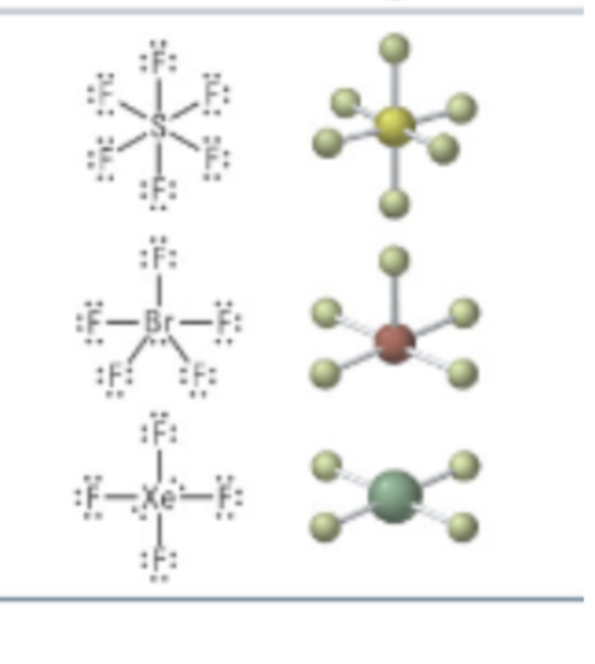
Octahedral
6 electron groups
0 lone pairs
octahedral (90 degrees)
6 electron groups
1 lone pairs
square pyramidal (less than 90 degrees)
6 electron groups
2 lone pairs
square planar (equal to 90 degrees)
Placing hydrogen in a covalent bond
Hydrogen goes first with group 16 and group 17 (except oxygen)
Hydrogen goes second with Carbon (CH) and nitrogen (NH)
hydrogen goes second with boron and silicon (BH) and (SiH)
It was always (CHO)
Bond polarity on the Pauling scale
(0 - 0.4 ) small electronegativity difference so it is still a covalent bond
(0.4 - 2.0 ) intermediate electronegativity difference, it is apolar covalent bond (with partial negative and partial positive charge)
(2.0 +) large ionic bond
Mass percent
(total mass of that compound in a given compound) / (the molar mass of the compound that we have) * 100
How to draw the structural formual
mirror lewis structures just without the lone Paris
don’t follow VESPR theory unless told to
Octet rule exceptions
helium and hydrogen form an octet
Lithium (2s^1 loses on electron to be stable) (mirror He Nobel gas)
Be (2s² loses two election to the stable) (minor the He Nobel gas)
doesn’t form a covalent bond because it is a metal
Boron (2s² 2p^1 loses three electron to mirror He Nobel gas, when it form a covalent bond it is stable with 6 valence electrons
Writing out chemical formulas
Write the cation first and then the anion (so the metal first and then the nonmetal)
The sum of the chargers have to cancel out
Remember Ag (transition metal) is always +1
Remember Cd (transition metals) is always +2
Remember Zn (transition metals) is always +2
Remember Al (transition metal) is always +3
Formula has to contain the smallest whole number ratio of ions
Writing out names for ionic compounds
Name the cation first (metal or polyatomic cation)
State the metal’s oxidation state (so the amount of electrons it has lost) as a roman numeral in parenthesis
Except Group I / II metals
Group 1 metals will always have a +1 charge (s^1)
Group 2 metals will always have a +2 charge (s^2)
Water of hydration
Water of hydration
Tells you how many water molecules are incorporated in a formula unit for an ionic compound
Name the ionic compound that add prefixes to indicate how many and then hydrate
How to name molecular compoudns
Start with the most metallic character first
So left most on the same row
Or if they are in the same group the ones that have the higher row number (so more down)
Then you would leave the first atom name unchanged
The you would change the second atom name to end in -ide
You would add prefixed to indicate the amount
DTT PHH NOD
Di
Tri
Tetra
Penta
Hexa
Hepta
Nona
Octa
Deca
You would omit Mono if included
How to write molecular chemical formula (the molecular formula)
How to write molecular chemical formula (the molecular formula)
Understand the prefixed
Understand how the metallic atom has to go first