biochem E3L6 gluconeogenesis 11/16

0.0(0)
Studied by 0 people
call kaiCall Kai
learnLearn
examPractice Test
spaced repetitionSpaced Repetition
heart puzzleMatch
flashcardsFlashcards
GameKnowt Play
Card Sorting

1/8

encourage image

There's no tags or description

Looks like no tags are added yet.

9 Terms

1
New cards

glucloneogenesis:

  1. where

  2. why do it

  3. 2 things needed

  4. what is it

    1. not just ___ =

  5. 3 bypass reactions =

    1. where liver stop?


  1. in the liver, in the cytosol

  2. brain needs glucose and the E to do gluconeogenesis can come from fatty acid synthesis or something else

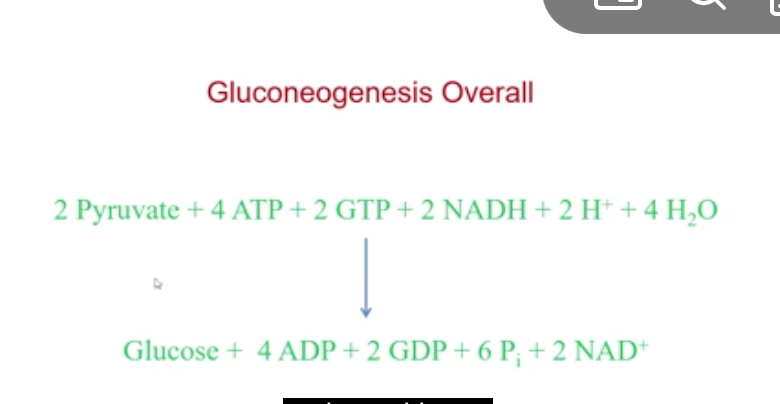
  3. need E and reducing power (2GTP then 2NADH and 4ATP to go backwards glycolysis)

  4. convert pyruvate (also amino acids and glycerol) back to glucose

    1. not just glycolysis in reverse = 3 irreversible bypass reactions

  5. 3 bypass reactions = 1, 3, 10 of glycolysis

    1. most tissues stop at bypass reaction #2 bc G6P is fine, but liver glucose to brain so it will do bypass reaction #3


<ol><li><p>in the liver, in the cytosol</p></li><li><p>brain needs glucose and the E to do gluconeogenesis can come from fatty acid synthesis or something else</p></li><li><p>need E and reducing power (2GTP then 2NADH and 4ATP to go backwards glycolysis)</p></li><li><p>convert pyruvate (also amino acids and glycerol) back to glucose </p><ol><li><p>not just glycolysis in reverse = 3 irreversible bypass reactions</p></li></ol></li><li><p>3 bypass reactions = 1, 3, 10 of glycolysis </p><ol><li><p>most tissues stop at bypass reaction #2 bc G6P is fine, but liver glucose to brain so it will do bypass reaction #3 </p></li></ol></li></ol><p></p>
2
New cards
<p>1st bypass reaction gluconeogenesis:</p><ol><li><p>what is it</p></li><li><p>reversible?’</p></li><li><p>2 step mechanism</p><ol><li><p>step 1 = what reaction</p><ol><li><p>where</p></li><li><p>purpose = </p></li></ol></li><li><p>step 2</p><ol><li><p>where</p></li></ol></li></ol></li></ol><p></p>

1st bypass reaction gluconeogenesis:

  1. what is it

  2. reversible?’

  3. 2 step mechanism

    1. step 1 = what reaction

      1. where

      2. purpose =

    2. step 2

      1. where


  1. pyruvate → PEP using ATP and GTP x 2 for 2 pyruvates

  2. irreversible

  3. step 1 = anaplerotic reaction = bicarb + pyruvate -(biotin)→ oxaloacetate using 1 ATP bc 1 pyruvate

    1. in mitochondria,

  4. step 2 = 2 Oxaloacetate -(carbokinase)→ 2 PEP using 2 GTP

    1. in cytosol, 2 GTP for 2 pyruvate


<ol><li><p>pyruvate → PEP using ATP and GTP x 2 for 2 pyruvates</p></li><li><p>irreversible</p></li><li><p>step 1 = anaplerotic reaction = bicarb + pyruvate -(biotin)→ oxaloacetate using 1 ATP bc 1 pyruvate</p><ol><li><p>in mitochondria,</p></li></ol></li><li><p>step 2 = 2 Oxaloacetate -(carbokinase)→ 2 PEP using 2 GTP</p><ol><li><p>in cytosol, 2 GTP for 2 pyruvate</p></li></ol></li></ol><p></p>
3
New cards

1st bypass reaction gluconeogenesis:

  1. equation

  2. purpose of step 1 ( ?

  3. if OAA made in mitochondria and consumed in cytosol, how does it get out of the mitochondria?

    1. 2 reasons why

  4. what makes it irreversible?


  1. in pic

  2. CO2 added during step 1 is same one removed during step 2

  3. purpose = activate pyruvate for rxn by adding good leaving group CO2

  4. OAA gets into the cytosol using the malate aspirate shuttle

    1. pyruvate carboxylase only in mitochondria, and

    2. need reducing power NADH for 1 of the bypass reactions (high in mitochondria)

  5. irreversible = quick removal of PEP makes DG negative even if DG’0 positive


<ol><li><p>in pic</p></li><li><p>CO2 added during step 1 is same one removed during step 2</p></li><li><p>purpose = activate pyruvate for rxn by adding good leaving group CO2</p></li><li><p>OAA gets into the cytosol using the malate aspirate shuttle</p><ol><li><p>pyruvate carboxylase only in mitochondria, and</p></li><li><p>need reducing power NADH for 1 of the bypass reactions (high in mitochondria)</p></li></ol></li><li><p>irreversible = quick removal of PEP makes DG negative even if DG’0 positive</p></li></ol><p></p>
4
New cards
<p>1st bypass reaction gluconeogenesis:</p><ol><li><p>starting w lactate instead of pyruvate = </p><ol><li><p>when?</p></li></ol></li><li><p>cori cycle 3 steps</p></li><li><p>how liver converting lactate to glucose?</p></li></ol><p></p>

1st bypass reaction gluconeogenesis:

  1. starting w lactate instead of pyruvate =

    1. when?

  2. cori cycle 3 steps

  3. how liver converting lactate to glucose?


  1. reducing equivalent, NADH, made in cytosol so not need for conversation of OAA to malate in the mitochondria

    1. vigorous exercise can’t provide O2 to muscle fast enough.glucose used anaerobically. lactate produced to recycle NAD+

  2. cori cycle = waste not want not

    1. lactate from muscle transported to liver

    2. liver converts lactate to glucose

    3. glucose sent into blood and ends up in muscle

  3. lactate → pyruvate → PEP → gluconeogenesis


5
New cards
<p>pyruvate carboxylase:</p><ol><li><p>anaplerotic reaction</p></li><li><p>cofactor</p></li><li><p>how like lipoate</p></li><li><p>mechanism</p><ol><li><p>site 1 = </p></li><li><p>.</p></li><li><p>site 2 = </p></li></ol></li></ol><p></p>

pyruvate carboxylase:

  1. anaplerotic reaction

  2. cofactor

  3. how like lipoate

  4. mechanism

    1. site 1 =

    2. .

    3. site 2 =


  1. adds CO2 to pyruvate to make OAA

  2. cofactor = biotin

  3. like lipoate = biotin on business end attached to lysine

  4. mechanism

    1. site 1 = use ATP to convert bicarb to activated CO2

    2. CO2 covalently attached to biotin

    3. site 2 = biotin swings to transfer CO2 to pyruvate, which reacts to give OAA


6
New cards
<p>lactic acidosis:</p><ol><li><p>why bullshit?</p></li></ol><p></p>

lactic acidosis:

  1. why bullshit?


  1. no protons are released when converting pyruvate to lactate


7
New cards

Gluconeogenesis bypass #2:

  1. reaction

  2. type of reaction

  3. reversible?


  1. Fructose 1,6 bisphosphate -(Fructose 6 phosphatase 1)→ fructose 6phosphate

    1. F16BP -(F6P-1)→ F6P

  2. simple hydrolysis

  3. irreversible


8
New cards

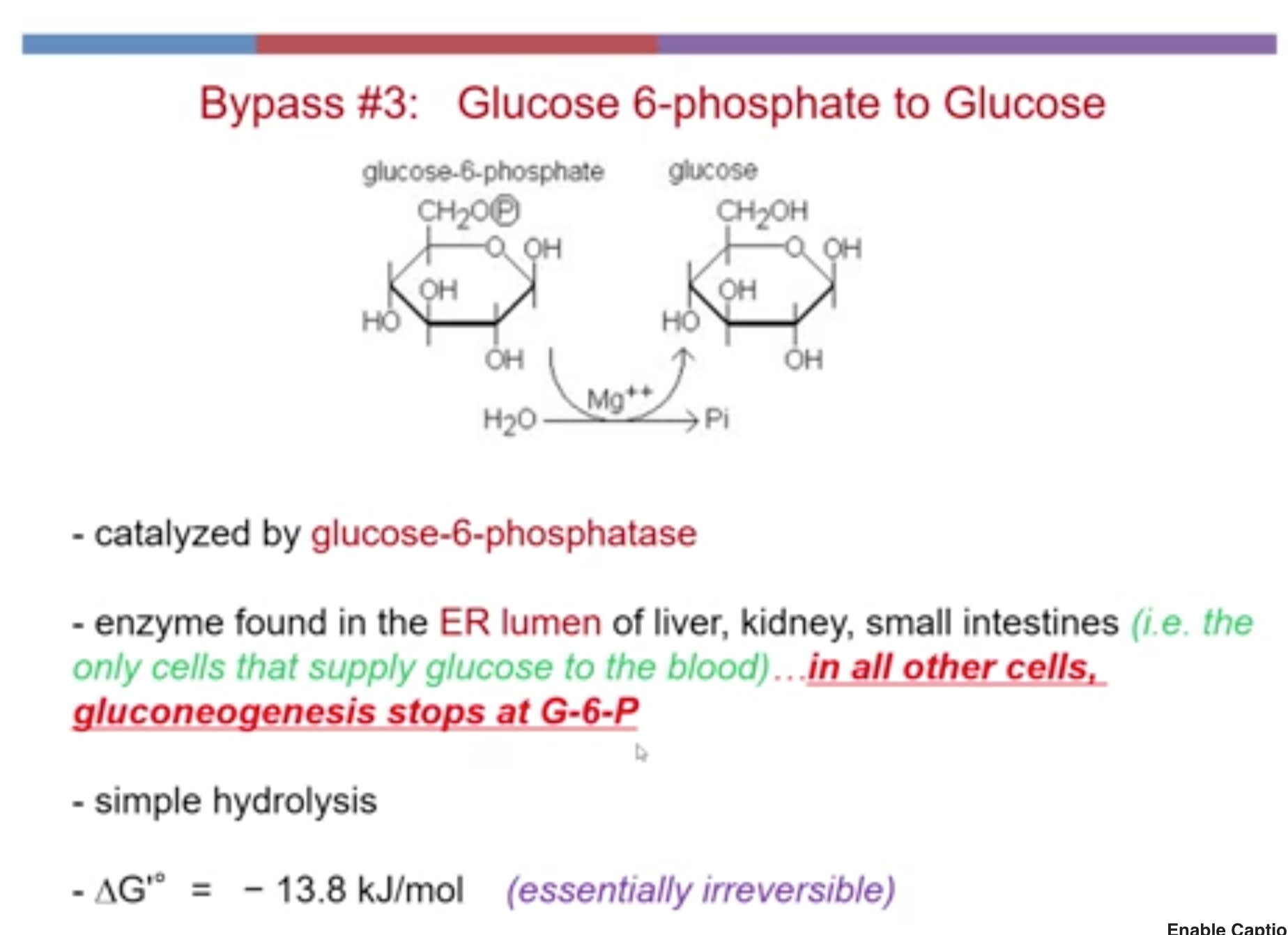
gluconeogenesis bypass #3:

  1. reaction

  2. where is this enzyme found (where does this reaction happen)


  1. glucose 6 phosphate -(glucose 6 phosphatase)→ glucose

  2. found in cells that supply glucose to the blood

    1. all other cells stops at G-6-P

  3. irreversible, simple hydrolysis


<ol><li><p>glucose 6 phosphate -(glucose 6 phosphatase)→ glucose</p></li><li><p>found in cells that supply glucose to the blood</p><ol><li><p>all other cells stops at G-6-P</p></li></ol></li><li><p>irreversible, simple hydrolysis</p></li></ol><p></p>
9
New cards

gluconeogenesis overall equation

knowt flashcard image