Exam 3 - Antipsychotics Chemistry (Jaki)
 Call Kai
 Learn
 Practice Test
 Spaced Repetition
 Match
 Flashcards
 Knowt Play
1/41

There's no tags or description
Looks like no tags are added yet.
42 Terms
Learning Objectives:
Chemically distinguish between Typical and Atypical Antipsychotics
➢ Recognize the chemical scaffold of the different groups of antipsychotics
➢ Describe the structure-activity relationships in Phenothiazines
➢ Recognize the chemical characteristics in antipsychotics that contribute to their therapeutic and/or adverse effects
➢ Describe and predict the metabolism
➢ Explain the reasons for tardive dyskinesia and agranulocytosis
What are our the different types of typical antipsychotics?
Phenothiazines (low potency)
Chlorpromazine
Thioridazine
Thioxanthenes (high potency)
Flupentixol
Thiohexane
Butyrophenones (High potency)
Haloperidol
Properidol
Penfluoridol
Miscellenous
Molindone
Loxapine
How does the structure of Chlorpromazine relate to the structure it mimics? (DOPAMINE) KNOWWWW
Chlopromazine → Dopamine antagonist at D1-4 → Antipsychotic properties
Chlorpromazine mimics the structure of DOPAMINE →
Binds to DA receptor and blocks it → Anti-dopaminergic

Which structure of chlorpromazine binds to the DA receptor? Which structure provides additional antagonistic effect?
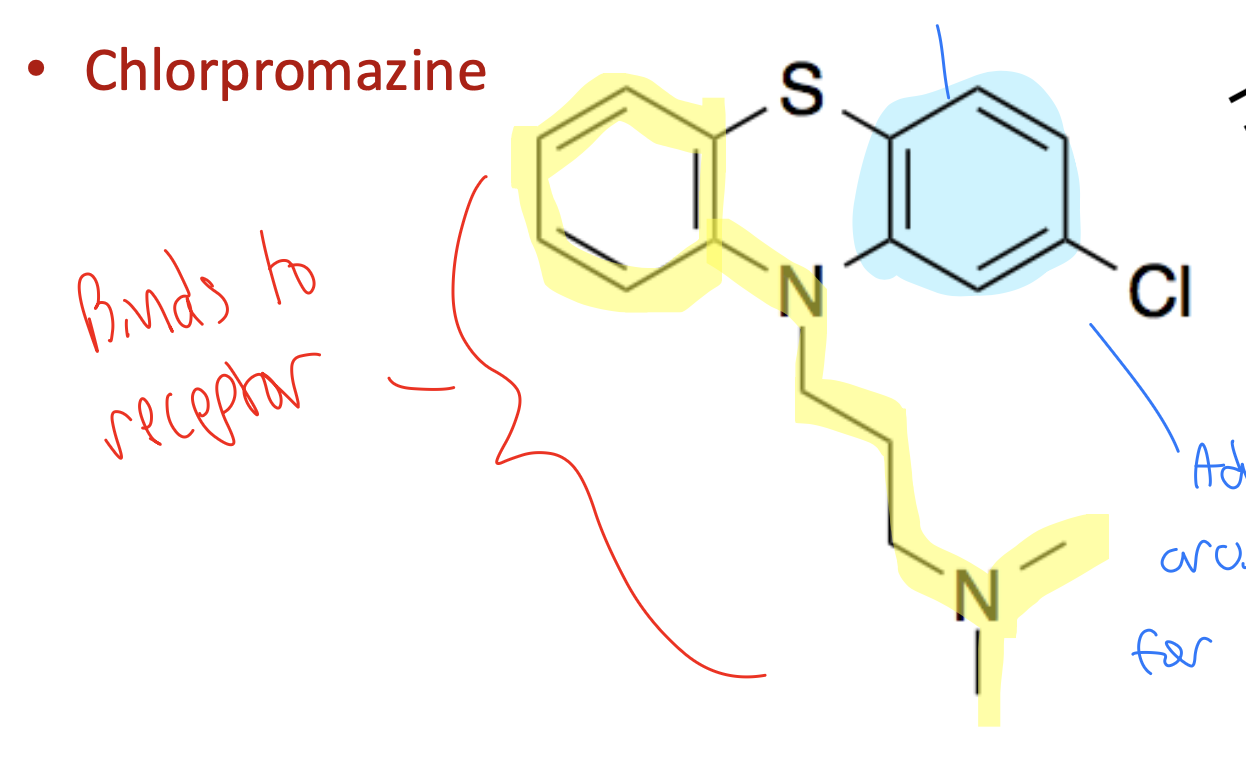
Yellow highlighted area binds to the DA receptor
Additional aromatic ring (blue) needed for antagonistic effect → pi-stacking allows tight binding to the receptor
Aromatic ring = antagonistic effect
How does the structure of Chlorpromazine relate to the structure it mimics? (histamine) KNOWWWW

Chlorpromazine mimics the structure of histamine
Binding to histamine receptor (H1): sedation, antiemetic effect, vertigo, and weight gain
Two aromatic rings → Anti-histaminic → Antagonistic effect
How does the structure of Chlorpromazine relate to the structure it mimics? (adrenaline) KNOWWWW

Chlorpromazine mimics the structure of adrenaline
Antagonism of alpha-1 and alpha-2-adrenergic receptors: sympatholytic properties, lowering BP, reflex tachy, vertigo, sedation, hypersalivation, and incontinence.
Two aromatic rings exert antagonistic effect
How does the structure of Chlorpromazine relate to the structure it mimics? (Acetylcholine) KNOWWWW

Chlorpromazine mimics the structure of acetylcholine
Binding to M1 and M2 muscarinic acetylcholine receptors: anticholinergic symptoms such as dry mouth, blurred vision, constipation, difficulty or inability to urinate, loss of memory.
How to phenothiazines get their name?


Thi - Sulfur
Azine - nitrogen
Pheno - phenyl rings
What are side-chain variations of phenothiazines?
1) Aliphatic
2) Piperidine
3) Piperazine

What do all the side-chain variations have in common?
3 carbon bridge between the two nitrogens
Ideally three because chains >3 introduce steric hindrance
Increase or decrease in length from 3 carbon decreases activity
2 carbon chains = H1 antagonistic effect but no D2 blockage
Which side-chain variation is most potent?
Piperazine
Extra N-atom introduces an additional binding site to the DA receptors

What is the function of the amino-group in phenothiazine?
Tertiary amine has MAXIMAL potency
Tertiary amines are most basic, thus, most likely to attract protons → become charged and bind to receptors
Receptors all have a negatively charged binding site and like to bind to (+) charged amines

What substituents are ideal for the terminal amine?
Methyl groups
Substituents that are larger than methyl groups decrease activity due to steric hindrance and bulkiness
What would the activity of a phenothiazine look like if the terminal amine was quaternary?
Quaternary compounds are INACTIVE
They do NOT cross the BBB
Which conformation os phenothiazines are preferred: Cis or trans?


Cis-conformation is preferred!
Electron-withdrawing group (Cl-) enhances activity
NH3 becomes protonated to NH4+ →
Electron-withdrawing group and protonated NH3 form hydrogen bonds to keep conformation in cis
This is why cis-conformation is preferred!
Looking at the potential ring substitutions, what is the order of potency from carbon 1-4?
Order: 2 > 3 > 4 > 1
Activity of phenothiazines INCREASE with electron-withdrawing power
CF3 > Cl
Multiple substitutions on the ring DECREASE activity

What impact does sulfoxidation have on phenothiazines? (Ring substitution)
Sulfoxidation DECREASES activity
Changes the conformation by flattening the ring
Why are TCAs not anti-psychotic?
Skewed ring formation due to the ethylene bridge
Which liver enzymes metabolize phenothiazines?
CYP1A2
CYP2C19
CYP2D6
CYP3A4
What are the four major CYP450-catalzyed metabolism pathways?
1) N-dealkylation (N-demethylation)
2) Sulfoxidation (to sulfoxide and sulfone)
3) Hydroxylations
4) Glucuronidation of the hydroxylated products
N-dealkylation (N-demethylation) of phenothiazine

Sulfoxidation of phenothiazine

Hydroxylations (blue) and glucuronidation of hydroxylated products of phenothiazine

De-methylated products are considered active or inactive?
ACTIVE metabolites
Sulfoxide and sulfone metabolites are considered active or inactive metabolites?
INACTIVE
They change the conformation → Ring flattened → Cannot assume the correct angle
How can we identify butyrophenones? What is a common example?
Look for the Butyro- group + phenyl ring!!!
Example: Haloperidol

Which functional group is essential for activity in Haloperidol’s structure?

A tertiary amino group on the FOURTH carbon of the butyrophenone skeleton is ESSENTIAL for antipsychotic activity
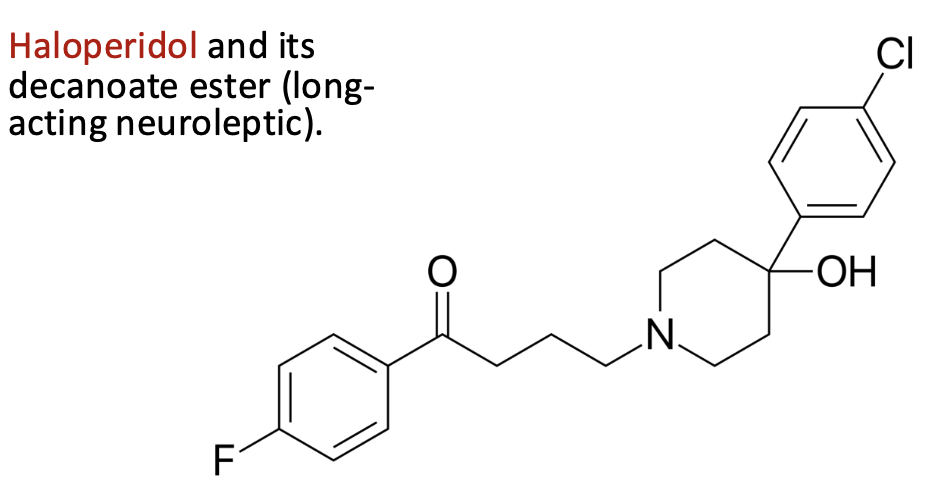
Looking at the structure of Haloperidol, why do you think it’s long acting?
Decanoate ester →
Lipophilic, nonpolar
Becomes hydrolyzed → into active metabolite
Looking at the structure of Haloperidol, what would reduce sntipsychotic activity?
Lengthening, shortening, or branching of the three-carbon propyl chain between the carbonyl and the tertiary amine functional groups drastically reduces its antipsychotic activity
Most potent butyrophenone antipsychotics have a fluorine atom in the para-position of the benzene ring. What purpose does the Fluorine group serve?
Prevents metabolic inactivation and INCREASES receptor affinity
Which enzyme oxidizes butyrophenones ?
MAO-B
Describe haloperidol-induced irreversible tardive dyskinesia
Tardive dyskinesia is a difficult-to-treat form of dyskinesia (disorder resulting in involuntary, repetitive body movements) that can be tardive (having a slow or belated onset)
Occurs after weeks-months of treatment → Long-term side effect
How haloperidol induces tardive dyskinesia:
MAO-B oxidizes butyrophenones (Haldol) →
Creates a reactive intermediate compound that covalently binds to dopamine receptors →
Covalent bond → “irrversible”
The body compensates by creating new DA receptors
these receptors are hypersensitive to DA and once they bind →
Tardive dyskinesia symptoms
How do ATYPICAL antipsychotics exert antipsychotic effect (2nd gen)?
Potent serotonin (5-HT2A) antagonism in the prefrontal cortex (this indirectly leads to dopamine release)
Serotonin modulates dopamine neurons in the prefrontal cortex
Indirect increase of DA in prefrontal cortex (mesocortical) leads to prevention/treatment of negative symptoms
Aytpical antipsych also exert dopamine antagonism in the mesolimbic pathway
Helps treat positive symptoms
Atypical antipsychotics are dibenzodiazepine derivatives: how can we identify structures of atypical antipsychotics?
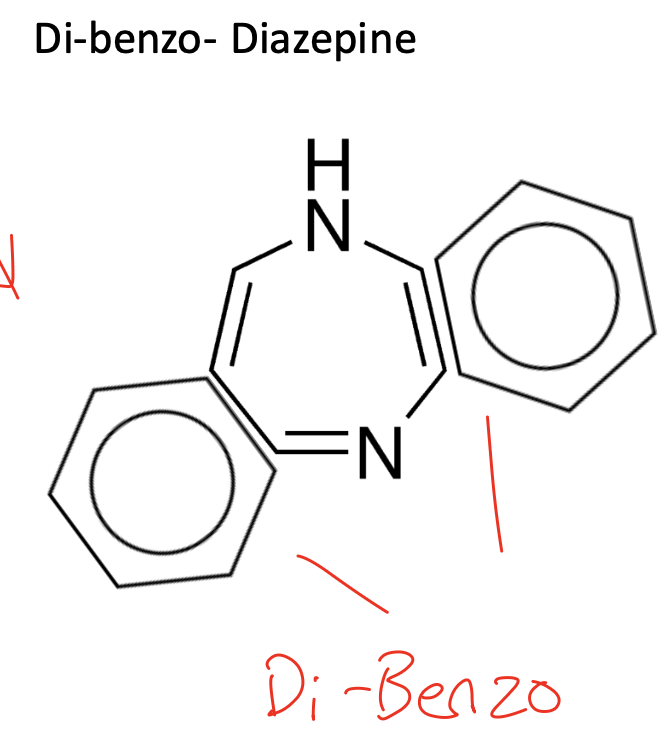
Look for the two-benzene (di-benzo) + 7-membered ring with 2 nitrogens (di-azepine) structure
What was the first atypical antipsych med marketed?
Clozapine
Unique antipsychotic properties:
➢ High antagonistic effect on serotonin 5-HT2A receptors, alpha 1-adrenergic, histamine H1, muscarinic M1
➢ Low antagonistic effect on dopamine D1 and D2
What is one acute condition (adverse effect) that can caused by atypical antipsychotics? (i.e. Clozapine)
Agranulocytosis
Acute condition involving a severe and dangerous leukopenia (lowered white blood cell count), most commonly of neutrophils, causing a neutropenia in the circulating blood.
It represents a severe lack of one major class of infection-fighting white blood cells.
People with this condition are at very high risk of serious infections due to their suppressed immune system.
Describe Clozapine-induced agranulocytosis:
Clozapine can be broken down into a nitrenium ion
This is a super reactive compound that covalently binds to neutrophils → Immune suppression
What is an advantage of Olanzapine over Clozapine?
Olanzapine does NOT induce agranulocytosis
→ I is highly electronegative (sulfur), therefore, does not bind to neutrophils

In addition:
Olanzapine is a more potent antagonist at dopamine D2 and serotonin 5-HT2A receptors.
What is an example of a dibenzothiazepine? How can we identify this compound?
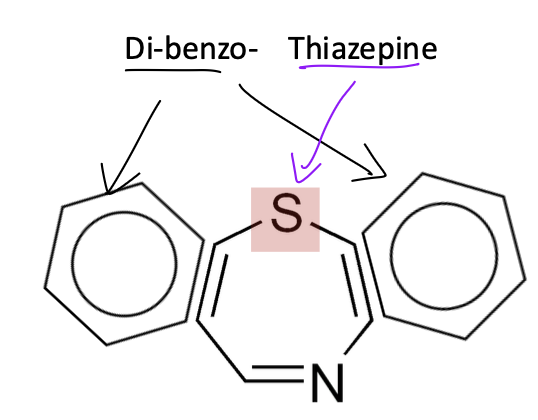

Quetiapine!!!
Look for di-benzo (two benzene) + thiazepine (7-membered ring containing sulfur)
Thi- = sulfur
What is the MOA of quetiapine?
Quetiapine
Modest antagonism on the D2 and a higher on the 5-HT2A receptors
It also has a greater binding affinity for a1-adrenergic, histamine H1, but weak muscarinic M1 antagonist activity
What is an example of a quinoline derivative antipsychotic medication? How can we identify these structures?
Aripiprazole!!! (3rd gen)


What is the MOA of aripirazole?
D2 receptor partial agonist (lower intrinsic activity than dopamine) →
Lowering dopaminergic neurotransmission in mesolimbic pathway and enhancing dopaminergic activity in mesocortial pathway, decreasing EPS due to D2 blockade → Mild anti-dopaminergic effect
➢ 5-HT2A antagonist
➢ 5-HT1A partial agonist (this action at the auto-receptors) → Increased antiserotonergic effect
➢ minimal affinity for alpha1-adrenergic, H1 and M1 receptors.