Exam 1 - Methods of behavioral change
 Call Kai
 Learn
 Practice Test
 Spaced Repetition
 Match
 Flashcards
 Knowt Play
1/57

There's no tags or description
Looks like no tags are added yet.
58 Terms
How many waves of behavior change were there?
There were 3
First generation - 1950s
Second generation
Third generation - 1990s
What was the first generation of behavior change characterized by?
Classical Conditioning
Operant conditioning
What was the second generation of behavior change characterized by?
Negative thoughts, images, feelings & beliefs seen as undesired/maladaptive behavior
CBT to modify cognitions constructively
CBT had the most evidence for effectiveness in many psychological problems
What was the third generation of behavior change characterized by?
Accept negative cognitions AND pursue your valued goals
Be present-oriented, nonjudgmental awareness of bodily states
Psychological flexibility – bigger range of coping strategies
Built on the 1st and 2nd generation waves
Acceptance and Commitment Therapy (ACT), Dialectical Behaviour Therapy (DBT), and
Mindfulness-based therapies
What is a behavioural intervention?
modify target behaviours by directly influencing their controlling conditions
What is a cognitive intervention?
Modification of the client’s cognitions as the target in order to then influence behaviours.
What was the third generation’s approach to behavior change?
learn mindfulness techniques
radical acceptance
What is the current behavior change approach?
combines
behavioural interventions
cognitive interventions
3rd generation approaches
to be the most efficacious
What is the problem-solving framework?
Intake: Develop a collaborative relationship w/client (w/ active participation of client)
Behavioral assessment: Assess problem, develop hypothesis, control conditions (antecedents, consequences)
Goal setting: Formulate behavior change goals (target behavior has to be measurable)
Intervention planning: Design an individualized plan (evidence-based, culturally aware, ethically sound)
Implementation: Implement behavior change program
Evaluation: Monitor and evaluate effects of the program
Generalization and maintenance of the program
What is the empowerement approach to behavioral change?
People should not be forced to change
They should be inspired to change
Avoiding doing change through fear and authority
Why is behavior change harder than we think?
Not everyone wants to change
May prefer familiarity
Growth threatens identity
Comfort can be addictive
Change can be scary and painful etc.
What is overt behavior and what is covert behavior?
overt behaviors, behavior you can see (cleaning, sleep habits etc.)
covert, behavior you cannot see (non-observable behaviors like spiralling, anxiety) etc.
Define “Behavior therapy”
A psychological treatment approach that focuses on changing maladaptive behaviours by applying principles of learning, such as conditioning and reinforcement.
Define “Behavior modification”
A systematic application of learning principles, especially reinforcement and punishment, to increase desirable behaviours and decrease undesirable ones.
Define “CBT”
A form of psychotherapy that helps people identify and change negative thoughts and beliefs that influence emotions and behaviours.
Define “Social Learning Theory”
A theory developed by Albert Bandura that states people learn behaviours by observing and imitating others, as well as through direct experience.
Define “ABA”
A scientific approach that applies principles of learning and behaviour to improve socially significant behaviours and reduce problematic behaviours.
What are the four principles of the Canadian Code of Ethics Principles?
Respect for the Dignity of Persons and Peoples
Responsible Caring
Integrity in Relationships
Responsibility to Society
What are the ABA intervention approaches?
Uses operant conditioning principles (reinforcement, punishment, rewards) to improve socially significant behaviours.
Focuses on shaping behaviours that help individuals meet social expectations and function effectively within their environment.
Progress is measured through observable, measurable behaviours, often using small, gradual steps toward meaningful goals.
What are some ethical concerns of behavioral change?
Coercion and behaviour control
Neurotypical standards vs. neurodiversity
Masking and impact on identity
Who decides what is "acceptable" behaviour?
Balancing adaptation with individual wellbeing
What are the typical target behaviors in ASD?
General Identity Target
Stim Target
Special Interest Target
Social Skill Target
Developmental/Language/Life Skill Targets
Immediate Danger/Self-harm Target
What are potential side effects of ABA?
Higher levels of PTSD
Correlation between masking & suicidality
May assume behaviors are due to ASD but miss functional analysis pieces
Social and developmental skills may emerge overtime in atypical ways
Why is ABA most common?
Often only treatment offered by medical personnel
Standard treatment for students in schools for 25 hours per week
Government endorses ABA, and pays for treatment
Only treatment covered by insurance, financial burden on parents if use alterative treatment
Even though they have decisional authority, they still need to consider their child’s autonomy-related interests
Do the benefits > compromises?
Why are covert behaviors harder to measure
Cannot be seen
Often relying on self report measures
Makes them less efficient for children since report would not be accurate
What are the four types of behavior changes?
Newly developed: A behavior that never happened before which we went to start engaging in
Ex: You want to start going to the gym once a week
Increased/strengthened: Behaviors that we want to increase or strenghten
Ex: You want to increase the time we are studying
Maintained at a certain rate/pattern: Behavior that is staying the same, that you woud like to keep engaging in consistently
Ex: You started going to the gym and you’d like to keep going consistently
Decreased/Weakened/Suppressed: Behaviors we want to engage in less, that we want to decrease
Ex: You want to reduce your screen usage
How is response strength measured?
Rate: frequency, how many times we do the behavior, it is “frequency/time”
Duration: How long?
Intensity: How severe?
Response Strength = rate + duration + intensity

Typically, how much baseline data do we want to collect?
About 2 weeks
Can help notice patterns
Can help getting more realistic and accurate data on the behavior we want to change
Define “Stimuli”
Can be an object, event, environment or behavior
Can come before or after a response
Can be unconditioned (primary) or conditioned (secondary)
Define “classical conditioning”
A stimulus precedes and elicits a response.

Define “operant conditioning”
Operant conditioning: A consequence follows a response and changes the future likelihood of that response.
Reinforcers: Increase the future frequency or likelihood of a response.
Punishers: Decrease the future frequency or likelihood of a response.

Define “Reinforcement” “Punishment” “Positive” & “Negative”

Explained how positive reinforcers work
“Positive” in this sense means that a stimulus is added in order to increase the response (either in rate, or in intensity etc.)
“R” refer to the primary stimuli
This means it is contingent
“R” must happen for “r” to be received
“r” secondary (or conditioned) stimuli
This means “r” is a consequence
It is the positive reinforcer that increases the response
ex:
R= homework completed
S= Praise
r= does homework more diligently
What is the difference between an unconditioned (natural) reinforcer & a conditioned reinforcer?
Unconditioned “Natural” Reinforcers
Tend to be more based on human needs
Food, water, sex, tactile stimulation
Conditioned reinforcers
Tend to be in association with other reinforcers
Money, praise, tokens
What is an operant behavior?
Behavior that is controlled by its consequences
Ex: positive reinforcement
Individual acts on the environment to produce consequences
Also called instrumental learning
Stimulus/Stimuli is neutral until we can prove that adding that consequence has led to increasing the response overtime
What is an unpleasant positive reinforcer?
Undesired behavior accidentally reinforced with unpleasant positive reinforcers
Attention is attention, positive or negative
Say a child throws a tantrum, giving them attention may unintentionally reinforce the behavior
Positive reinforcement has to happen as a consequence; cannot offer them something to stop (bribery) or you will be reinforcing the negative behavior at the beginning rather than the stopping
Define “rewards”
It is important to note:
All rewards are positive reinforcers but not all positive reinforcers are rewards
For a positive reinforcer to be a reward, it has to be a pleasant reinforcer rather than an unpleasant reinforcer
We also have to carefully distinguish between “rewards” & “bribery”
Bribery happens in response to the challenging behavior
Say a child has a tantrum
You give them a cookie on the condition they stop
You may reinforce the behavior “throwing a tantrum” rather than quieting down
You have to clearly communicate a consistent reward schedule based on the behavior rather than negotiate on the spot
How do we assess reinforcer effectiveness?
In order for a reinforcer to be effective we need:
For the reinforcer to be close to the response
In younger children, it is important it is close and with age, the delay can be longer
Ex: You made it to class, you can rewards yourself with a coffee a few hours after
It has to be some sort of a stimuli which they cannot access easily or frequently
The positive reinforcer has to match the behavioral demand
Ex: REB thinking about what your time is worth to compensate you approrpiately
How to identify potential reinforcers?
Free choice
Examine past reinforcers
Complete a reinforcement survey
What is the difference between internal and external positive reinforcers
Internal (self-administered)
Self-talk, completion of a task, satisfied from their work/performance
External (tangible or social demonstrations of their worth)
Points, privileges, praise, tangible positive reinforcers
Approval from others
How do you assess the effect of a potential positive reinforcer
Assess baseline, track target behavior for a week
Track the same way after doing intervention
Define extinction
Decrease strength of response (frequency)
Fully extinguished = 0
Prespecified rate
Baseline rate (rate prior to intervention)
Systematically withhold previously positively reinforced consequences
Contingency discontinued

What is single-subject evaluation?
This design has several names, but the professor generally uses the book’s heading: single-subject evaluation.
In an A-B-A-B design:
A = extinction or baseline condition
B = reinforcement or intervention condition
Repeatedly alternating between A and B provides strong evidence that the intervention caused the change in behavior.
Although A-B-A-B is a strong demonstration of experimental control, it is not always appropriate in therapy:
We are often satisfied when behavior improves from B to A.
We should not withdraw an effective intervention for dangerous behaviors, such as headbanging or self-harm, simply to demonstrate that the intervention worked.
What is a multiple baseline design
Multiple behaviors can be targeted within the same evaluation.
The key is to measure the baseline of each behavior simultaneously before introducing the intervention.
What is the application of extinction for undersired behaviors?
Determine the baseline rate.
Conduct an assessment to identify the maintaining reinforcer.
Implement the A-B-A-B design.
Reassess the behavior.
Replicate the A-B-A-B sequence.
Reassess again.
What is active ignoring?
Stay silent, avert your eyes
Keep facial expression neutral
Do not communicate anything with your body language/non-verbal language
Leave area of the child, go to other side of the room
Praise once behavior becomes appropriate
What is the key to extinction?
Consistently withhold positive reinforcement to avoid behavior being reinstated even briefly
This is because that would make the behavior harder to extinguish in the future
You must also prevent others from delivering positive reinforcement
What is differential reinforcement?
xtinction and positive reinforcement usually work together when designing an intervention:
Extinguish the undesired behavior.
Reinforce a desired replacement behavior.
A common mistake is trying to extinguish a behavior without providing an alternative.
For example, rather than simply trying to eliminate alcohol use, a person might replace it with social activities, clubs, or other rewarding experiences.
Using extinction and reinforcement together is called differential reinforcement.
What is spontaneous recovery
A behavior may reappear even after it has been extinguished.
This can happen when the person encounters a similar situation or context in which the behavior was previously reinforced.
What is a response class?
Reponse class = class or grouping of very similar behaviors
The idea is that we may reinforce one behavior and the other one may come along with it
When working with response class we would use differentiation to avoid reinforcing undesired behaviors as a “side effect” of positively reinforcing a desired behavior in the same response class
What is DRO?
Differential Reinforcement of Other (DRO)
Reinforce any behavior other than an undesired behavior
Often used with self-harming behaviors
Replacing this behavior by anything is better than having the self-harming behavior
Downside: Hard to manage what you are reinforcing, feels like wack-a-mole, you are differentially reinforcing anything else and more undersired behaviors pop up
What is DRI
Reinforce a behavior that would make it incompatible to engage in the undesired behaviors
If you are pulling on hoodie strings, your hands are occupied so you cannot pull at your hair
What are the different types of differential reinforcement
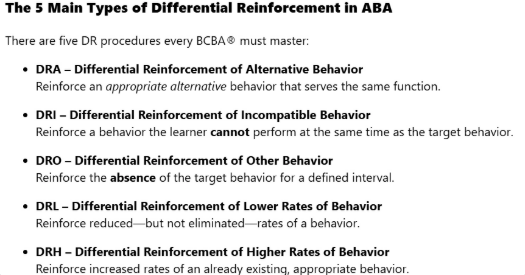
What is shaping?
Shaping develops a new behavior by reinforcing successive approximations of the target response.
Begin with a response that already occurs, even if it is only loosely related to the target.
Gradually raise the criterion: reinforce closer and closer approximations while earlier approximations no longer receive reinforcement.
Shaping is especially useful when the target behavior rarely occurs or is not yet in the person’s repertoire.
Why do we use shaping for selective mutism?
Shaping can build communication gradually by reinforcing low-anxiety approximations first, such as eye contact, gestures, nonverbal responses, whispering, or speaking with a trusted person.
Progressively generalize the response across people, places, and louder forms of speech; avoid forcing speech or reinforcing distress.
What are the steps of shaping?
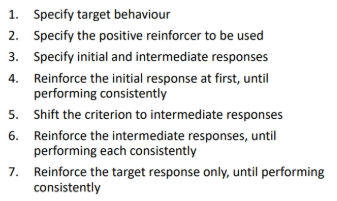
What are some effective shaping strategies?
Instructions and prompting can be used at every stage; fade prompts as the person becomes more independent.
Demonstration and modeling are useful when the learner benefits from seeing the response.
Physical guidance may be used when appropriate, with consent and attention to safety.
Consequences such as punishment should be used cautiously and only when appropriate; reinforcement remains the central shaping strategy.
What are discriminative stimuli/discrimination training?
Type of antecedents that impacts the performance of a response
SD sets the occasion for a response to be reinforced, increases the strength
SΔ does not set the occasion for a response to be reinforced, extinguishes the strength
What are the ABC’s of behaviors
ABC
Antecedent
Behavior
Consequence