Dislocations and Strengthening
 Call Kai
 Learn
 Practice Test
 Spaced Repetition
 Match
 Flashcards
 Knowt Play
1/19

There's no tags or description
Looks like no tags are added yet.
20 Terms
How do all plastic deformations occur?
Shear stresses
Dislocation Glide
Must apply sufficient stress to break a line of bonds
Think caterpillar moving
Which plane has the highest atomic packing density in an FCC metal?
{1 1 1} planes
Which plane has the highest atomic packing density in an BCC metal?
{1 1 0} planes
Slip Planes
Crystalline planes with the highest real packing density
Slip Directions
Crystalline planes with the highest linear packing density
Where do dislocation glide occur?
Along the path of least resistance!
Dislocations want to make the shortest hop to break & reform bonds
Slip Systems
The greater the number of unique slip systems in a material, the easier it is to plastically deform
What must be true to be counted as a unique slip system?
Slip planes must not be parallel and slip direction must not be collinear
FCC Slip systems/directions and properties
{111} <110>; 12 slip systems
Most ductile
Close-packed
intersect in 3d
BCC Slip systems/directions and properties
{110} <111>; {112} <111>; {123} <111> 48 slip systems
not close-packed
still has a lot, but each one is worse
HCP Slip systems/directions and properties
{0001}; <1000>; 3 slip systems
Least ductile
Close-packed, but only 3
does NOT intersect in 3d
Method to find Burgers vector
Identify the defect
Draw a clockwise square/rectangle around the defect
Parallel sides must have equal lengths
You will find that the loop does not close (weird! A square
with equal sides “should” be a closed shape!)
This gap is due to the dislocation, and the vector required
to close the loop is the Burgers vector.
How can we strengthen crystalline solids? (3)
impeding dislocation glide increases yield strength
Enhancing dislocation glide improves ductility
We can use processing/structural changed to make dislocation motion more difficult
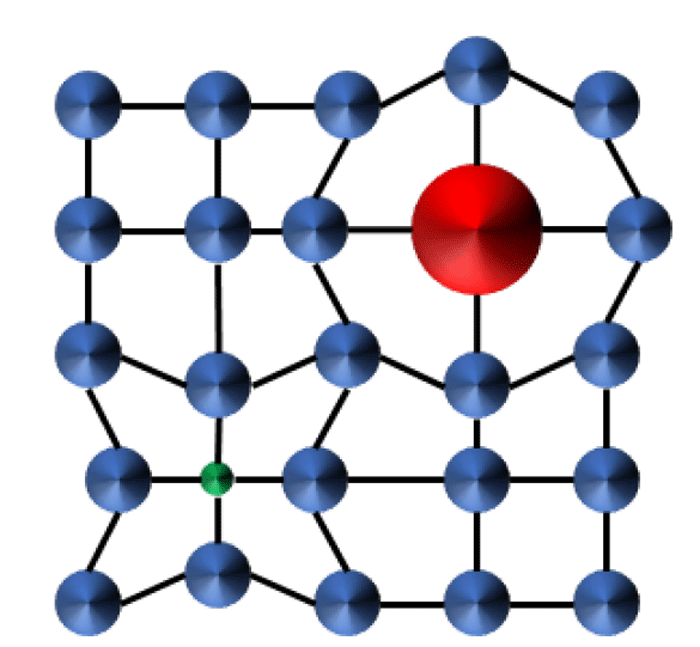
Solution Hardening
Adds point defects
Impurities impose strain on the crystal lattice, making it harder for dislocations to move
Precipitation Hardening
Adds volume defects
Two mechanisms for a dislocation to “get around” a precipitate/inclusion
Mechanism 1: Cutting
Easier when precipitates are small
Mechanism 2: Bowing
Easier when precipitates are large
Dislocation will take the path of least resistance, leading to a maximum strengthening at a critical radius
Work Hardening
Adds line defects
metals become harder and stronger as they are plastically deformed
As dislocations move during plastic deformation, they become pinned or tangled, which stops further movement
Plastic deformation also increases the number of dislocations

Grains
A single crystal of a material oriented in an arbitrary direction
Grain Boundary Hardening — Hall - Petch
Adds planar defects
Grain boundaries impede the movement of dislocations
Smaller grains → more grain boundaries → less dislocation movement → increased strength
Total Yield Strength of Crystalline Materials
T_y = T_lattice + T_ss + T_ppt + T_dislocations + T_gb