Ch.2 Extensions to Mendel's laws
 Call Kai
 Learn
Learn Practice Test
 Spaced Repetition
 Match
Match Flashcards
 Knowt Play
1/33

There's no tags or description
Looks like no tags are added yet.
Name | Mastery | Learn | Test | Matching | Spaced | Call with Kai | Chat |
|---|
No analytics yet
Send a link to your students to track their progress
34 Terms
How can crosses of pure breeding results in different progeny phenos? (4)
No definitively dominant or recessive allele
More than two alleles exist
Multiple genes involved
Gene-environment interactions
Extensions to Mendel for single-gene inheritance (3)
Dominance is not always complete
Incomplete dominance + Codominance
A gene may have >2 alleles
Pleiotropy
Pleiotropy
one gene may contribute to several characteristics
Recessive lethal alleles
Delayed lethality
Complete dominance
Hybrid resembles one of the two parents
Incomplete dominance
Hybrid resembles neither parent
EX: pink flower color in snapdragons (cross of pure red + white = pink)
Codominance
Hybrid shows traits from both parents
EX: Spotted (CSCS) x dotted (CDCD)
F1: all spotted (CSCD)
F2: 1:2:1 ratio

Gene I
Codominance
controls the type of sugar polymer on surface of RBCs
IA and IB (6 genotypes produce 4 blood phenos)
5 alleles for C gene (D to R)
Marbled-1 is the most dominant > Marbled-2 > spotted = dotted > clear

Allele Frequency
the percentage of the total number of gene copies for one allele in a population
Most common: wild-type (+) allele
1 common = monomorphic vs 1+ = polymorphic
Rare allele: mutant/variant
Pleiotropy
the phenomenon of a single gene determining several distinct and seemingly unrelated characteristics (pleio=many, trophic=effect)
EX: Kartagener’s syndrome
recessive lethal alleles
two copies of the mutant allele required for the lethal phenotype
dominant lethal alleles
only one copy of the mutant allele required for the lethal phenotype
Lethality
Before birth: death
Midlife: genetic disorder
EX: Huntington’s disease (if midlife risk passing to children unknown)
Novel phenotypes
Can result from gene interactions
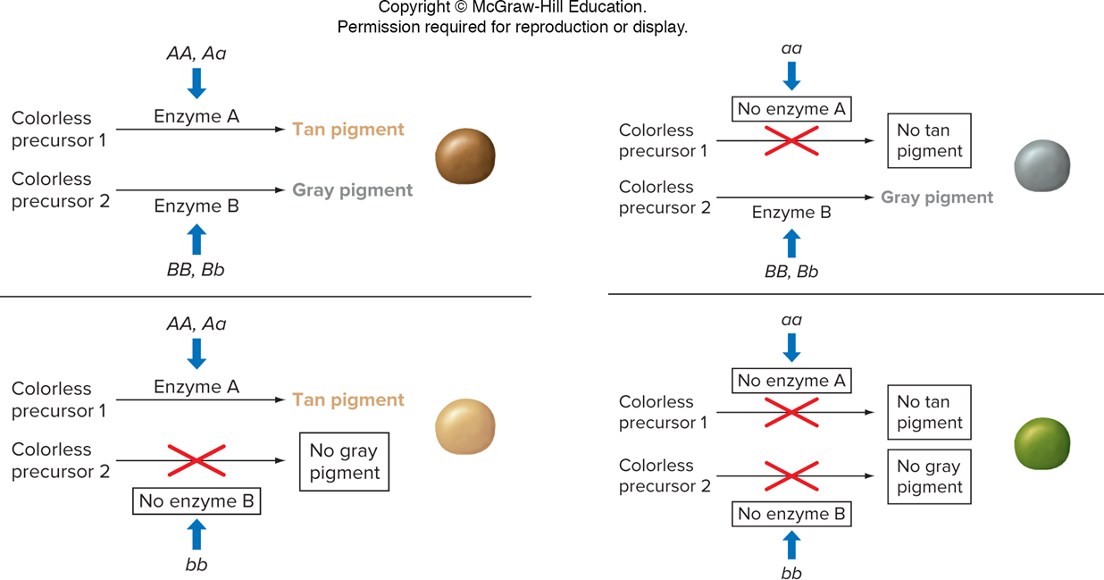
EX: Additive gene interaction affects seed coat in lentils
tan + gray = brown
no tan or gray = green
Epistasis
when an allele at one gene masks the phenotype of alleles at another gene
Recessive, Reciprocal Recessive, Dominant
Hypostatic
gene that is masked
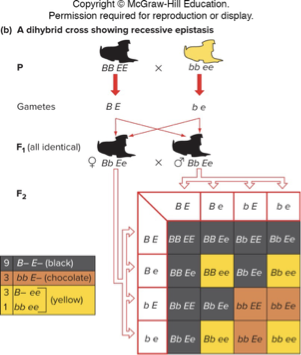
Recessive Epistasis
9:3:4 ratio F2
Two copies of one allele needed to mask the other gene
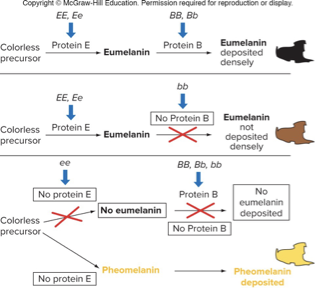
EX: coat color in labs
Recessive allele ee of gene E is epistatic to B and determines yellow (yellow has no eumelanin)
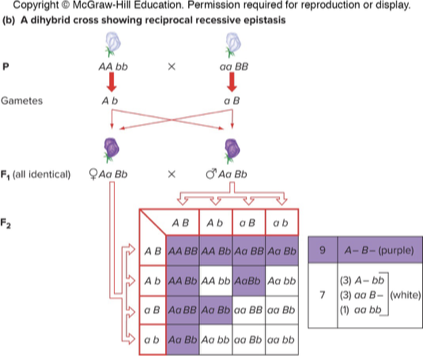
Reciprocal Recessive
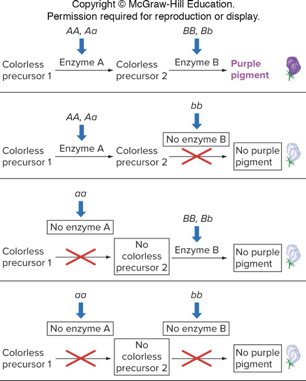
9:7 ratio F2
Two copies of each gene can mask the dominant allele of the other gene
EX: Purple F1 progeny are produced by crosses of two pure-breeding white lines

Dominant epistasis
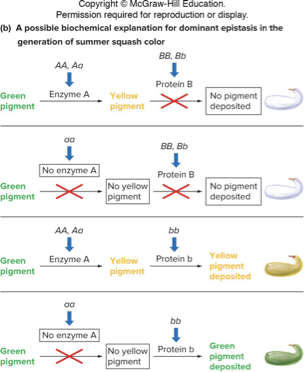
12:3:1 ratio F2
One copy of an allele masks the other gene
EX: summer squad, Dominant B allele is epistatic to any A alleles
Protein B is a dominant allele that prevents pigment deposition
Recessive epistasis in blood type
Gene for substance H is epistatic to the ABO gene
hh = type O
Parents with type O can have type A/B if child doesnt have hh

Redundant genes
15:1 ratio
EX: Control leaf development in maize
Must be homozygous recessive for both A and B = SKINNY (aa bb)

Locus heterogeneity
mutations in 2 or more genes cause the same phenotype
What causes “continous” traits (3)
Incomplete dominance, codominance for multiple genes controlling a single trait
Various combinations of genetic interactions
Environmental effects
Heterogeneous traits
have the same phenotype but are caused by mutations in different genes
EX: deafnesss can be caused by ~50 diff genes
Complementation testing
Cross two mutant strains with the same phenotype
Wild-type = complementation = mut in diff genes
Mutant = no complementation = same gene
Genetic heterogeneity in humans (2)
Deaf: 2 parents R mutation = all double hetero (not deaf) BUT if 2 parents R same mut = all deaf
OCA

Discontinuous traits
give clear-cut, "either-or" phenotypic differences between alternative alleles
EX: Mendel’s pea plants
Continuous traits
determined by segregating alleles of many genes that interact together and with the environment
appear to be blend + “unblend”
polygenic
EX: height + skin color
Mendelian explanation of continuous variation
More genes = more phenotypic classes + similarity to continuous variation
EX: gene E + B = amount of eumelanin in dog coat
EX: gene S + M = control spotting (M1 dilute, M2 norm)

Why Phenotypic variation for some traits occur (4)
Penetrance and expressivity
Effects of modifier genes
Effects of environment
Pure chance
Penetrance
the percentage of individuals with a particular genotype that show the expected phenotype
complete or imcomplete
Expressivity
the degree or intensity with which a particular genotype is expressed in a phenotype
Can be variable or unvarying
Modifier Genes
alter the phenotypes produced by alleles of other genes
Can have major effect or more subtle effects
EX: Mice tail length by T locus
Temperature
common element of the environment that can affect phenotype
EX: Coat color in Siamese cats