Introduction to American Public Policy Midterm Review
 Call Kai
 Learn
 Practice Test
 Spaced Repetition
 Match
 Flashcards
 Knowt Play
1/135

There's no tags or description
Looks like no tags are added yet.
136 Terms
Public Policy
What public officials within the government, and by extension the citizens they represent, choose to do or not to do about public problems
Policy
Purposive course of action that an individual or group consistently follows in dealing with a problem
Language used to discuss public policy
Intentions - purposes for gov action
Goals - stated ends to be achieved
Plans or Proposals - means for achieving goals
Programs - authorized means for pursuing goals
Decisions or Choices - specific actions that are taken to set goals, develop plans, or implement programs
Policy outputs
Formal actions that government takes to pursue their goals
Policy outcomes
Effects that actions of government have on society
Policy Analysis
Study of causes and consequences of policy decisions
Government
Institutions and political processes which public policy choices are made - legal authority to govern over people
Politics
Exercise of power in society or in specific decisions over public policy
Context of public policy
Political context
Economic context
Cultural Context
Governing Context
Social Context
All intertwined in diagram
Core values
Freedom, equality, security, efficiency
Reasons for Government Involvement
Political Involvement - re-election, calling out gov
Moral Involvement - healthcare, education
Economic Involvment - market failure
Market Failure
Free market fails to allocate goods
Four types of Market Failure
Existence of monopolies
Information Failure
Externalities
Public Good
Information Failure
A lack of information resulting in consumers and producers making decisions that do not maximise welfare
Positive Externalities
2 parties interact, 3rd outside party gets a benefit
Negative Externalities
2 parties interact, 3rd party gets a disadvantage
Public Good
a shared good or service for which it would be impractical to make consumers pay individually and to exclude nonpayers
Pure Private goods
Exclusion feasible, no joint consumption, no market failure
Ex: computer, house
Toll goods
Exclusion feasible, joint consumption, infinite, paid
Ex: cable tv, electricity
Common pool resources
Exclusion is not feasible, no joint consumption, natural things
Ex: water, air
Pure public goods
Exclusion is not feasible, joint consumption
Ex: national parks
Representative Democracy
A system of government in which citizens elect representatives, or leaders, to make decisions about the laws for all the people.
Refrendum
a way for citizens to vote on state or local laws
American Ideals
Huntington 1982: American identity deeply rooted in ideals - liberty, equality, individualism, democracy, rule of law
American Institutions
While American ideals are aspirational, institutions that govern the country reflect practical realities about people, compromise, and hierarchy
Periods of Reform and Conflict
Gap between ideals and institutions, periods where they attempted to bridge that gap: Abolition, civil rights, women and suffrage
1776 and 1789: Atlantic Revolution
American and French Revolution replaced ideas of monarchy with popular sovereignty and government by consent
Second Founding
Reconstruction Era:
13th Amendment - abolished slavery
14th Amendment - birthright citizenship
15th Amendment - Black people could bote
Federalism
System of government divided by federal government and states
Bicameralism
Two-house congress - Senate and House of Representatives
Unequal Representation in Congress
Senate - same number of people despite population and size of states
Electoral Systems in the U.S
U.S - vote for the people
Other - vote for the party
Political stability, effective protection of democratic rights
Democratic fairness fosters conversation building, promotes effective problem solving -- mixed record
Constitution
Fragments power vertically and horizontally, provides basic framework on many important matters
From when to when did the government grow?
18th Century to 19th Century, complexity of society caused growth of government
Incremental policymaking
Small, gradual changes to existing laws, the norm
Dual Federalism
Separate states of power, used in 18th century
Cooperative Federalism
Systems work together, norm
Block grants
Federal funding: fixed set of money to state to spend on whatever
Categorical grants
Federal Funding: funds given with strict rules on how to spend them
Unfunded Mandates
Federal funding: Federal requirements placed on states without money to implement
Executive Branch - 3 main catefories of making laws
Lawmaking through Congress- harder to get rid of
Executive Action - proclomations
Leading through Rhetoric - giving speeches, (State of Union Address), Diplomacy
Where does it talk about the President's powers in the Constitution?
Article 2
Formal Powers of President
Commander-in-chief, faithfully implement and administer law, executive power, make treaties (2/3 Senate needed), appoint judges and major executive branch officials (Senate), Pardons, veto legislation
President expanded their authority/power overtime
Informal Powers
Power to persuade, bargaining, negotiation
Role of President in 19th Century
Small role in domestic policymaking, limited to international policy
Role of President in 20th Century
Greater authority to influence - greater delegation, increased role in foreign affairs for U.S, mass media
Three types of executive orders
Policy Orders - change existing policy
Orders Creating New Agencies - new guidelines, create new agencies
Symbolic Orders - medals, seals, honor people who passed away
How many executive departments are there?
How many federal agencies?
15 Executive Departments, 438 Federal Agencies
Bureaucracy
A large, complex organization composed of appointed officials
Implementation of law, monitor compliance with the law
Delegation
Bureaucracy fills in details of legislation when necessary
3 types of Bureaucratic Agencies
Cabinet Level
Independent Executive
Independent Regulatory Commissary - specific sector relating to money
Factors that shape presidential power
Party control in Congress, time of term, election cycle, issue (foreign v. domestic), public approval, national events, informal abilities, presidential leadership
Difference between Congress and President
Separate institutions - results in divide
Difference in term Limit
Congress members are more susceptible to public interests
Congress and It's functions
Representation
Legislation - authorization + appropriation
Oversight - ensuring executive authority is executing law
Senate v. House
Senate - 100 members, 6-year term
House - 435 members, 2-year terms
Filibuster
A procedural practice in the Senate whereby a senator refuses to relinquish the floor and thereby delays proceedings and prevents a vote on a controversial issue.
Bill to Law Process

Congress: The Basics
Parties structure everything - majority party has agenda control
- Party loyalty higher than in previous decades
Goals of Congress
reelection, make good public policy, advance their career
Party leaders
Speaker + majority leader have power over legislative agenda
BUT members can band together to limit party leaders power
Why so much polarization?
1. ideologically sorted (no more moderates)
2. votes to send a message, emphasis on polarization
3. Activists, media, outside pressure
4. Members come from safe districts - less incentives
5. Fewer congress members socialize with one another
What can President do if Congress doesn't listen?
Unilateral Action
Go Public
Give up, pivot to other issues
Who makes Policy?
Congress, President, Courts, Interest groups?
Courts and Policymaking
Interpret, legislate, setting precedent
Least dangerous to political rights of Constitution - Federalist 78. Hamilton
Supreme Court of the United States
9 Judges (by Federal law, not Constitution) , Lifetime appointments, Final arbiter of federal statutory and constitutional law, no right to be heard, no formal ethical rules
Power of Supreme Court
Institutionally more insulated from public opinion compared to Congress or President
Judicial review, perceived legitimacy, higher public approval than congress or president most of the time, government expansion and new laws = new areas for judicial involvement
Limitations of Supreme Court
Policymaking limited to reactive behavior, no formal enforcement power, desire to preserve legitimacy
Judicial Review
Allows the court to determine the constitutionality of laws
Structure of Courts in United States
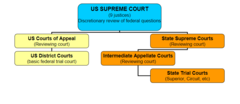
13 Court of appeals
Covers specific region to handle major trials or review legal appeals
94 District Courts
Lowest general trial courts, where legal cases begin
Precendent and Stare Decisis
The doctrine of stare decisis means that courts look to past, similar issues to guide their decisions
Expanding or limiting rights - Judiciary Branch
Free speech, privacy, discrimination, decisions shape societal norms and government policies
Emergency Docket
Courts can act quickly without full briefing or oral argument - raises broader questions about transparency and powers of Supreme Court
Majoritarian Electoral Democracy
Policy reflects average citizens and median voters
Economic-Elite Domination
Policy reflects wealthy individuals
Majoritarian Pluralism
Competition among diverse interest groups represent citizens
Biased Pluralism
Interest group system disproportionately favors business and professional interests
Why Interest Groups?
Collective Action Problems: Forming organization with like-minded people makes sense, strength in numbers to acheive a goal
BUT rational from individuals to freeride and not contribute
Solutions for freeride problem for interest groups
Coercion - employment restriction, peer pressure
Material benefits - events, discounts
Social benefits - like-minded people
Psychological benefits - sense of efficacy and belonging
Argument of Schattschneider 1960
Politics is about control and expansion of conflict, conflicts can either be contained (localized) or expanded (brought to a larger audience), outcome depends on how the scope of conflict changes
Scope of Conflict
size, scale, reach of disagreement or dispute - number of people, groups, individuals, at stake
Spectator Role
Position where citizens or groups monitor, observe, or react to political and regulatory developments
Role of Parties
They play a central role in shaping conflicts and determining who participates in politics
Bias
A particular preference or point of view that is personal, rather than scientific.
Agenda-setting
power of news, media, government to determine which issues people think about
Political theories vs. Political models
Political theories - attempts to explain why things happen the way they do
Political models - more descriptive, less concerned with explanation
Elite theory
A theory of government and politics contending that societies are divided along class lines and that an upper-class elite will rule, regardless of the formal niceties of governmental organization.
Group (pluralist) theory
the view that a large number of diverse groups control government and politics and promote policies to serve their particular interests
Institutional theory
theory that organizations operate according to taken-for-granted institutional norms and rules
Rational-choice theory
A popular theory in political science to explain the actions of voters as well as politicians. It assumes that individuals act in their own best interest, carefully weighing the costs and benefits of possible alternatives.
Political systems theory
A policymaking theory that stresses the way the political system responds to demands that arise from its environment, such as public opinion and interest group pressures. Systems theory emphasizes the larger social, economic, and cultural context in which political decisions and policy choices are made.
Lobbying
Engaging in activities aimed at influencing public officials, especially legislators, and the policies they enact.
Insider Strategies
Requires person access to government officials, aimed at directly influencing officials and policy by drafting legislation, doing research, participating in hearings and litigation
Outsider Strategies
Generate public support for a cause, pressure officials, protests, media ads, conference, letters to politicians, grassroots lobbying, ballot measures
Why do Interest groups lobby congress>
Provide information to elected officials, gain access to elected officials, change public conversation around a topic, buy votes in Congress (unlikely), elect ideological allies
Interest groups often contact congressional allies - not politicians - who can be convinced
Coaltion
a combination, union, or merger for some specific purpose
Iron Triangle

Agenda Setting Theories
Multiple Streams Approach
Agenda-Setting
Punctuated Equilibrium Theory