Wound healing
 Call Kai
 Learn
Learn Practice Test
 Spaced Repetition
 Match
Match Flashcards
 Knowt Play
1/17

There's no tags or description
Looks like no tags are added yet.
Name | Mastery | Learn | Test | Matching | Spaced | Call with Kai | Chat |
|---|
No analytics yet
Send a link to your students to track their progress
18 Terms
What is a wound?
Break in the epithelial integrity of the skin which may affect deeper layers even to bone.
What are the types of wounds?
- Superficial
- Partial thickness
- Full thickness
Describe superficial wounds.
- Damage to the epithelium
- Heals rapidly through regeneration of epithelial cells.
Describe partial thickness wounds.
- Involves dermal layer
- Vascular damage
Describe full thickness wounds.
- Involves subcutaneous fat and deeper.
- Longest time to heal as new connective tissue is required.
- Contraction during healing.
What are the stages of wound healing?
- Haemostasis,
- Inflammatory (early, late)
- Proliferative
- Remodeling
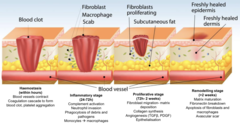
Describe the haemostasis stage of wound healing.
- Blood flows into the wound, and injured vessels contract to reduce bleeding.
- Coagulation cascade activates, forming a clot.
- Platelets release growth factors, such as IGF, which attract and activate neutrophils and fibroblasts.
- Platelets also release serotonin, which increases vascular permeability.
What are the phases of the inflammatory stage of wound helaing?
- Early inflammatory phase
- Late inflammatory phase
Describe the early inflammatory phase.
- Activation of complement systems.
- Infiltration of neutrophils
- Phagocytosis of bacteria and foreign particles occurs.
- Dying cells are cleared by macrophages or extrusion to wound surface.
What are blood monocytes and what do they do?
- A type of cell in the blood essential for tissue repair.
- Secretes cytokines and growth factors which recruit fibroblasts and keratinocytes to repair damage.
- Also secrete collagenases to degrade damaged tissue.
Describe the late inflammatory phase.
- Blood monocytes arrive and become macrophages.
- Lymphocytes enter wound and are involved in remodelling.
Describe the proliferative stage of wound healing.
- Fibroblasts migrate to the wound, producing a new ECM and repair proteins like collagen.
- Neoangiogenesis organizes the vascular network.
- Granulation tissue forms, producing collagen, fibronectin, and GAGs.
- New epidermal cells migrate to form a delicate wound covering.
Describe the remodelling stage of wound healing.
- Collagen become more organised and increase in strength.
- Fibroblasts and macrophages apoptose.
- Angiogenesis stops and blood flow is reduced to the area
When are chronic wounds formed?
- When normal process of healing is disrupted at one of the stages, usually inflammatory or proliferative.
- Caused by disturbances in growth factors, cytokines or proteases.

What local factors affect wound healing?
- Pressure
- Mechanical injury
- Infection
- Oedema
- Necrosis
- Lack of oxygen
What systemic factors affect wound healing?
- Old age
- Obesity
- Chronic diseases e.g., diabetes
- Smoking
- immunosuppression
What causes chronic wounds?
- Neuropathy
- Peripheral oedema
- Pressure
- Ischemia
What are clinical features of chronic wounds?
- Presence of necrotic and unhealthy tissue
- Excess exudate and slough
- Lack of adequate blood supply
- Absence of healthy granulation tissue