6.2 Economic Influences
 Call Kai
 Learn
Learn Practice Test
 Spaced Repetition
 Match
Match Flashcards
 Knowt Play
1/37

There's no tags or description
Looks like no tags are added yet.
Name | Mastery | Learn | Test | Matching | Spaced | Call with Kai | Chat |
|---|
No analytics yet
Send a link to your students to track their progress
38 Terms
How government might intervene to help businesses and encourage enterprise
Governments often intervene in the economy to:
Promote economic growth
Create jobs
Encourage innovation and enterprise
Increase international competitiveness
Ways governments support new businesses & encourage enterprise
Finance - Grants, Tax Incentives & Low interest loans
no need to repaid → reduces start-up cost & improves cash flow
offering lower tax rates/ reliefs → reduce costs
offering lower interest rates → makes finance easier & cheaper to obtain → can invest in equipment → bus grows.
Providing Training & Advice
entrepreneur gain skills → improves quality of bus. decisions → increase chance of bus. survival.
Improve Infrastructure
invest in roads, transport & internet → reduce operating & distribution difficulties → bus. can operate more efficiently → encourage new firms to set up.
Reduce barriers to start a bus.
Simplify registration & unnecessary regulations/paperwork → faster & cheaper to start bus.
How government might intervene to constrain business activity
Laws / Regulations
eg. min wage, health & safety or env. regulations → compliance increases bus. cost
Taxation Policy
gov. increase corporation/ indirect taxes → cost increase profit falls
Quotas
gov. set max limit on how much product can be produced, sold or imported → protects resources & reduce harmful productions.
Competition law Enforcement
preventing anti-competitive behaviour such as price fixing or abuse of monopoly power → protects consumer & small bus.
Market failure
When business fail to produce products efficiently
eg. goods or services are underprovided (healthcare/ education) while others are overproduced causing harm like pollution or when there’s limited access to (clean water/ housing).
Examples of Market Failure, Stakeholders affected by it and Gov. Intervention
Lack of Labour Training
Consumers - receives bad customer service
Gov. - worried abt int competitiveness if there’s insufficient skilled workers
Shareholders - may see future profits fall as output falls
Increase in External Costs
Damage to bus. reputation
Gov. can impose fines on polluting bus. / impose strict limits on pollution levels.
Monopoly Producers
Consumers - lack of choice, limited supplies & high prices
Gov. concerned as prices are high & important industries lack competitiveness
Solutions to Market Failure
Government Provision
directly providing public or merit goods such as healthcare → ensures these goods are provided even if private firms have little incentives to provide them → reduces underproduction.
Controlling negative externalities (pollution)
enforce regulations, set limits or fine for polluting business & env. damage
Taxing or regulating Demerit goods (drugs, sugary drinks)
introduce taxes/ regulation to reduce consumption & raise awareness of these goods.
Macroeconomic objectives
The main goals that a government tries to achieve in the wider economy to keep the economy stable and growing
What are some of the government macroeconomic objectives?
Economic Growth (Increasing GDP)
Low Inflation
Low Unemployment
Balance of Payments
Exchange Rate Stability
Impact of Employment Levels on the Business
High Employment
More people with incomes to spend → increase demand
Boost business confidence → encourage firms to invest & expand
Reduce availability of labour = harder to recruit → increase wage
Low Employment
Demand fall = lower sales & bus. closures
Recruit workers more cheaply & improve labour cost competitiveness
Inflation
The increase in avg price level of goods & services resulting in a fall in the value of the money.
Deflation
A fall in avg price levels of goods & services
Cost Push Inflation vs Demand Pull Inflation
Cost Push
An increase in price level caused by higher cost of production
eg. higher wage demands, trade union intervention
Demand Pull
An increase in the price levels caused by an increase in demand
eg. usually during boom period/ supply shortages / higher incomes
Monetary Inflation
When money supply (amt available for spending) grows to quickly relative to the amount of goods & services being produced
Impact of Low inflation rate on Business
Prices rise slowly
consumers purchasing power is stable → demand more predictable
Smaller increase in cost
profits margin are less pressured
Greater Business Confidence
firms more likely to invest & expand
Low interest rates
borrowing cost remain lower
Impact of High inflation rate on Business
Prices rise rapidly
purchasing power falls → demand decrease
Cost of materials increase + Harder to predict future costs & price
raw materials, wages become more expensive → profit margin fall
Long-term planning become harder
Interest Rate increase
borrowing more expensive → investment fall
Disadvantage of Deflation
Lower sales revenue
prices fall → delay in purchases → demand decrease
Unemployment increase
lower demand & profits → workers made redundant
Debts Increase
Incomes fall while value of debt increase → risk of bankruptcy increase
Economic Growth
An increase in a country’s productive potential / national output, measured by an increase in its real GDP.
Real GDP
GPD data adjusted for the effect of inflations
Why Government wants Economic Growth
Higher Tax Revenue
Gov. collect more income tax, corporation tax & VAT → more spending on public services
Higher Living Standards
Higher employment & incomes → quality of life improves
Absolute poverty can be reduced/ eliminated
Causes of Economic Growth
Increase in labour
More workers enter workforce → more product produced → real GDP increases
Technological Progress
New tech allows product to be produced more efficiently→ productivity increases → output increase
Improved Education & Skills
Better education & training → workers more skilled & productive → output per worker increase → economic grow
Economic Cycle
The regular swings in output, measured by real GDP that occur in most economies, varying from boom conditions to recession.
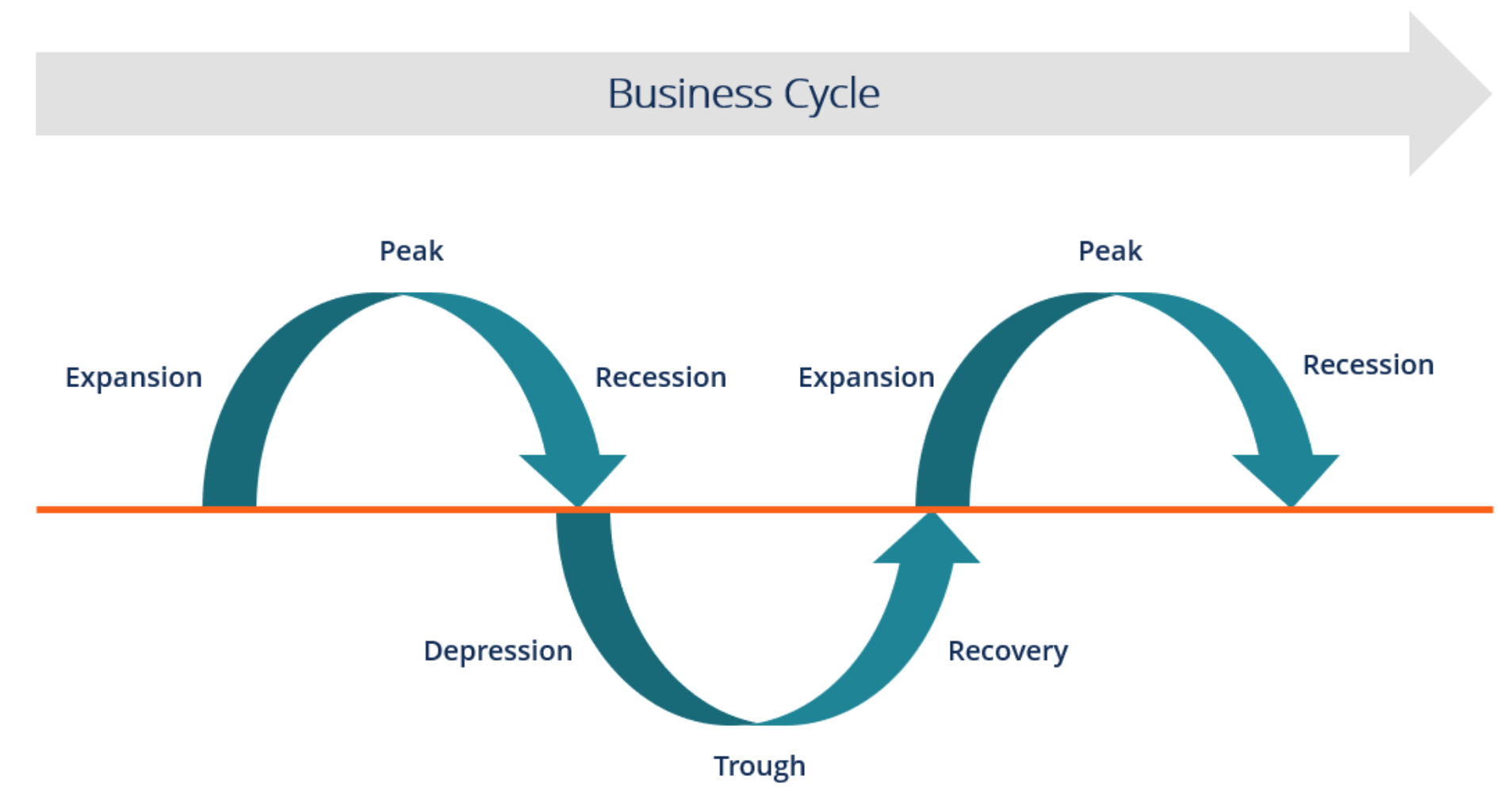
Stages of the Economic Cycle
Recession🍃 - when economic activity is falling
Real GDP fall
Consumer Spending fall
Profit fall
Tax revenue fall
Unemployment rise
Inflation reducing
→ lower consumer confidence = spending falls → sales fall → production fall → workers made redundant = high unemployment
Slump / Trough - lowest point of economic cycle
GDP low
Consumer spending weak
High unemployment
Inflation Low
Recovery / Upturn - economy improving after trough
GDP starts increasing
Consumer spending increase
Production Increase
Unemployment fall
Inflation starts increasing
→ consumer confidence rise = spending increase → sales increase → production increase → firms hire more → income increase = spending increase
Boom 🚀 - rapid growth & high economic activity
GDP grow rapidly
Unemployment v low
Consumer spending high
Bus. profit high
Inflation high
Unemployment
People who are members of the working population are willing & able to work but unable to find job.
What are the 3 main cause of Unemployment?
Cyclical Unemployment
Structural Unemployment
Frictional Unemployment
Cyclical Unemployment
Caused by a fall in economic activity eg. during recession
lower demand → sales fall → reduce production = need fewer workers → unemployed increase
Structural unemployment
Caused by mismatch between workers skill & job available
eg. New tech replaces factory workers - dh the skills needed for tech related jobs → unemployment.
Frictional Unemployment
When people are in-between jobs or left education waiting for first job.
Cost of unemployment to the Economy
Slows Economic Growth
Unemployed not producing output → real GDP falls below potential level
Lowers Tax Revenue
Unemployed = no/ less income tax + spends less = less indirect tax
Lower consumer spending
Less disposable income → reduce spending = lower demand → reduce production & cut more jobs
Loss of skills
Long term unemployment = workers losses skills
4 Mains Policies gov. try to use to achieve Macroeconomic Objectives
Monetary Policy
Fiscal Policy
Supply side Policy
Exchange Rate Policy
Monetary Policy
Government / central bank actions to influence interest rates & the money supply to achieve macroeconomic objectives.
eg. Increase interest rates → borrowing falls → spending falls → inflationary pressure decreases.
Fiscal Policy
Government changes taxation and government spending to influence aggregate demand and achieve macroeconomic objectives.
Supply-side policy
Government measures designed to increase the productive capacity & efficiency of an economy.
eg. education & training, privatisation
Exchange Rate Policy
Government/ central bank actions designed to influence the value of a country’s currency relative to other currencies.
Exchange Rate Appreciation
If the demand for a currency is greater than its supply, prices of currency rate rises
Effect of Appreciation
Exports Decrease: Domestic goods become more expensive to foreign buyers
Imports Increase: Foreign goods become cheaper to domestic buyers
Inflation Decreases → imports cheaper = raw materials cheaper = reduce cost push inflation
Economic Growth Slows → exports become less competitive = net export fall
Exchange Rate Depreciation
If the demand for a currency is lower than its supply, price of currency fall
Effect of Depreciation
Exports Increase: Domestic goods become cheaper for foreign buyers
Imports Decrease: Foreign goods become more expensive
Inflation Increase: Imported goods become expensive = cost push-inflation increase
Economic Growth Increase: Exports become more competitive = net export increase → GDP increase