Chapter 20: Skeletal Muscles and their Actions
 Call Kai
 Learn
 Practice Test
 Spaced Repetition
 Match
 Flashcards
 Knowt Play
1/46

There's no tags or description
Looks like no tags are added yet.
47 Terms

Motor Unit: consists of one motor neuron and all the skeletal muscle fiber it controls
conists of one motor neuron and all the skeletal muscle fiber it controls

Motor Neuron:
A nerve cell that sends signals to muscle fibers

Axon:
the part of the neuron that carries the electrical signal

Neuromuscular Junction (NMJ):
point where the motor neuron communicates with a muscle fiber

Muscle Fibers:
individual muscle cells that contract to create movement

How a motor unit works:
Your brain/spinal cord sends a signal through a motor neuron.
The signal reaches the neuromuscular junction.
The muscle fibers controlled by that neuron are activated.
The fibers contract, producing force.
Small Motor Units:
control fewer muscle fibers and allow precise movements, such as moving your eyes.
Large Motor Units:
control many fibers and allow precise movements, such as when your leg muscles help you jump.
One motor neuron + all the muscle fibers it controls = ________
one motor unit
Muscles often work in ______ because muscles pull on bones rather than push them.
pairs
Agonist:
The prime mover
the muscle primarily responsible for a particular movement
Antagonist:
The opposing muscle
the muscle that produces the opposite movement and often relaxes or lengthens as the agonist contracts.
Example of Agonists and Antagonists:
Bending your elbow (flexion)
agonist: biceps brachii
antagonist: triceps brachii
Example of Agonists and Antagonists:
Straightening your knee (extension)
agonist: quadriceps
antagonist: hamstrings
Synergist:
Assists the agonist
Fixator:
stabilizes a bone or joint so the movement can occur efficiently

Origin:
the attachment usually associated with the less movable bone

Insertion:
attachment usually associated with the more moveable bone.

Tendon:
strong connective tissue that attaches muscle to bone or, in some cases, other structures.

When a muscle contracts it generally pulls its insertion toward its ______,
origin
Origin = generally stays put;
insertion = generally moves
Movement occurs at ______.
joints
Abduct:
away from midline
Adduct:
toward midline

Frontalis(surprised face):
raises eyebrows; wrinkles forehead

Masseter(chewing)
elevates mandible (closes jaw)

Temporalis(closes jaw):
elevates and rectracts mandible

Orbicular Oris (puckering):
closes and protrudes lips

Orbicularis Oculi(blinking):
closes eyelids

Zygomaticus(smiling):
raises corners of mouth.

Sternocleidomasteoid:
flexes the neck; rotates the head to the opposite side when one side contracts

Trapezius:
elevates, retracts, depresses, and upwardly rotates the scapula, depending on the fibers used
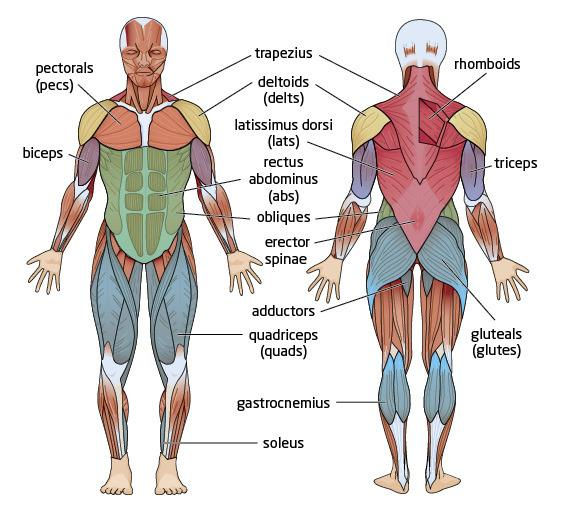
Pectoralis Major:
Flexex, adducts, and medially rotates the arm

External Abdominal Oblique:
compresses abdomen; flexes and rotates trunk
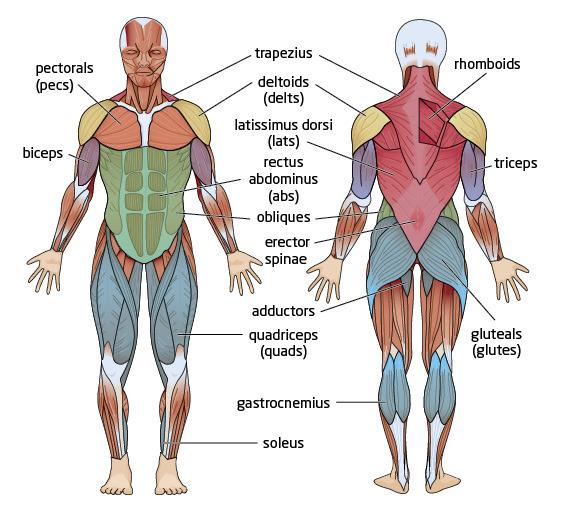
Rectus Abdominis:
flexes trunk; compresses abdomen

Transverse Abdominis
compresses abdominal contents and stabilizes the trunk
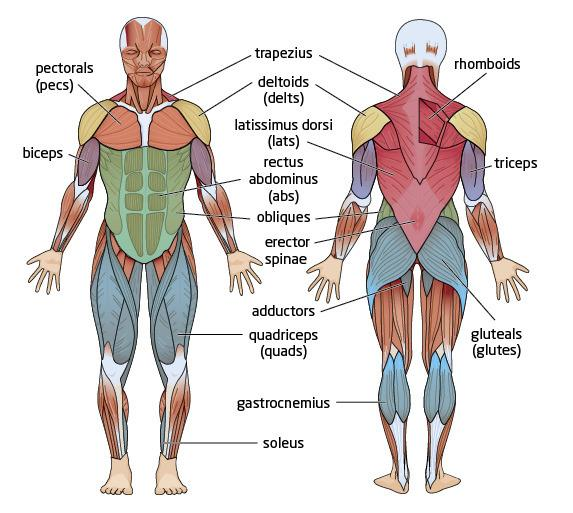
Serratus Posterior Superior:
assists with depression of the lower ribs during forced expiration

Serratus posterior inferior:
Assists with depression of the lower ribs during forced expiration

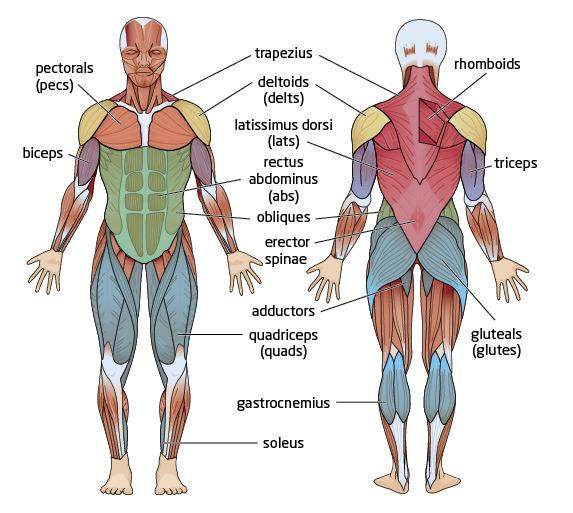
Latissimus dorsi:
Extends, adducts, and medially rotates the arm
Serratus anterior
Protracts the scapula and holds it against the rib cage

Rhomboids
Retract and stabilize the scapula

Platysma
Tenses skin of the neck; helps depress the lower lip and mandible