5: R-O Relations
 Call Kai
 Learn
 Practice Test
 Spaced Repetition
 Match
 Flashcards
 Knowt Play
1/64

There's no tags or description
Looks like no tags are added yet.
65 Terms
Instrumental Learning/ Conditioning
synonymous to R-O Learning
learning in which the probability of a given behavior is altered by its consequences
behavior is instrumental in producing the outcome
Opernat Learning/ Conditioning
subset of instrumental learning
instrumental learning in which the organism specifically learns to manipulate its environment to achieve a desired outcome
Instrumental Criteria
the behavioral modification depends on a form of plasticity
the modification depends on the organism’s experiential history
(a) the modification outlasts (extends beyond) the environmental contingencies used to induce it (b) the experience has a lasting effect on performance
imposing a temporal relationship between a response and an outcome alters the response
Additional Operant Criteria
The nature of the behavioral change is not constrained (ex. either an increase or decrease in the response can be established)
the nature of the reinforcer is not constrained (a variety of outcomes can be used to produce the behavioral deficit)
discrete-trial method
a form of instrumental learning where an organism may only perform a behavior to earn a response only at specific times
ex. iclicker quizzes
free-operant method
a form of instrumental learning where an organism may perform a behavior to earn a response at any time
ex. checking social media
the type of instrumental learning depends on two factors
nature of the reinforcer
relation to the behavior
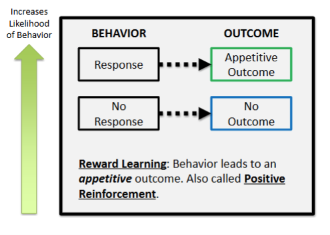
reward learning (positive reinforcement)
behavior leads to an appetitive outcome (relates to nature of the reinforcer)
increases likelihood of behavior
Punishment learning (positive punishment)
behavior leads to an aversive outcome (relates to nature of the reinforcer)
decreases likelihood of behavior

omission learning (negative punishment)
behavior removes an appetitive outcome (relates to relation to the behavior)
decreases likelihood of behavior
escape/avoidance learning (negative reinforcement)
behavior removes an aversive outcome (relates to relation to the behavior)
increases likelihood of behavior
Instrumental Learning in the Lab
reward: bar press → food
omission: bar press → no food
punishment: bar press → shock
recall (preparedness in instrumental learning)
learning occurs in a heterogenous behavioral substrate
some action-outcome relationships are learned more easily than others
Key-peck → Grain: A pigeon naturally pecks at food, so learning that pecking produces grain is relatively easy.
Treadle → Turn off shock: A pigeon can learn to step on a pedal to stop an unpleasant stimulus.

Heterogeneous behavioral substrate
Animals aren't born as blank slates. They have natural behaviors and instincts that influence what they learn easily
recall (contingency in instrumental learning)
extra US’s undermine Pavlovian conditioning
extra outcomes disrupt instrumental conditioning

schedules of reinforcement
continuous reinforcement (CRF)
fixed ratio (FRX)
variable ratio (VRX/RRX)
fixed interval (FIX)
variable intervals (VIX)
continuous reinforcement (CRF)
stable 1:1 ratio of behavior to reinforcer
behavior always produes reinforcer
fixed ratio (FRX)
stable X:1 ratio of behavior to reinforcer
X number of responses always produces the reinforcer
variable ratio (VRX/RRX)
average of X:1 ratio of behavior to reinforcer
the number of responses needed to produce the reinforcer will vary, but average out to X
fixed interval (FIX)
stable interval separates rewardable behaviors
behavior will only produce reinforcer after a constant amount of time has passed
variable interval (VIX)
average interval separates rewardable behaviors
behavior will only produce reinforcer after a variable amount of time has passed
learned helplessness
idea that unavoidable aversive events impair performance on future avoidable aversive events
Experiment (Maier, Overmier, Seligman)
three groups: Master (escapable shock), Yoke (inescapable shock), and unshocked
learned helplessness: signaled active avoidance
master, yoked, and unshocked groups and 24 hours later put in a test shuttle avoidance where they could turn to the other side of the box to avoid an uncontrollable shock
yoked group took the longest to respond when it came to the shock, as they previously learned that they could not control the outcome
Master: Experienced control → better avoidance learning.
Yoked: Experienced no control → impaired avoidance learning.
Unshocked: No previous shock experience → normal avoidance learning.

learned helplessness hypothesis: causes motivational and associative deficit
related to Julian Rotter’s Locus of Control
internal: “I believe I can control my own future.”
external: “My life is directed by forces outside of my control.”
contributes to common psychiatric disorders, including anxiety, depression, and PTSD
learned helplessness: behavioral therapy
behavioral therapy for after learned helplessness is learned
rats underwent two sessions of shock: restrained-restrained (RR), inescapable shock-escapable shock (IE), inescapable shock-inescapable shock (II), inescapable shock-restrained (IR)
after 24 hours, rats were put in a test shuttle avoidance
II and IR rats took longer to respond to move to another side of the box
IE and RR took less time to move

learned helplessness: behavioral immunization
giving an animal experience with control over its environment BEFORE exposing it to uncontrollable negative situations
rats underwent two sessions of shock: restrained-restrained (RR), escapable shock-inescapable shock (EI), inescapable shock-inescapable shock (II), restrained-inescapable shock(IR)
after 24 hours, rats were put in a test shuttle avoidance
II and RI rats took longer to respond to move to another side of the box
EI and RR took less time to move
learned helplessness: endogenous opioids
learned helplessness can be conditioned in most mammals
used endogenous opioids: chemical naturally produced by your body that help reduce pain
used naltrexone: an opioid antagonist, meaning it blocks opioid receptors and prevents opioids from having their usually effects
left graph: latency to respond when performance when FR2 was required
yoked animals took the most time to respond, then yoked+naltrexone rats
shows that Blocking opioid receptors with naltrexone reduced the learned helplessness effect.
right graph: pain reactivity
The inescapable shock group (I) showed increased tail-flick latency, suggesting reduced pain sensitivity. When naltrexone was given, this effect decreased.
This suggests that uncontrollable shocks activate the body's natural opioid system, producing pain relief (analgesia).
organisms are always behaving in some way
ex. dog training:
dog sits on command
receives treat immediately
dog associates sitting w/ treat
dog poops in house while owner is away
dog walks around, eats food, sleeps
dog greets owner upon return, owner yells at dog about poop
dog learns the wrong lesson
secondary (conditional) reinforcers
a Pavlovian association is formed between a neural stimulus and a primary reinforcer
Gold Stars in classrooms
marking stimuli
brief auditory or visual cue distinguishing target response from other behaviors
not valued
ex. shaping activity
exceptions to the importance of contiguity
secondary (conditional) reinforcers
marking stimuli
instrumental behavior typically begins as goal-directed and becomes habitual over time
to test whether a behavior is goal-directed, we can use reinforcer-devaluation
same as US devaluation
establish RO-contingency → devalue outcome → test behavior
if habitual, rats press the same as rats without devaluation (control)
if goal-directed, rats press less than control rats

ration schedules produce more responding than interval schedules
feedback functions: how quickly the organism learns to maximize benefit
internal feedback functions: reach an asymptote earlier than ratio feedback functions
concurrent schedules of reinforcement
organism has two response options that each lead to reinforcement, but on different schedules
example:
Lever A yields a large pile of food, but is on a 10-minute fixed-interval schedule
Lever B yields only a single food pellet, but is on a 5:1 fixed ratio schedule
matching law
IF similar effort is required for response alternatives AND
IF switching from one alternative to the other is easy…
THEN the distribution of responses will depend only on schedule of reinforcement for each response.
THUS, the relative rate of each response is equal to the relative rate of reinforcement obtained w/ that response alternative
generalized matching law
takes differences in effort, reinforcer strength, and switching from one response to the other
if the initial conditions of matching law are not met, it doesn’t work
concurrent-chain schedules
lock the organism’s initial choice in for the remainder of a trial
choice link: initial decision wherein participant can select either option
terminal link: trials following initial trial where only selected option is available
drive-reduction theory
traditional view:
reinforcers satisfy biological needs
mediated by internal drives
Clark Hull: drive reduction provides a way to derive the internal drives of a species
problems w/ drive-reduction theory
long and implausible list of drive
ex. monkeys will respond to watch a toy train
learning can occur w/o drive reduction
ex. rats learn to seek saccharine = sweet, but no nutritional value
premack principle
given two responses arranged in an operant conditioning procedure, the more probable response will reinforce the less likely behavior, but the less probable response will not reinforce the more probable behavior
view: reinforcing events are opportunites to engage in behavior
rate would lever press for opportunity to sniff
rat would not groom for opportunity to sniff
Premack vs. Hull
premack didn’t designate a special class of events as reinforcing
Hull:
If a rat is thirsty, drinking reduces its thirst.
If a rat is deprived of water, drinking becomes more valuable because it satisfies that biological need.
Premack:
something you WANT to do more can be used as a reward for something you WANT to do less
problems w/ premack’s approach
its difficult to quantify time spent performing individual behaviors
ex. how to quantify drinking behavior?
response deprivation theory
proposed a schedule of reinforcement must deprive the organism of the consequent reinforcer
is not fixated on the time spent performing a response
avoids measurement problems
premacks theory in simple terms
a high-probability behavior reinforces a low-probability behavior
focuses on which behavior you prefer more
response deprivation theory in simple terms
a behavior becomes reinforcing when access to it is restricted below its normal level
focuses on how much access to a behavior you are allowed
bliss point
ideal amount of time an organism would naturally like to spend doing different activities when it has free access to them
perfect balance between activities
backward bending labor supply curve
People initially work more as wages rise, but eventually may work less because they can afford more leisure
early neurological view
believed that all learning occurred via common mechanism
modern neurological view
multiple systems underlie different types of memory
early in training for a t-maze
place learning (spatial/explicit)
late in training for a t-maze:
response learning (habit/impliicit)
lesioning the hippocampus disrupts place learning
facilitates habit learning
lesioning the basal ganglia disrupts habit learning
basal ganglia
striatum:
globus pallidus
ventral pallidum
substantia nigra:
subthalamic nucleus
ventrolateral nucleus of the thalamus
striatum involvement in learning
involved in motivation, reinforcement, and planning movements
received dopaminergic input from the substantia nigra
2 key receptors
substantia nigra involvement in learning
produces dopamine
neurons synapse onto neurons in the striatum
amygdala
basolateral nucleus encodes reward magnitude and valence
striatum
integrates positive and negative with behavior over multiple trials
habit learning is incremental
more trials = stronger habit
in complex situations, organisms need to do more than represent reward
must also consider how much reward/punishment will be gained now vs. in the future
orbital frontal cortex (OFC)
allows the organism to weigh the relative value of alternative outcomes
value: estimate of relative gain both now and in the future
lesions to the OFC:
trouble incorporating negative feedback from previous training
more dependent on amygdala = more impulsive
trouble learning that reinforcement contingencies have changed
delayed discounting
can be modelled in both animals and humans
in rats, lesions of OFC bias behavior toward immediate reward
in humans, choosing the immediate reward is associated w/ increased limbic activity (amygdala)
choosing the delayed reward elicits OFC activity
people w/ substance-use disorders tend to be biased towards immediate rewards
fail to weigh long-term negative consequences
two classes of striatal projection neuron
distinguished by type of dopamine receptor (D1 vs D2)
D1 receptor expressing direct pathway
involved in reward learning and initiating action
D2 receptor expressing indirect pathway
involved in punishment learning and inhibiting action
direct vs indirect pathways experiment
set up: used two groups of rats to implant w/ mechanism to stimulate either direct pathway neurons (D1 medium spiny neurons; dMSN) or indirect pathways neurons (D2 medium spiny neurons; iMSN)
both groups of rats were presented w/ 2 levers
lever 1: engaged stimulation
lever 2: no stimulation
findings:
direct pathway mice worked for stimulation
indirect pathway mice avoided stimulation
conclusion: direct pathway encodes reward, indirect pathway controls punishment, both involve dopamine
conditional place preference experiment
animals placed on 1 side of a divided chamber and received stimulation
direct pathway rats preferred the stimulation side during re-exposure
indirect pathways rats avoided the stimulation side during the re-exposure