advanced clinical judgement
 Call Kai
 Learn
 Practice Test
 Spaced Repetition
 Match
 Flashcards
 Knowt Play
1/59

There's no tags or description
Looks like no tags are added yet.
60 Terms
Fundamentals - Leadership & Management
The nurse is preparing to discharge a client who had a stroke and require a walker for ambulation. Which of the following concerns should the nurse address first according to Maslow’s hierarchy of needs?
reports limited social support
expresses embarrassment about using a walker
is experiencing homelessness
requests a referral for physical therapy to strengthen the lower extremities
is experiencing homelessness
Fundamentals - Basic Care & Comfort
the nurse is using the SBAR (Situation, Background, Assessment, Recommendation/Request) technique to talk to the health care provider about a client. Which of the following information should the nurse include in the situation component? SATA
medication
client’s name
admission date
reason for calling
advance directives
client’s name
reason for calling
Maternal & Newborn health - Antepartum
The nurse is caring for a 22 YO client at 27 weeks gestation with no known complications. The client’s immunization history is unknown. Which routine vaccine should be recommended to the client at the visit?
hepatitis B
measles, mumps, and rubella
tetanus-diphtheria-acellular pertussis
varicella
tetanus-diphtheria-acellular pertussis
Adult Health - Hematological/Oncological
the nurse is talking with a client about cervical cancer. Which of the following statements by the client would require follow up?
“cervical cancer may be asymptomatic in the early stage”
“I should receive routine pap testing to screen for cervical cancer”
“The human papillomavirus vaccine is the preferred treatment for cervical cancer”
“I should use condoms during sexual activity even if I am taking an oral contraceptive”
“The human papillomavirus vaccine is the preferred treatment for cervical cancer”
Fundamentals- Leadership & Management
The public health nurse is talking to residents of a local community. Which of the following statements by a resident would provide information about the community’s structure? SATA
“I use the public train system to commute to work”
“A local food bank provides a free meal once per week”
“There is a fire department 3 miles from my house”
“There has been a recent decrease in violent crime in my neighborhood”
“My community has seen an increase in the number of births over the last 2 years”
“I use the public train system to commute to work”
“There is a fire department 3 miles from my house”
“There has been a recent decrease in violent crime in my neighborhood”
Fundamentals - Leadership & Management
The nurse is planning a staff education program about level of preventive care. Which of the following scenarios should the nurse include as an example of the tertiary level of preventive care?
administering an antiplatelet medication to a client with atrial fibrillation
providing teaching to a client about modifiable risk factors for hypertension
recommending HIV screening to a client who reports IV recreational substance use
arranging transportation to cardiac rehabilitation for a client who recently had coronary artery stenting
arranging transportation to cardiac rehabilitation for a client who recently had coronary artery stenting
Adult health - Gastrointestinal/Nutrition
The nurse is reviewing education with a client about lifestyle modifications to reduce the risk for colorectal cancer. Which of the following client statements indicate a correct understanding of teaching? SATA
“I should begin an exercise program to lose excess weight”
“I should cut back on the amount of alcohol I consume”
“I should enroll in a smoking cessation program”
“I should include more high fiber foods in my diet”
“I should limit my intake of red and processed meat”
“I should begin an exercise program to lose excess weight”
“I should cut back on the amount of alcohol I consume”
“I should enroll in a smoking cessation program”
“I should include more high fiber foods in my diet”
“I should limit my intake of red and processed meat”
Adult Health - Hematological/Oncological
The nurse is screening clients for those at risk for developing cervical cancer. Which of the following factors would increase a client’s risk for developing cervical cancer? SATA
human papillomavirus infection
menopausal hormone therapy
immunosuppressant therapy
multiple sexual partners
tobacco use
human papillomavirus infection
mmunosuppressant therapy
multiple sexual partners
tobacco use
fundamentals - Leadership & Management
The nurse is planning a staff education program about specific, measurable, achievable, realistic, and time bound (SMART) goals. Which of the following should the nurse include as an example of a SMART goal?
“The client will attend group therapy”
“The client’s pain will remain a 0 on a scale of 0-10 after surgery”
“The client will be able to self administer insulin the day before discharge”
“The client will walk better today with assistance from the PT”
“The client will be able to self administer insulin the day before discharge”
Adult health - Respiratory
The nurse is caring for assigned clients. The nurse should first assess the client who
had an open appendectomy 1 day ago and has fine inspiratory crackles in the lung bases bilaterally
has a right sided hemothorax and a chest tube that has intermittent bubbling in the water seal chamber
is experiencing an acute exacerbation of asthma and has soft expiratory wheezing in the anterior and posterior chest
has severe acute pancreatitis and inspiratory crackles and rhonchi in the lung bases bilaterally
has severe acute pancreatitis and inspiratory crackles and rhonchi in the lung bases bilaterally

Adult Health - Respiratory
The nurse is caring for a client with COPD disease when the client becomes tachypneic and reports significant dyspnea. The client’s oxygen saturation is 85% on 2L/min of oxygen per nasal cannula. Which oxygen delivery device is appropriate for this client?
4.

Adult health - Respiratory
The graduate nurse (GN) prepares educational materials about Goodpasture syndrome (GS) for a group of nursing students. Which teaching point made by the GN would cause the supervising nurse to intervene?
GS is an acute bacterial infection
GS may cause glomerulonephritis and pulmonary hemorrhage
GS most commonly occurs in males who smoke
GS often requires treatment with plasmapheresis
GS is an acute bacterial infection
Adult Health - Respiratory
The nurse is observing a staff member caring for a client with acute respiratory distress syndrome. The nurse should intervene if the staff member is observed
requesting a low calorie diet for the client
maintaining strict monitoring of intake and output
obtaining supplies for mechanical ventilation
administering supplemental oxygen to the client
requesting a low calorie diet for the client
Adult Health - Respiratory
The nurse is observing a staff member caring for a client with acute opioid intoxication. The nurse should intervene if the staff member is observed
preparing to administer IV flumazenil
monitoring the client’s level of consciousness
initiating continuous cardiac monitoring
placing the client in the semi fowler position
preparing to administer IV flumazenil
Adult Health - Respiratory
A nurse is caring for a client who is mechanically ventilated with an endotracheal tube. Which interventions should the nurse carry out to reduce the risk of ventilator associated pneumonia? SATA
maintain the incline of the head of the bed at 30-45 degrees
perform oral care frequently and include antiseptic solution at least once per shift
provide opportunities for mobilization such as ROM exercises
replace the ventilator circuit tubing routinely at least once per day
suction secretions pooling above the endotracheal tube cuff
maintain the incline of the head of the bed at 30-45 degrees
perform oral care frequently and include antiseptic solution at least once per shift
provide opportunities for mobilization such as ROM exercise
suction secretions pooling above the endotracheal tube cuff
Adult Health - Respiratory
The nurse is caring for a client who reports frequent episodes of epistaxis. The nurse should recognize that which of the following factors contributes to epistaxis? SATA
allergic rhinitis
decreased BP
lives in a warm and humid environment
takes coumadin
cocaine use
allergic rhinitis
take coumadin
cocaine use

Adult Health - Respiratory
The home health nurse visits a client with advanced COPD every month for routine follow up. Which of the following interventions should the nurse perform to help improve the client’s nutritional status? SATA
discuss increasing the client’s intake of high fiber food like broccoli and beans
encourage the client to drink lots of fluids during meals to thin secretions
help the client identify high protein, high calorie foods to include in meals
schedule smaller, more frequent meals to reduce dyspnea while eating
teach the client to rest for 30 minutes before and after meals to decrease fatigue
help the client identify high protein, high calorie foods to include in meals
schedule smaller, more frequent meals to reduce dyspnea while eating
teach the client to rest for 30 minutes before and after meals to decrease fatigue
Adult Health - Respiratory
The nurse is caring for clients who are receiving opioid analgesics. The nurse should recognize that the client at highest risk for developing respiratory depression is the
38 YO client who had an appendectomy 1 day ago and has diverticulitis
43 YO client who had a small bowel resection 1 hour ago and has osteoporosis
67 YO client who had a vaginal hysterectomy 2 hours ago and takes a benzodiazepine
72 YO client who had a laparoscopic cholecystectomy 18 hours ago and takes a beta blocker
67 YO client who had a vaginal hysterectomy 2 hours ago and takes a benzodiazepine
Adult Health - Respiratory
The nurse is teaching about naloxone administration to the spouse of a client who has a new prescription for hydrocodone. Which of the following statements by the client’s spouse would require follow up?
“I should avoid administering more than 1 dose of naloxone to my spouse”
“I can expect my spouse to experience the effects of naloxone quickly after administration”
“My spouse should receive medical care after administration of naloxone”
“Naloxone should be administered if I cannot wake my spouse from sleep after taking hydrocodone”
“I should avoid administering more than 1 dose of naloxone to my spouse”
Fundamentals - Vital signs
The nurse is caring for a client with COPD who has a continuous pulse oximeter that is alarming frequently. What action should the nurse take first?
check the client’s most recent hemoglobin level
observe the client’s respiratory rate and effort and auscultate the lungs
review the alarm parameters set on the monitor
verify the location of the probe and ensure the site has good circulation
observe the client’s respiratory rate and effort and auscultate the lungs
Adult Health - Respiratory
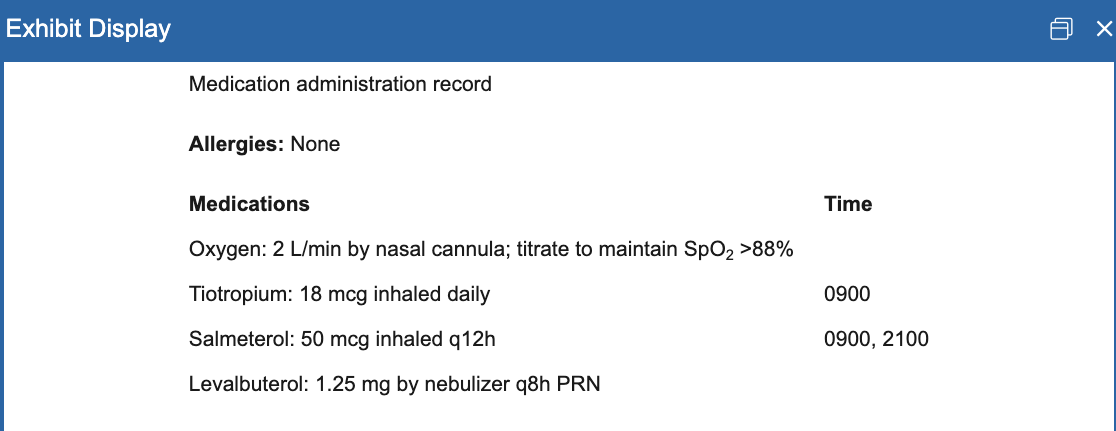
At 0830, a nurse is reassessing a client who has chronic obstructive pulmonary disease. The nurse notes wheezing bilaterally that is increased from the previous assessment. The client appears breathless when trying to speak. Oxygen saturation is 89%. What action should the nurse take first? Click exhibit for additional information
activate the rapid response team and notify the health care provider
administer a levalbuterol nebulizer treatment
administer scheduled tiotropium and salmeterol inhaler treatments
request a prescription to increase the amount of supplemental oxygen
administer a levalbuterol nebulizer treatment
Adult Health - Respiratory
The nurse is screening clients for those at risk for developing obstructive sleep apnea (OSA). The nurse should recognize the client at highest risk for developing OSA is the client who:
is age 55
is prescribed levothyroxine
has hypertension
has a large neck circumference
has a large neck circumference

Adult Health - Respiratory
The nurse reviews clinical data for a client diagnosed with pneumonia and exacerbation of chronic obstructive pulmonary disease. Which clinical finding is the priority to report to the health care provider? Click exhibit for additional information
arterial pH of 7.35
PaCO2 of 59 mm Hg (7.85 kPa)
PaCo2 of 50 mmHg (6.65 kPa)
Respiratory rate of 27/min
PaCo2 of 50 mmHg (6.65 kPa)
Adult Health - Respiratory
The nurse is teaching a client with OSA about sleep apnea about self care management. Which of the following statements by the client would indicate a correct understanding of the teaching? SATA
“I sleep on my side now instead of sleeping on my back”
“I am attending an exercise program to lose excess weight”
“I wear the nose mask and use the breathing machine every night”
“I have stopped consuming alcoholic beverages, especially before bedtime”
“I take an over the counter medication when I am having difficulty sleeping”
“I sleep on my side now instead of sleeping on my back”
“I am attending an exercise program to lose excess weight”
“I wear the nose mask and use the breathing machine every night”
“I have stopped consuming alcoholic beverages, especially before bedtime”
Adult Health - Respiratory
The nurse is screening clients for those at risk for developing acute respiratory distress syndrome (ARDS). Which of the following factors would increase a client’s risk for developing ARDS? SATA
Septic shock
chronic venous insufficiency
viral pneumonia
aspiration of gastric contents
submersion injury
septic shock
viral pneumonia
aspiration of gastric contents
submersion injury
Adult Health - Respiratory
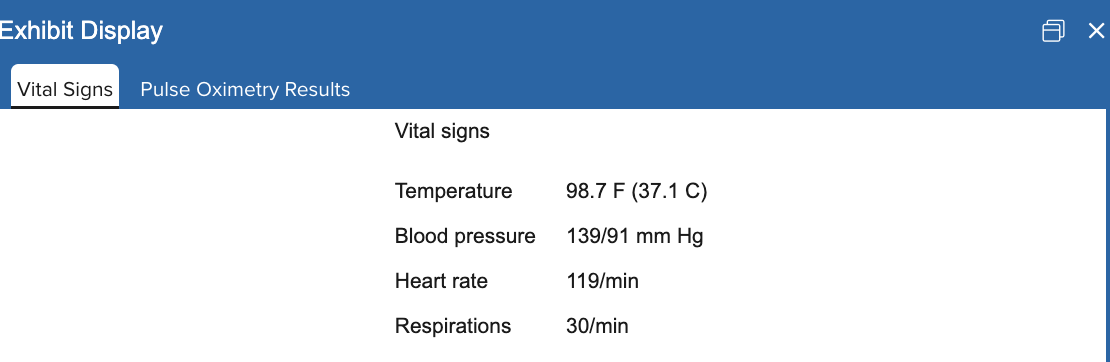
The graduate nurse (GN) is caring for a client who has COPD. The client develops wheezing, coughing, and shortness of breath while returning to bed after bathing. After collecting current vital signs, which actions by the GN should cause the supervising nurse to intervene? Click the exhibit for additional information
advise the client to pace activities and take rest breaks
assist the client in leaning over into the tripod position
encourages the client to use pursed lips breathing
increase the client’s oxygen from 2L/min to 5L/min
increase the client’s oxygen from 2L/min to 5L/min
Adult Health - Respiratory
The nurse is participating in a community health screening event. Which of the following clients does the nurse identify as having a risk factor for lung cancer? SATA
A client who has seasonal allergies and has always lived in a rural area
a client who has worked as a coal miner for the past 5 years
a client who smoked 1 pack of cigarettes per week for 10 years and quit 3 years ago
a client who used embalming fluid while working as a mortician at a funeral home
a client who was exposed to asbestos during home renovation projects
a client who has worked as a coal miner for the past 5 years
a client who smoked 1 pack of cigarettes per week for 10 years and quit 3 years ago
a client who used embalming fluid while working as a mortician at a funeral home
a client who was exposed to asbestos during home renovation projects
Adult Health - Respiratory
A nurse is caring for a client with hypercapnia caused by COPD. Which nursing action will help reduce serum carbon dioxide levels?
encourage coughing and deep breathing
increase oxygen flow rate to 4L/min from 2L/min
instruct the client on pursed lips breathing
perform percussion and postural drainage
instruct the client on pursed lips breathing
Adult Health - Respiratory
The nurse is assessing a client with suspected COPD. Which of the following statements by the client would support a diagnosis of COPD? SATA
“I am tired during the day even though I sleep for 8 hours every night.”
“I become short of breath when I am walking up the stairs”
“I have gained 5 lbs (2.3 kg) in the last month”
“I am experiencing increased hair loss”
“I have a cough that will not resolve”
“I am tired during the day even though I sleep for 8 hours every night.”
“I become short of breath when I am walking up the stairs”
“I have a cough that will not resolve”
Adult Health - Respiratory
The nurse is teaching a client with COPD who is experiencing insomnia due to difficulty expectorating secretions. Which of the following information should the nurse include? SATA
“Take guaifenesin as prescribed”
“place a cool mist humidifier in your bedroom”
“Perform the huff cough technique before going to bed each night”
“Lie flat while performing pursed-lip breathing to promote relaxation”
“Increase the oxygen flow rate until your oxygen saturation level is at least 96%”
“Take guaifenesin as prescribed”
“place a cool mist humidifier in your bedroom”
“Perform the huff cough technique before going to bed each night”
Adult Health - Gastrointestinal/Nutrition
The nurse is reinforcing teaching to minimize dumping syndrome with a client who recently underwent a gastrojejunostomy. Which statement by the client indicates a need for further education?
“I will drink chocolate milk with my breakfast”
“I will eat toast with peanut butter instead of jelly”
“I will lie down for at least 30 minutes after eating”
“I will try to eat a small meal every few hours”
“I will drink chocolate milk with my breakfast”
Adult Health - Gastrointestinal/Nutrition
The nurse is assessing a client who has suspected Clostridioides difficile infection (CDI). Which of the following finding would support a diagnosis of CDI? SATA
abdominal pain
watery diarrhea
history of diverticulosis
recently received antibiotic therapy
oral temperature of 100.6 F (38.1)
abdominal pain
watery diarrhea
recently received antibiotic therapy
oral temperature of 100.6 F (38.1)
Adult Health - Gastrointestinal/Nutrition
The nurse has taught a client with newly diagnosed celiac disease. Which of the following statements by the client would indicate a correct understanding of the teaching?
“Celiac disease increases my risk for developing vitamin deficiencies”
“I should use a private toilet at home to avoid transmitting the condition to my family”
“Celiac disease can be cured with medications and lifestyle changes”
“I should limit the amount of protein in my diet to decrease symptoms of the condition”
celiac disease increases my risk for developing vitamin deficiencies”
Adult Health - Gastrointestinal/Nutrition
The nurse cares for a client with suspected acute appendicitis. Which clinical findings best supports this diagnosis?
client reports when the nurse removes hands after palpation of abdomen
client reports reduction in pain when lying supine with both knees flexed
hypoactive bowel sounds are auscultated in all 4 quadrants
sharp pain and tenderness are felt between the right iliac crest and umbilicus
sharp pain and tenderness are felt between the right iliac crest and umbilicus
Adult Health - Gastrointestinal/Nutrition
The nurse is assessing a client with cholecystitis. Which of the following. findings would be consistent with the condition? SATA
temperature of 100.8 F (38.2 C)
positive fecal occult blood test
right shoulder pain
leukocytosis
nausea
temperature of 100.8F (38.2C)
right shoulder pain
leukocytosis
nausea
Adult Health - Gastrointestinal/Nutrition
The nurse is observing a staff member care for a client who had a sleeve gastrectomy 8 hours ago. The nurse should intervene if the staff member is observed
maintaining the client on bed rest
requesting a clear liquid diet for the client
applying sequential compression device while the client is in bed
administering an anticoagulant medication subcutaneously to the client
maintaining the client on bed rest
Adult Health - Gastrointestinal/Nutrition
The nurse is screening clients for those at risk for developing constipation. Which of the following factors would increase a client’s risk for developing constipation? SATA
travel
pregnancy
celiac disease
advanced age
lactose intolerance
iron supplementation
travel
pregnancy
advanced age
iron supplementation
Adult Health - Gastrointestinal/Nutrition
The nurse is reviewing new orders for a client with suspected acute appendicitis. The nurse should clarify the order for
a mineral oil enema
CT scan of the abdomen
ondansetron IV push PRN
a blood specimen for complete blood count
a mineral oil enema
Adult Health - Gastrointestinal/Nutrition
The nurse is assessing a client who has a small bowel obstruction. Which of the following findings would be consistent with the condition?SATA
steatorrhea
bilious vomiting
abdominal distension
inability to pass flatus
changes in bowel sounds
bilious vomiting
abdominal distension
inability to pass flatus
changes in bowel sounds
Adult Health - Gastrointestinal/Nutrition
The nurse has taught a client about colostomy care. Which of the following statements by the client would indicate a correct understanding of the teaching? SATA
“A small amount of blood in my stool is expected”
“The size and shape of my stoma may change as it heals”
“I need to increase my intake of raw fruits and vegetables, such as broccoli”
“I will notify my health care provider if my stoma changes color”
“I should empty my colostomy bag when it is one third full”
“The size and shape of my stoma may change as it heals”
“I will notify my health care provider if my stoma changes color”
“I should empty my colostomy bag when it is one third full”
Adult Health - Urinary/Renal
The nurse is teaching a client of the female sex who has acute pyelonephritis. Which of the following information should the nurse include? SATA
“Drink at least 2L of fluid daily”
“Urinate as soon as you feel the urge”
“Take acetaminophen to reduce your fever”
“Notify your health care provider if your flank pain does not resolve”
“Wipe your perineum from front to back after urinating or having a bowel movement.”
“Drink at least 2L of fluid daily”
“Urinate as soon as you feel the urge”
“Take acetaminophen to reduce your fever”
“Notify your health care provider if your flank pain does not resolve”
Adult Health - Urinary/Renal
The nurse talking with a client who has chronic kidney disease and is receiving peritoneal dialysis. Which of the following statements by the client would require follow up?
“I have had no urinary output in the past 24 hours”
“The fluid in my dialysate drainage bag looks cloudy”
“The dialysate drainage amount is greater than the infusion amount”
“I put on a surgical mask before accessing my peritoneal dialysis catheter”
The fluid in my dialysate drainage bag looks cloudy”
Adult Health - Urinary/Renal
The nurse assesses a client who is receiving continuous bladder irrigation 12 hours after transurethral resection of the prostate. The nurse notes that the client’s urinary drainage bag contains reddish-pink urine. Which action is appropriate at this time?
decrease the rate of irrigation
document findings in the medical record
manually irrigate the catheter
notify the health care provider
document findings in the medical record
Adult Health - Urinary/Renal
The nurse has attended a staff education program acute kidney injury. The nurse should recognize that the client at risk for developing prerenal acute kidney injury is the client who has
a ureteral stone
systemic lupus erythematosus
severe dehydration
benign prostatic hyperplasia
severe dehydration
Adult Health - Urinary/Renal
The nurse is screening clients for those at risk for developing urinary retention. Which of the following factors would increase a client’s risk for developing urinary retention? SATA
diabetes insipidus
anticholinergic use
general anesthesia
thiazide diuretic use
benign prostatic hyperplasia
anticholinergic use
general anesthesia
benign prostatic hyperplasia
Adult Health - Urinary/Renal
The nurse has taught a client with nephrolithiasis about strategies to prevent recurrence. Which of the following statements by the client would indicate a correct understanding of the teaching?SATA
“I should drink at least 2L of water daily”
“I will increase my consumption of foods high in fiber”
“I will consume foods high in oxalates such as spinach and rhubarb”
“I should engage in physical exercise daily to improve my kindey function”
“I should finish the full course of antibiotic therapy if I have a bladder infection”
“I should drink at least 2L of water daily”
“I should engage in physical exercise daily to improve my kindey function”
“I should finish the full course of antibiotic therapy if I have a bladder infection”
Adult Health - Urinary/Renal
The nurse is caring for a client with acute kidney injury. Which of the following findings would indicate that the client has progressed to the diuretic phase of acute kidney injury? SATA
edema of the lower extremities
increased serum potassium level
blood pressure of 155/90 mmHg
decreased serum creatinine level
urine output of 2L over the past 24 hours
decreased serum creatinine level
urine output of 2L over the past 24 hours
Adult Health - Urinary/Renal
The nurse is planning a staff education program about acute poststreptococcal glomerulonephritis (APSGN). Which of the following information should the nurse include?
“clients with APSGN are at increased risk for developing acute kidney injury”
“antifungal therapy is indicated for the treatment of APSGN”
“hyperlipidemia increases the risk for developing APSGN”
“client with APSGN should consume 3L of fluids daily”
“clients with APSGN are at increased risk for developing acute kidney injury”
Adult Health - Urinary/Renal
The nurse is talking with a client who has benign prostatic hyperplasia. Which of the following statements by the client would require follow up?
“I should limit my intake of caffeine and spicy foods”
“I take my tamsulosin every day after breakfast”
“I take pseudoephedrine for nasal congestion”
“I should increase my dietary intake of fiber”
“I take pseudoephedrine for nasal congestion”
Adult Health - Urinary/Renal
Adult Health - Endocrine
The nurse is teaching a group of clients with type 1 diabetes mellitus about hypoglycemia. Which of the following should the nurse include as signs or symptoms of hypoglycemia? SATA
diaphoresis
flushing
pallor
polyuria
trembling
diaphoresis
pallor
trembling
Adult Health - Endocrine
The nurse has taught a client with diabetes mellitus. Which of the following statements by the client would require follow up?
“I will apply lanolin to my feet to prevent dry skin”
“I will avoid applying a heating pad directly to my feet”
“I will test the water with a thermometer before bathing”
“I will wear sandals instead of gym shoes to prevent moisture”
“I will wear sandals instead of gym shoes to prevent moisture”
Adult Health - Endocrine
The nurse is observing a staff member providing foot care for a client with type 2 diabetes mellitus. The nurse should intervene if the staff member is observed
providing closed toe shoes for the client
separating overlapping toes with dry gauze
using nail clippers to remove an ingrown toenail
avoiding applying moisturizer between the client’s toes
using nail clippers to remove an ingrown toenail
Adult Health - Endocrine
The nurse is talking with a client who has type 1 diabetes mellitus and is receiving NPH insulin before breakfast and dinner. The client reports hypoglycemia in the mornings before breakfast. Which of the following actions should the nurse take?
hold the prebreakfast dose of NPH insulin
collect a urine specimen to check for ketones
tell the client to increase the carbohydrate intake at each meal
instruct the client to consume a snack of cereal with milk at bedtime
instruct the client to consume a snack of cereal with milk at bedtime
Adult Health - Endocrine
The nurse is teaching a group of clients with diabetes mellitus about foot care. Which of the following information should the nurse include? SATA
“Wash your feet with lukewarm water”
“Allow your feet to air dry after bathing”
“Wear hard-sole shoes and do not go barefoot”
“Use an over-the-counter kit to treat corns and calluses”
“Use cotton or lamb’s wool to separate overlapping toes”
“Wash your feet with lukewarm water”
“Wear hard-sole shoes and do not go barefoot”
“Use cotton or lamb’s wool to separate overlapping toes”
Adult Health - Endocrine
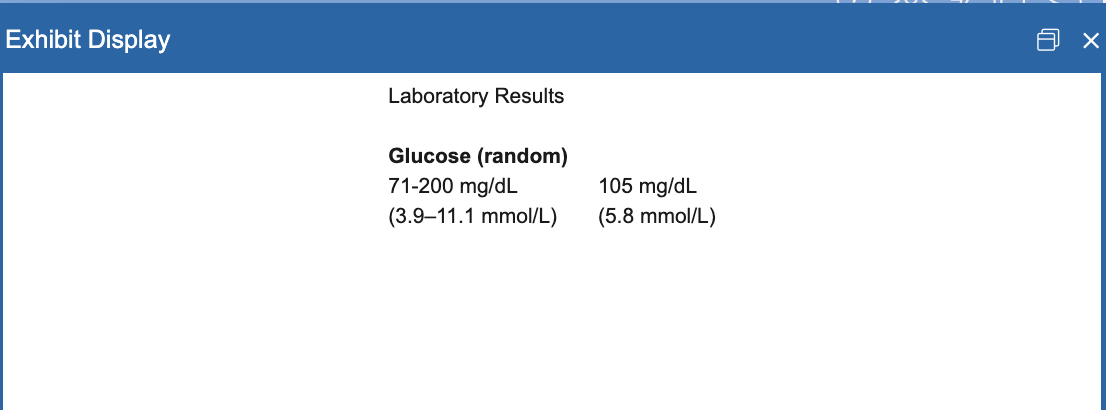
A client’s diabetes is controlled with a morning dose of glargine and a scheduled, fixed dose of lispro with meals. Before breakfast, the client’s finger-stick blood glucose is 105 mg/dL (5.8 mmol/L). The tray is in the room, and the client is eager to eat. What action should the nurse take? click exhibit for additional client information.
administer both insulins as prescribes
hold both insulins
hold the insulin glargine
hold the insulin lispro
administer both insulins as prescribes
Adult Health - Endocrine
The nurse in the ED is caring for a client with hyperosmolar hyperglycemic state. The nurse should recognize that which of the following findings are commonly associated with the condition? SATA
abdominal pain
blood glucose level >600 mg/dL (33.3 mmol/L)
history of type 2 diabetes mellitus
Kussmaul respirations
Neurological manifestations
blood glucose level >600 mg/dL (33.3 mmol/L)
history of type 2 diabetes mellitus
neurological manifestations
Adult Health - Endocrine
The nurse is assessing a client during a routine physical examination. Which of the following findings would be most important to report to the health care provider?
BMI of 30 kg/m²
thickened brownish skin on the neck
elevated fasting cholesterol
round 3×3 mm pale pink mole
thickened brownish skin on the neck
Adult Health - Endocrine
The nurse in the outpatient clinic is caring for assigned client with type 1 diabetes mellitus. Which client should the nurse recognize as having the highest risk of developing hypoglycemia?
29 YO client with new-onset influenza
40 YO client who is a cyclist and is training for an upcoming race
65 YO client with cellulitis of the right leg
72 YO client with emphysema who is receiving prednisone
40 YO client who is a cyclist and is training for an upcoming race

Adult Health - Endocrine
A client with diabetic ketoacidosis is most likely to have which of the following arterial blood gas results? Click exhibit for additional information
pH 7.26, PaCO2 56 mm Hg (7.45 kPa), HCO3 23 mEq/L (23 mmol/L)
pH 7.30, PaCO2 30 mm Hg (3.99 kPa), HCO3 15 mEq/L (15 mmol/L)
pH 7.40, PaCO2 40 mm Hg (5.32 kPa), HCO3 24 mEq/L (24 mmol/L)
pH 7.58, PaCO2 48 mm Hg (6.38 kPa), HCO3 44 mEq/L (44 mmol/L)
pH 7.30, PaCO2 30 mm Hg (3.99 kPa), HCO3 15 mEq/L (15 mmol/L)