practical three
 Call Kai
 Learn
 Practice Test
 Spaced Repetition
 Match
 Flashcards
 Knowt Play
1/69

There's no tags or description
Looks like no tags are added yet.
Name | Mastery | Learn | Test | Matching | Spaced | Call with Kai | Chat |
|---|
No analytics yet
Send a link to your students to track their progress
70 Terms
Direct (fleshy) attachment
The connective tissue of the muscle belly blends directly with the periosteum of the bone.
Indirect attachment
A muscle attaches to a bone or other structure through a tendon or aponeurosis.
Tendon
A cord of dense fibrous connective tissue that attaches a muscle to a bone.
Aponeurosis
A flat sheet of dense fibrous connective tissue that attaches a muscle to another structure.
Muscle belly
The thick, bulging middle portion of a muscle.
Prime mover (agonist)
The muscle primarily responsible for producing a movement.
Antagonist
A muscle that performs the opposite action of another muscle around the same joint.
Synergist
A muscle that helps another muscle perform the same action around the same joint.
Fixator
A muscle that stabilizes a joint or body part so another muscle can move effectively.
Flexion
Movement that decreases the angle between two body parts.
Extension
Movement that increases the angle between two body parts.
Dorsiflexion
Moving the foot upward toward the shin.
Plantar flexion
Pointing the foot downward, away from the shin.
Abduction
Moving a limb away from the body's midline.
Adduction
Moving a limb toward the body's midline.
Circumduction
Moving a body part in a circular motion around a joint.
Rotation
Turning a bone around its long axis.
Medial rotation
Turning a limb inward toward the body's midline.
Lateral rotation
Turning a limb outward away from the body's midline.
Supination
Rotating the forearm so the palm faces upward in anatomical position.
Pronation
Rotating the forearm so the palm faces downward in anatomical position.
Inversion
Turning the sole of the foot inward toward the body's midline.
Eversion
Turning the sole of the foot outward away from the body's midline.
Protraction
Moving a body part forward.
Retraction
Moving a body part backward.
Elevation
Moving a body part upward.
Depression
Moving a body part downward.
Opposition
Moving the thumb to touch the tips of the fingers on the same hand.
Sphincter action
Closing a circular opening in the body.
Orbicularis oculi
Closes the eyelids for blinking and squinting.

Orbicularis oris
Closes the lips.

Zygomaticus major
Pulls the corners of the mouth upward and backward during smiling.
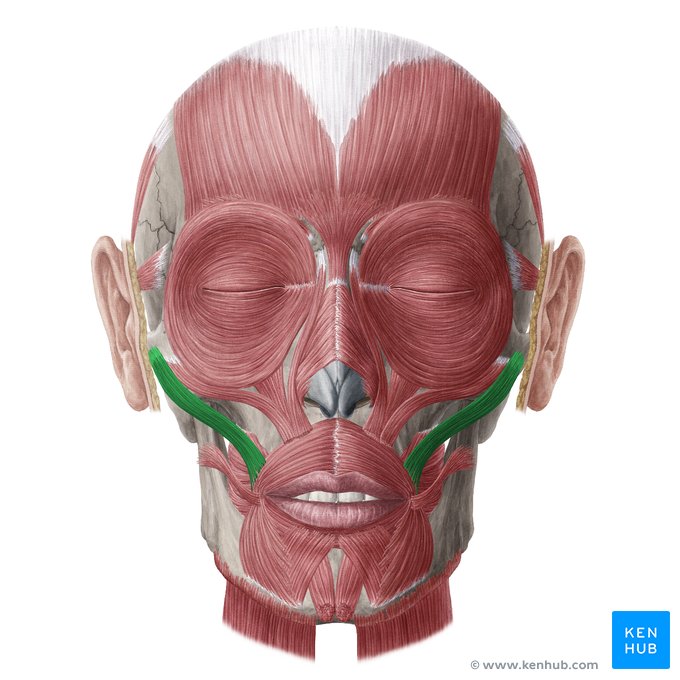
Risorius
Pulls the corners of the mouth laterally, or sideways.

Levator labii superioris (quadratus labii superioris)
Raises the upper lip.

Depressor labii inferioris (quadratus labii inferioris)
Pulls the lower lip downward.

Depressor anguli oris (triangularis)
Pulls the corners of the mouth downward.

Mentalis
Protrudes the lower lip.

Buccinator
Compresses the cheek to keep food between the teeth during chewing and helps move food into position.

Platysma
Pulls the lower lip and corners of the mouth downward and helps depress the mandible.

Masseter
Elevates the mandible to close the jaw during chewing.

Temporalis
Elevates and retracts the mandible.

Digastric
Elevates the hyoid bone when both bellies contract; the anterior belly can depress the mandible when the hyoid is fixed.

Stylohyoid
Elevates the hyoid bone.

Mylohyoid
Elevates the hyoid bone and raises the floor of the mouth.

Sternohyoid
Depresses the hyoid bone.

Omohyoid
Depresses the hyoid bone.

Sternocleidomastoid (SCM)
Both muscles contracting together flex the neck; one contracting alone laterally flexes the neck to the same side and rotates the head to the opposite side. It also assists inhalation.

Scalenes
Flex the neck and elevate the first and second ribs during inhalation.

Trapezius
Retracts the scapula and extends the neck.

Splenius (capitis)
Extends the neck.

Erector spinae
A group of three muscle columns that extend the neck and vertebral column.

Iliocostalis
The lateral column of the erector spinae group.
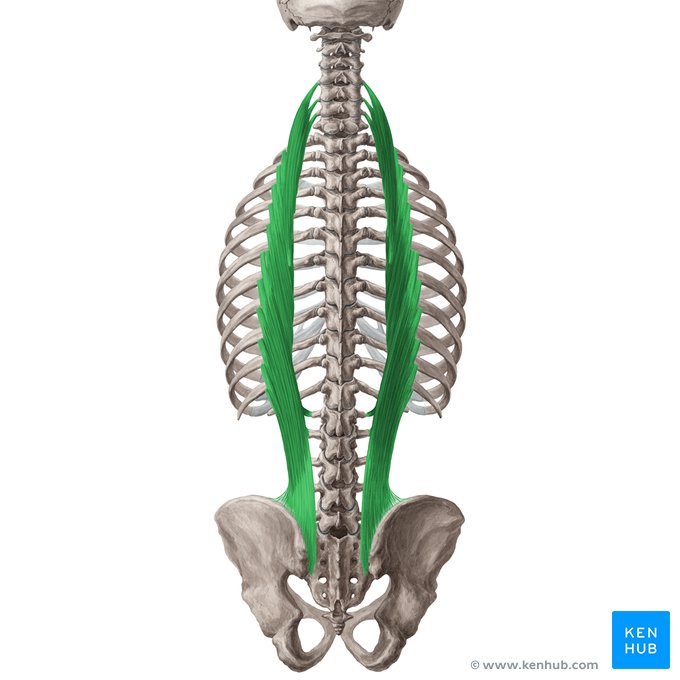
Longissimus
The intermediate column of the erector spinae group.
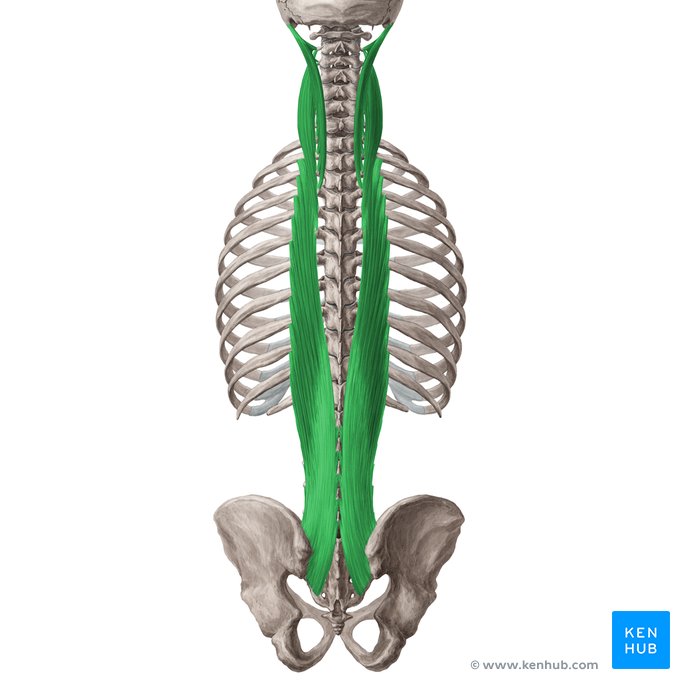
Spinalis
The medial column of the erector spinae group.

External intercostals
Elevate the ribs and increase thoracic volume during inhalation.

Internal intercostals
Depress the ribs and decrease thoracic volume during forced exhalation.

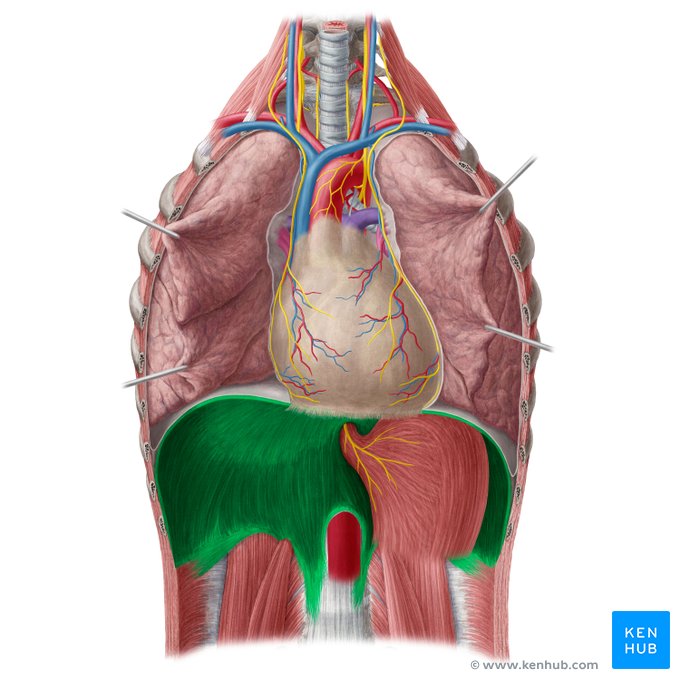
Diaphragm
The primary muscle of inhalation; contracts and moves downward to increase thoracic volume. It can also compress abdominal contents.
Rectus abdominis
Flexes the vertebral column and compresses abdominal contents.

External oblique
Flexes the vertebral column and compresses abdominal contents.

Internal oblique
Flexes the vertebral column and compresses abdominal contents.

Linea alba
A tendinous seam, or white line, running from the sternum to the pubic symphysis.

Pectoralis minor
Protracts and depresses the scapula and can assist inhalation.

Serratus anterior
Protracts the scapula, moving it forward around the rib cage.

Subclavius
Depresses and stabilizes the clavicle.

Levator scapulae
Elevates, retracts, and rotates the scapula.

Rhomboid major and minor
Retract the scapula, pulling it toward the vertebral column.

Buccinator
Draws corners of mouth posteriorly, compresses cheek to hold food between teeth.

Suprahyoid muscles
Muscles above the hyoid bone that help elevate it and assist movements of the jaw and swallowing.
Infrahyoid muscles
Muscles below the hyoid bone that help depress the hyoid bone.
Superficial muscles of thorax
Movers of the scapula.