Antimicrobial therapies
 Call Kai
 Learn
 Practice Test
 Spaced Repetition
 Match
 Flashcards
 Knowt Play
1/134

There's no tags or description
Looks like no tags are added yet.
135 Terms
Which pathogen was targeted by Salvarsan?
Treponema pallidum.
What disease is caused by Treponema pallidum?
Syphilis.
What major limitation restricted the use of Salvarsan?
Toxicity.
Was Prontosil bactericidal or bacteriostatic?
Bacteriostatic.
Why are sulphonamides often combined with trimethoprim?
Both inhibit sequential steps of folate synthesis.
What is co-trimoxazole?
A combination of sulfamethoxazole and trimethoprim.
Why are sulphonamides becoming more important again?
Increasing resistance to other antibiotic classes has renewed their use.
What is selective toxicity?
Selective inhibition or destruction of microorganisms while minimizing harm to host cells.
How do antibiotics achieve selective toxicity?
By targeting structures or processes that differ between bacteria and humans.
Why is the bacterial cell wall an excellent antibiotic target?
Peptidoglycan is absent from human cells.
What are the repeating sugar units of peptidoglycan?
N-acetylglucosamine (NAG) and N-acetylmuramic acid (NAM).
What gives the bacterial cell wall mechanical strength?
Peptide cross-links between peptidoglycan strands.
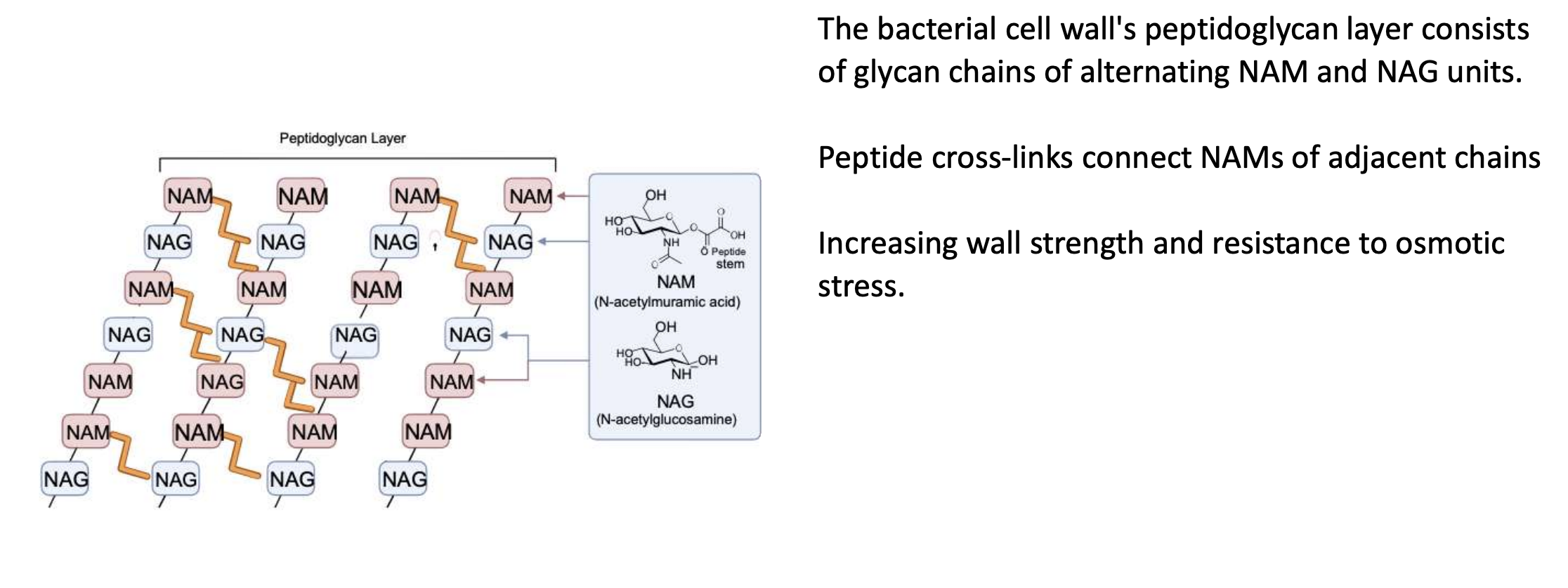
Why does peptidoglycan help bacterial survival?
It protects against osmotic stress.
What do penicillin-binding proteins normally do?
Catalyse peptidoglycan synthesis and cross-linking.
What is the critical action of beta-lactam antibiotics?
Inhibition of peptidoglycan cross-linking.
Why does inhibition of PBP activity kill bacteria?
The cell wall weakens, leading to osmotic lysis.
Why are beta-lactams bactericidal?
They cause structural failure of the bacterial cell wall.
What feature is shared by all penicillins?
A beta-lactam ring and common penicillin nucleus.

How can different penicillin derivatives achieve different spectra of activity?
Modification of side chains alters antibacterial properties.
What was the purpose of developing anti-staphylococcal penicillins?
To resist degradation by staphylococcal penicillinase.
Why do newer beta-lactams not eliminate antibiotic resistance?
Bacteria evolve resistance mechanisms against them.
What structural feature determines many cephalosporin properties?
The side chains at positions 3 and 7.

How does cephalosporin evolution generally change antibacterial activity?
Each generation extends activity further into Gram-negative organisms.
What trend occurs across cephalosporin generations?
Progressively broader Gram-negative coverage.
What molecule does vancomycin target?
Lipid II and D-Ala residues involved in peptidoglycan synthesis.
How does vancomycin differ from beta-lactams?
It inhibits cell wall synthesis through a different target (Lipid II component of cell wall biosynthesis, as well as wall crosslinking via D-ala residues)
Why has vancomycin use increased despite toxicity concerns?
Rising prevalence of resistant organisms such as MRSA.
What ribosomal difference underlies selective toxicity of many protein synthesis inhibitors?
Bacteria possess 70S ribosomes whereas humans possess 80S ribosomes.
What subunits make up the bacterial ribosome?
30S and 50S subunits.
What subunits make up the eukaryotic ribosome?
40S and 60S subunits.
How do macrolides inhibit bacterial growth?
By binding the 50S subunit and blocking amino-acyl transfer.
What is the consequence of macrolide action on translation?
Truncated, incomplete polypeptides are produced.
Name three clinically important macrolides.
Erythromycin, clarithromycin and azithromycin.
How do aminoglycosides inhibit bacterial growth?
They target the 30S subunit and disrupt proofreading during translation, alongside damaging the cell membrane
Why are aminoglycosides bactericidal while many protein synthesis inhibitors are bacteriostatic?
They generate abnormal proteins and also damage cell membranes.
What are two major toxicities of aminoglycosides?
Nephrotoxicity and ototoxicity.
Name four important aminoglycosides.
Gentamicin, amikacin, tobramycin and streptomycin.
How does linezolid inhibit protein synthesis?
It inhibits initiation of translation by binding 50S rRNA.
Is linezolid bactericidal or bacteriostatic?
Bacteriostatic.
What spectrum does linezolid mainly have?
Gram-positive organisms.
Why can sulphonamides exhibit selective toxicity?
Humans lack dihydropteroate synthase.
Why are bacteria vulnerable to folate synthesis inhibitors?
Bacteria must synthesise folate de novo.
Why are humans less affected by sulphonamides?
Humans obtain folate through diet.
What enzyme is inhibited by trimethoprim?
Dihydrofolate reductase.
Why is trimethoprim relatively selective for bacteria?
Bacterial DHFR binds trimethoprim more strongly than human DHFR.
What enzyme is targeted by quinolones in Gram-negative organisms?
DNA gyrase.
What enzyme is targeted by quinolones in Gram-positive organisms?
Topoisomerase IV.
Describe quinolones.
Synthetic, broad-spectrum, bactericidal antibiotics.
Why are quinolones bactericidal?
They disrupt essential DNA replication processes.
What is the target of rifampicin?
The RpoB subunit of bacterial RNA polymerase.
Why is rifampicin rarely used alone?
Resistance develops readily through spontaneous mutations.
What distinctive side effect of rifampicin may affect compliance?
Orange-red discolouration of secretions.
Why is rifampicin a major TB drug?
It powerfully inhibits bacterial transcription.
What is the mechanism of action of daptomycin?
Disruption of the bacterial cell membrane.
Is daptomycin bactericidal or bacteriostatic?
Bactericidal.
What spectrum does daptomycin primarily have?
Gram-positive organisms.
What determines whether an organism is classified as resistant?
Its MIC exceeds clinically achievable therapeutic concentrations.
What is MIC?
The minimum inhibitory concentration needed to prevent visible microbial growth.
What is MIC50?
The concentration inhibiting 50% of isolates.
What is MIC90?
The concentration inhibiting 90% of isolates.
Why must resistance tests be interpreted cautiously?
In vitro results may not precisely predict in vivo behaviour.
Name three methods used to detect resistance.
Disc diffusion, broth microdilution and PCR detection of resistance genes.
Why can antibiotic under-dosing encourage resistance?
It applies selection pressure without eliminating resistant mutants.
How does natural selection drive antimicrobial resistance?
Antibiotic exposure favours survival and expansion of resistant organisms.
Why may resistant bacteria have a fitness cost in antibiotic-free environments?
Resistance mutations can slow growth or reduce competitiveness.
Why do resistant strains become dominant during antibiotic treatment?
Susceptible competitors are eliminated by selection pressure.
What evidence demonstrates resistance predates modern medicine?
Resistance genes have been identified in microbial samples approximately 30,000 years old.
Why is resistance considered a natural phenomenon?
Microbes have co-evolved resistance mechanisms against naturally occurring antibiotics for millions of years.
Why does extensive antibiotic use accelerate AMR evolution?
It provides strong selection pressure.
What four major mechanisms produce antibiotic resistance?
Altered target site, antibiotic inactivation, altered metabolism and decreased drug accumulation.
How does MRSA resist beta-lactams?
It acquires PBP2a encoded by mecA.
Why is PBP2a effective against beta-lactams?
It has low affinity for beta-lactam antibiotics.
How does the erm gene confer macrolide resistance?
It methylates the 50S ribosomal target site.
How do vancomycin-resistant enterococci resist treatment?
They alter the peptide target recognised by vancomycin.
How does quinolone resistance commonly arise?
Point mutations in DNA gyrase or topoisomerase genes.
How does rifampicin resistance commonly arise?
Mutations in rpoB.
How do beta-lactamases cause resistance?
They hydrolyse and inactivate beta-lactam antibiotics.
What are examples of antibiotic-inactivating enzymes?
Beta-lactamases and chloramphenicol acetyltransferases.
What is an ESBL?
An extended-spectrum beta-lactamase capable of degrading many cephalosporins.
Why is NDM-1 clinically important?
It can destroy a very broad range of beta-lactam antibiotics.
What is a penicillinase?
A beta-lactamase that preferentially hydrolyses penicillins.
What is a cephalosporinase?
A beta-lactamase that preferentially hydrolyses cephalosporins.
What antibiotic class usually remains active against ESBL-producing organisms?
Carbapenems.
Why is AmpC beta-lactamase clinically important?
It can destroy cephalosporins and is not inhibited by clavulanic acid.
What are carbapenemases (CPE)?
Beta-lactamases capable of destroying carbapenems and many other beta-lactams.
What is clavulanic acid?
A beta-lactamase inhibitor that protects susceptible beta-lactam antibiotics.
How can bacteria become resistant to sulphonamides through altered metabolism?
By overproducing PABA.
How can metabolic pathway switching cause resistance?
Bacteria reduce dependence on the inhibited pathway.
Why does porin loss cause resistance in Gram-negative bacteria?
The antibiotic can no longer efficiently enter the cell.
Why are Gram-negative bacteria particularly susceptible to porin-mediated resistance?
Drugs must cross the outer membrane before reaching their targets.
Which pathogen commonly develops carbapenem resistance through porin loss?
Pseudomonas aeruginosa.
How do efflux pumps cause resistance?
They export antibiotics before inhibitory intracellular concentrations are reached.
Why can one efflux pump mutation create multidrug resistance?
Some pumps export many unrelated antibiotic classes.
What is AcrAB-TolC?
A multidrug efflux pump found in Gram-negative bacteria.
What is Tet(A)?
A plasmid-mediated tetracycline efflux pump.
What is Mef(A)?
A streptococcal macrolide efflux pump.
What is horizontal gene transfer?
Movement of genetic material between bacteria outside parent-offspring inheritance.
What three major mechanisms mediate horizontal gene transfer?
Transformation, transduction and conjugation.
Why are plasmids important in AMR?
They often carry multiple resistance genes.
What are plasmids?
Extrachromosomal circular DNA molecules capable of independent replication.