The Integumentary System
 Call Kai
 Learn
 Practice Test
 Spaced Repetition
 Match
 Flashcards
 Knowt Play
1/64

Earn XP
Description and Tags
65 Terms
External covering of an animal
Integument
Single-celled Protozoa
Plasma membrane as external covering
The integument is the
external covering of an animal
The skin is the largest organ with respect to
surface area
Which is NOT a function of the integument?
digestion of food
The external covering of single-celled protozoa is the
plasma membrane
The thick protein coat of Paramecium and Euglena is the
pellicle
In most multicellular invertebrates, the epidermis is the outer layer made of
a single layer of columnar epithelial cells
The epidermis of Hydra is
a few cell layers thick
Nematodes and annelids have an epidermis that is
one cell thick and secretes a multilayered cuticle
The waxy cuticle in the epidermis is found in
rotifers, crustaceans, arachnids, insects, nematodes, and annelids
The CaCO3 shell is found in
cnidarians (corals) and echinoderms (starfish, sea urchins)
The tegument of parasitic flatworms is used for
nutrient absorption and protection against host enzymes
Echinoderms have an epidermis that is
ciliated, with a dermis containing CaCO3
Arthropods are the most complex invertebrates because their integument is a
specialized chitinous exoskeleton
The two main layers of vertebrate skin are the
epidermis and dermis
The epidermis is the outermost layer made of
squamous epithelial tissue, one to several cells thick
Jawless fishes (lampreys and hagfishes) have thick skin due to
a multilayered epidermis with glandular cells and fat storage cells in the hypodermis
Denticles, bony structures resembling teeth, are found in the skin of
cartilaginous fishes (sharks)
Bony fishes (teleosts) have skin that contains
scales
Which vertebrates have stratified skin with mucous and poison glands plus pigmentation?
amphibians
The warts of toads are
special sensory structures with sensory cells
Which vertebrates have a thick epidermis with keratinized scales and no integumentary glands, resulting in dry skin?
reptiles
Birds have a soft, thin epidermis with no epidermal glands and
feathers
Which tough coiled protein waterproofs the skin and provides strength and flexibility?
keratin
Melanin, which protects the skin from UV, is produced by
melanocytes
Skin pigmentation in frogs is due to
chromatophores
The uppermost thin layer of flat dead cells that is constantly shed off is the stratum
corneum
The stratum germinativum is a thick inner layer of stratified squamous epithelium that is
actively dividing
The stratum germinativum is composed of
S. granulosum, S. spinosum, and S. basale
The stratum lucidum is found only in
thick skin such as palms, soles, and digits
Which is NOT a characteristic of epidermal cells?
they remain alive and permanent in the stratum corneum
The dermis is composed of dense/fibrous connective tissue made of collagen, which imparts
strength and flexibility
Which dermal layer is loose connective tissue with blood vessels, nerves, and cutaneous glands?
papillary layer (stratum spongiosum)
Which dermal layer is a thick lower layer of dense irregular connective tissue with mostly collagen fibers?
reticular layer (stratum compactum)
Hairs are derived from the
epidermis
When the hair muscle (arrector pili) contracts, it
pulls the hair erect
Nails are made of
keratin
Sweat (sudoriferous) glands in the deeper dermis function in
sweating for cooling
Which gland secretes sebum, an oily substance that lubricates and softens?
oil (sebaceous) gland
The hypodermis (subcutaneous layer)
is not part of the skin itself, is abundant in adipose, and binds the skin to the body

Whats the part of the black bracket called?
Papillary layer

Whats the maroon line pointing to?
Stratum corneum

whats the red line pointing to?
Stratum lucidum
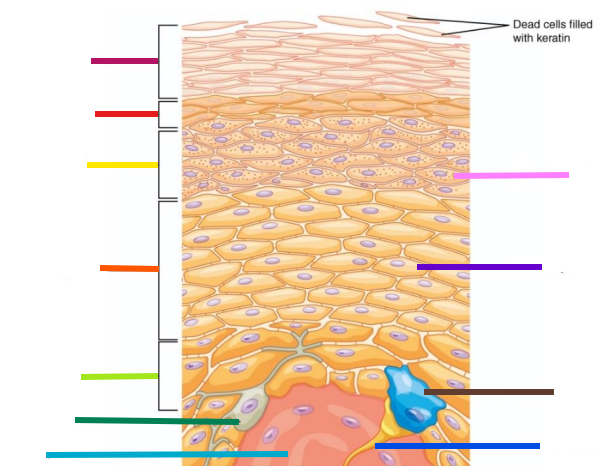
whats the yellow pointing to?
Stratum granulosum
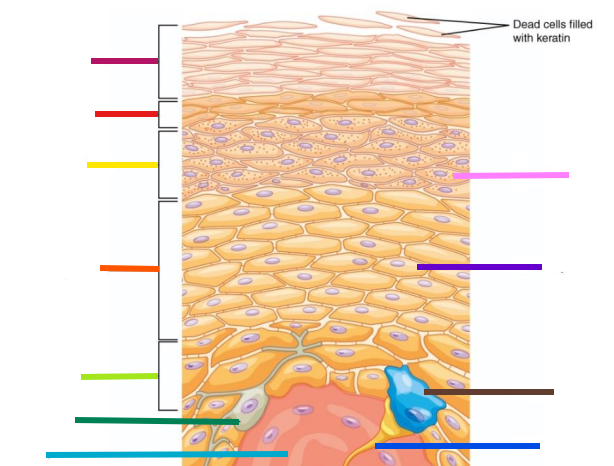
whats the orange line pointing to?
Stratum spinosum

whats the light green line pointing to?
Stratum basale

whats the dark green line pointing to?
Melanocyte
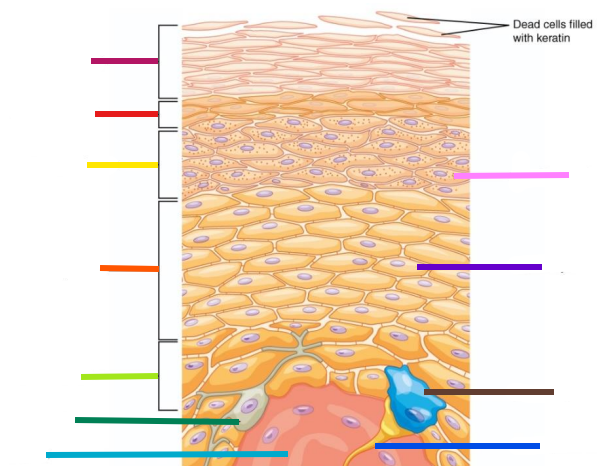
Whats the light blue pointing to?
Dermis

Whats the dark blue pointing to?
Sensory neuron

whats the brown line pointing to ?
Merkell cell
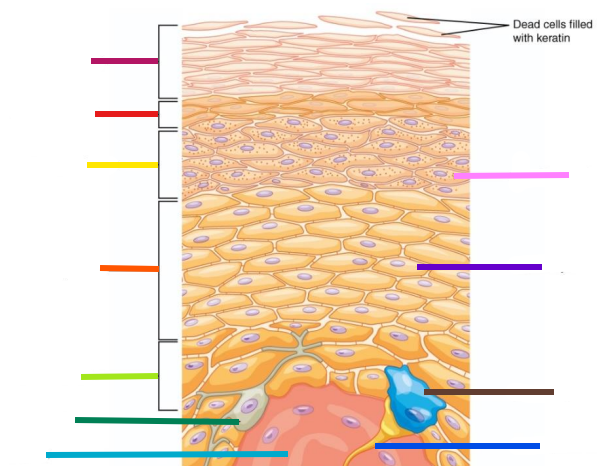
whats the purple line pointing to?
Keratinocyte

whats the pink line pointing to?
Lamellar granules

whats the pink line pointing to?
Merkel’s discs

whats the purple line pointing to?
skin surface

whats the brown line pointing to?
Ruffini’s corpuscles

whats the green line pointing to?
Pacinian corpuscles

whats the blue line pointing to?
Meissner’s corpuscles
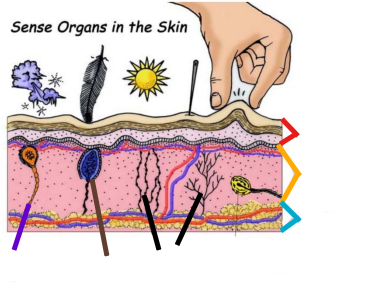
whats the red line pointing to?
epidermis

whats the orange line pointing to?
dermis

whats the blue line pointing to?
hypodermis

whats the black line pointing to?
Nociceptors

whats the brown line pointing to?
Meissner’s corpuscles

whats the purple line pointing to?
Thermoreceptors

whats the dark blue line pointing to?
Pacinian corpuscles