Chapter 2 - Lewis Structures
 Call Kai
 Learn
 Practice Test
 Spaced Repetition
 Match
 Flashcards
 Knowt Play
1/37

Earn XP
Description and Tags
27/09/26
38 Terms
compounds
chemicals that are combinations of two or more different elements in defined proportions
they do not have overall charges
they are isolable, which allows chemists to easily study them
what does it mean to be isolable?
it means that they can be isolated from condensed phases (liquid/solid) because they are neutral, allowing them to be easily studied
ions and their subdivisions
species carrying an overall charge
can be cations or anions (single positive or negative charged ____)
____ that contain a single atom are called simple ____
____ that contain multiple atoms are called complex, polyatomic, or molecular ___
in contrast to compounds, ____ are not isolable due to thier overall charge, and need a counter-___ (an ___ of opposite charge) to form a net neutral compound and become isolable
chemical bonds
these consist of electrons that simultaneously feel the electrostatic forces of attraction for both of the positively charged nuclei of adjacent atoms.
by forming these, the elements achieve a lower overall energy than they would in their atomic form
there are three types: ionic, covalent, and, metallic
metallic bonds
occur when electrons are shared between many atoms simultaneously and are free to “flow” between the atoms. in elemental metals or metallic alloys (mixtures of two or more metals), the most important type of bond is the metallic bond
what decides between which kind of bond is b/w two atoms?
the electronegativity difference between the two atoms (the higher it is, the more likely its ionic)
electronegativity
the tendency of an atom in a molecule to attract electrons to itself
the thing that causes polarity in molecules
it is not a property of the atom, it is the property of an atom within a molecule. it cannot be measured when the atom is outside of a bond, instead is calculated based on other characteristics
electronegativity and size
typically, the more protons in the nucleus, the more positivity is there to attract more electrons, but in actuality, a high amount of protons means a high amount of electrons already with the atom, that repel any incoming electrons
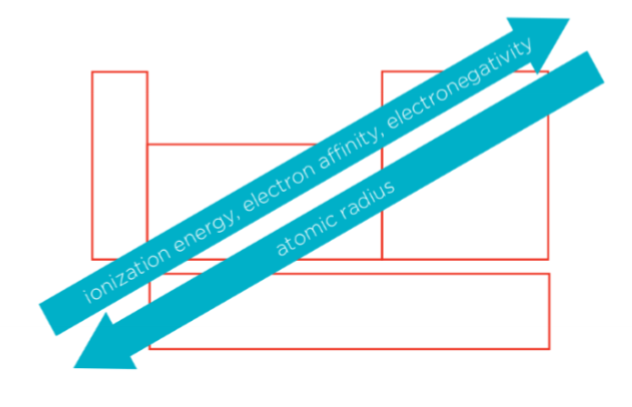
Electronegativity trends on the periodic table, and a small ranking
the most electronegative atom is fluorine, and then oxygen, then chlorine, then nitrogen and then so on
homonuclear diatomic bonds and electronegativity
in homonuclear diatomic bonds (a bond between two identical atoms, think HOFBRINCL) are an example of non-polar covalent bonds, as polarity stems from electronegativity differences, which wont exist between two of the same atom
all heteronuclear covalent bonds are polar to some degree
polar covalent bonds
in these bonds, electrons are polarized toward the atom with greater electronegativity, which gives rise to a bond dipole
i.e., they are shared unequaly and the atoms have partial charges
ionic compounds (salts)
these contain ions held together by electrostatic forces
these are formed by a redox reaction b/w a metal and non-metal (have a large diff in EN)
covalent bonds
these exist when pair(s) of electrons are shared b/w two atoms
in general, an element will form one of these to achieve a closed shell, with an electron configuration matching a noble gas
lewis structure
a chemical representation that uses lines as bond pairs and pairs of dots for lone pairs
bond order
the number of bonding pairs of electrons b/w two atoms
b.o. = 1 = single bond, etc.
bond length
the distance b/w the two nuclei participating in the bond
bond dissociation energy
the amount of energy required to completely separate two bonded atoms
relationships b/w bond adjectives
a high bond length usually means a low bond order
and a high bond order means a higher dissociation energy
note: these are not laws, usually just trends
the Octet Rule
its the goal of any atom to fill its outer shell and have 8 valence electrons
note: hydrogen makes duets, as it only has one 1 shell and needs 2 electrons
note: theres exceptions to this rule
electron deficient species
some group 13 elements can exist with just 6 valence electrons. this does violate the octet rule, but it just happens, and they’re stable
on occasion, an electron deficient species could manage to fill its octet if it had a double bond, but often, this doesn’t happen because the bonded atoms are high EN
hypervalent species
these are species containing elements of the third and later periods of the p-block, and sometimes have more than an octet of electrons
free radicals
species containing upaired electrons
ex: nitric oxide
what is percent ionic character?
% ionic character = ((measured dipole moment of X-Y)/ (calculated dipole moment of X+Y-)) x100
formal charge
represents the difference between the number of valence electrons present in the neutral atom and the number of valence electrons in a particular Lewis structure
formal charge values assume that the bonding electrons are shared equally b/w the bonded atoms
calculating formal charge
determine the number of valence electrons in the desired atom as if it was unbonded
count the outer shell electrons surrounding the bonded atom in the compound or ion (draw a circle around its lewis, count split bonds as 1e-)
formal charge = (regular valence count) - (what it has in the structure)
label the formal charges:
show only non-zero charges
they must be indicated by putting the charge in a circle near the atom that has it
dont show the number if its a singular charge
any unmatched formal charges become the overall charge of the atom

how to draw lewis structures
put the least EN atom as the central atom
count total valence e-s
add/subtract formal charges
form the skeleton between the atoms using single bonds
add electrons to outer atoms (prioritizing high EN atoms)
add remainders to the central atom
move lone pairs from outer pairs to form double bonds w/ central to fil its octet (when possible)
make the central hypervalent (if possible) to reduce FC
add FC’s
check for alternate structures, eliminate the least likely
checks to determine what makes a good lewis structure
minimized formal charges
valid octets
you haven’t made something hypervalent
high EN atoms have most electrons??? (if theres a - FC, put it on something EN)
resonance structures
when two or more valid Lewis structures can represent the arrangement of electrons in the same molecule/ion
only electrons in multiple bonds or lone pairs can “move“ between the resonant lewis structures
the arrangement of atoms does not change, and the overall charge doesn’t change either

what’s the best resonance structure? (in comparison to chemically reasonable)
a structure that has minimal formal charges, but keeps negative ones on more electronegative atoms (and vice versa). if appropriate, heavier elements can exceed the octet to minimize formal charge

what is a chemically reasonable resonance structure? (in comparison to best)
where the magnitudes of the FC are small, (maybe not minimized). these represent bonding that is typical of various elements and is consistent with experimental observations
what are isomers?
chemical species that have the same formula, but different arrangements of atoms
isomers vs resonance structures
isomers rearrange atoms
resonance structures rearrange electrons
to identify, look for changes in bonds/lone pairs
or movement of atoms
hypervalence and the octet rule
hypervalence only exists on the central atom. terminal atoms cannot have expanded octets
the octet rule is not exceeded unless it is necessary to reduce formal charges to to make a bond with all the atoms
RULE OF THUMB: when expanding the octet to minimize formal charge, the octet rule should not be exceeded if it results in placing a negative formal charge on an atom of lower electronegativity
formal charges, oxidation states, and partial charges
formal charges: assumes the electrons are shared equally between the two bonded atoms (covalent bonding)
oxidation state: assumes the bonding electrons are given to the more electronegative atom (ionic bonding)
partial charger: most representative of the actual charge distribution in a bond
oxidation state rules
the o state for a free element is 0
for a simple (monoatomic) ion, the o state is = to the net charge on the ion
hydrogen has a o state of +1, and oxygen has an o state of -2 in most compounds.
exceptions: hydrogen in hydrides of active metals (-1)
why does oxygen typically have an o state of 2-?
because its highly EN, and therefore it “wins” all the electrons in its circle, meaning it almost always has 8 electrons to it, and with its usual 6 valence e-, it always gets 2-
in a similar vein, fluorine always has a - because it brings 7 but always gets 8
edge cases of o states
if two of the same atom are bonded, the have the same EN, so they can split a bond 50/50
and, if two atoms are splitting a bond, they don’t have to share with their other neighbours if they don’t have the same EN

is it possible for an atom to have the same FC and o state?
yes, all homonuclear diatomic are, and there’s more