Orgo practice problems II
 Call Kai
 Learn
 Practice Test
 Spaced Repetition
 Match
 Flashcards
 Knowt Play
1/34

There's no tags or description
Looks like no tags are added yet.
35 Terms
Draw the major product that is obtained when (2S,3S)-2-bromo-3-phenylbutane is treated with sodium ethoxide (NaOEt), and explain the stereochemical outcome of this reaction.
for an E2 reaction, the leaving group and beta hydrogen must be antiperiplanar. Once the double bond is formed, we must recognize that double bonds possess planar geometry, placing the dashed CH3 group on a solid line


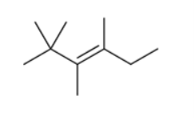
Each of the following compounds can be prepared from an alkyl iodide and a suitable nucleophile. In each case, identify the alkyl iodide and the nucleophile that you would use.

Each of the following compounds can be prepared from an alkyl iodide and a suitable nucleophile. In each case, identify the alkyl iodide and the nucleophile that you would use.


Each of the following compounds can be prepared from an alkyl iodide and a suitable nucleophile. In each case, identify the alkyl iodide and the nucleophile that you would use.
use CH3COONa to get a charged, strong nucleophile (CH3COO-)


Each of the following compounds can be prepared from an alkyl iodide and a suitable nucleophile. In each case, identify the alkyl iodide and the nucleophile that you would use.
use NaCN to get strong, charged nucleophile (CN-)


use NaSH to get a strong, charged nucleophile


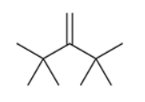

In each of the following cases, draw the structure of an alkyl halide that will undergo an E2 elimination to yield only the indicated alkene.
draw either or (only need one for exam)


In each of the following cases, draw the structure of an alkyl halide that will undergo an E2 elimination to yield only the indicated alkene.
draw either or (only need one for exam)


In each of the following cases, draw the structure of an alkyl halide that will undergo an E2 elimination to yield only the indicated alkene.
draw either or, only need one for exam
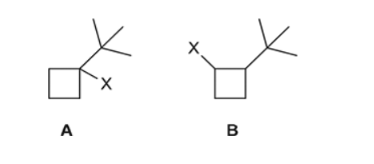

In each of the following cases, draw the structure of an alkyl halide that will undergo an E2 elimination to yield only the indicated alkene.

Draw the transition state for the reaction between tert-butyl chloride and sodium hydroxide.
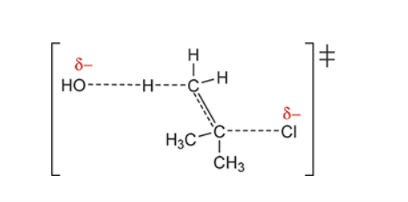


CH3OH
(a substitution has taken place, meaning it is Sn1 or Sn2, but the substrate is tertiary indicating SN1, meaning we need a weak base)

an elimination has taken place, meaning E2 or E1, however the substrate is tertiary, meaning E1. We need a concentrated acid


TaCl/Py and NaSH


In substituted cyclohexenes, E2 will be achieved if the leaving group and beta hydrogen can achieve anti-periplanarity. This is only achieved when one is on a wedge and the other is on a dash. In this case, the Br is on a wedge and the only dashed hydrogen is on the carbon to the left. leading to the hoffman product


Draw a plausible mechanism for each of the following transformations:


Draw a plausible mechanism for each of the following transformations:
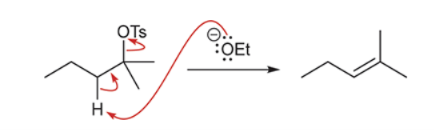

Draw a plausible mechanism for each of the following transformations:
(note that this is solvolysis no strong nuc or base bc Et is not a spectator to get rid of)
solvolysis favors E1 and Sn1, first mechanism is E1 (double bond) and the second is SN1 (substitution)
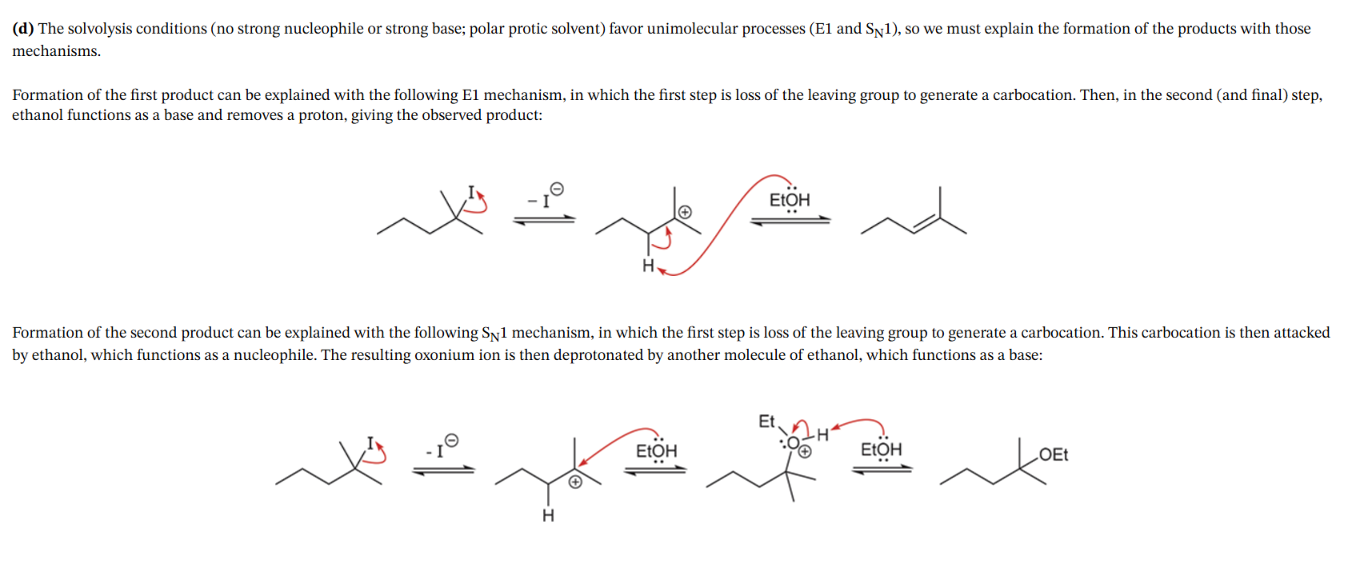

The chiral center is lost when the leaving group leaves and a carbocation with trigonal planar geometry is formed. The nucleophile can then attack either face of the planar carbocation with equal probability, leading to a racemic mixture


Identify reagents that can be used to achieve each of the following transformations. Two steps may be required.
NaOH

Identify reagents that can be used to achieve each of the following transformations. Two steps may be required.
HBr (SN1 reaction, OH must be protonated first and then the substrate can be substituted)

Identify reagents that can be used to achieve each of the following transformations. Two steps may be required.
OH-
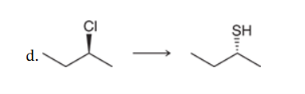
Identify reagents that can be used to achieve each of the following transformations. Two steps may be required.
NaSH

Identify reagents that can be used to achieve each of the following transformations. Two steps may be required.
TsCl, py ….. NaCN

Identify reagents that can be used to achieve each of the following transformations. Two steps may be required.
t-BuOK

solvolysis is associated with SN1 and E1 reaction mechanisms
for A, the molecule on the right will undergo solvolysis faster bc it is a tertiary halide, which is favored by SN1 and E1.
for B, the compound on the right will undergo solvolysis faster bc it is a tertiary allylic halide and is more stabilized

In the first Newman projection, the phenyl groups (highlighted) are anti to each other, so the transition state is not expected to exhibit a steric interaction between the phenyl groups. In contrast, the second Newman projection exhibits a gauche interaction between the two phenyl groups (highlighted), so the transition state is expected to exhibit a steric interaction. Therefore, trans-stilbene is formed at a faster rate than cis-stilbene (because formation of the less stable cis-stilbene involves a higher energy transition state).
B.) trans stilbene is still the major product because the newman projection displays no steric hinderance when the phenyl groups are antr-periplanar

There are two stereoisomers of 1-tert-butyl-4-chlorocyclohexane. One of these isomers reacts with sodium ethoxide in an E2 elimination that is 500 times faster than the reaction of the other isomer. Draw the most stable chair conformation of each stereoisomer, identify the isomer that reacts faster, and explain the difference in rate for these two isomers.
This conformation rapidly undergoes an E2 reaction, because it has anti-periplanar β protons readily available. Therefore, the cis isomer is the one that reacts 500 times faster.
(cl points eq down in other chair and is on dash for other isomer)
