5 Stages of Spelling Development
 Call Kai
 Learn
 Practice Test
 Spaced Repetition
 Match
 Flashcards
 Knowt Play
1/7

There's no tags or description
Looks like no tags are added yet.
8 Terms
Pre-communicative Spelling
A child uses letters from the alphabet to represent words without demonstrating knowledge of letter-sound correspondence. The words appear as random strings of letters.

Semiphonetic Spelling
Some knowledge of letter-sound correspondence is apparent in a child's attempt to spell. It is common to see single letters used to represent whole words, syllables, or sounds in which multiple letters are conventionally used.
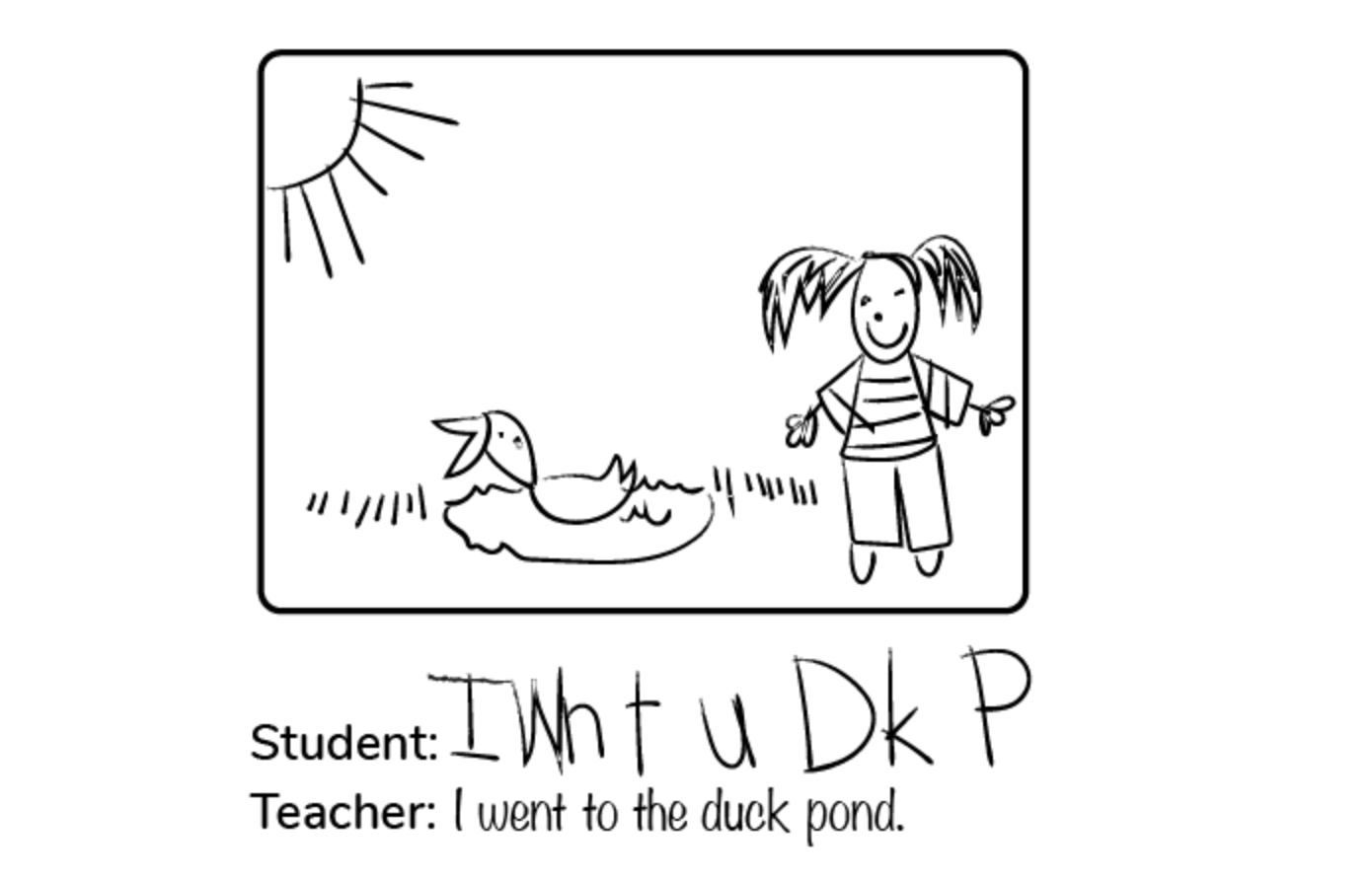
Phonetic Spelling
A child uses a letter or group of letters to represent every sound heard in a word. Spelling choices still may not be conventional, but they are easily understood through the lens of letter-sound correspondence.

Transitional Spelling
A child moves from depending solely on knowledge of letter-sound correspondence to incorporating knowledge of word structure and common visual representations of words in their spelling as well. More conventional spelling is present in the child's writing, but misspellings are still common and frequent.

Conventional Spelling
A child applies knowledge of letter-sound relationships, general spelling rules, and morphology in their spelling. The child is better able to recognize misspellings, and the spelling in their writing is generally correct.

Morphology
the study of forms of words, including affixes, roots, stems, and parts of speech
The word "bicycles" is made up of three individual morphemes. The prefix bi-, the stem cycle, and the suffix -s.
Morpheme
a combination of sounds that has meaning in speech or writing and cannot be divided into smaller grammatical parts; this includes prefixes and suffixes
write, cat, laugh, box