Lab Practical 4
 Call Kai
 Learn
 Practice Test
 Spaced Repetition
 Match
 Flashcards
 Knowt Play
1/138

There's no tags or description
Looks like no tags are added yet.
139 Terms
What are the 3 things the nervous system do?
monitors the body’s internal and external environments
integrates sensory information
coordinates voluntary + involuntary responses
The brain and spinal cord are enclosed + protected by?
Cranium + vertebral column
What is the purpose of CNS?
Integrates + coordinates processing of sensory data + transmission of motor commands
What can the CNS hold?
Intelligence, memory, and emotion
Nerves are what?
Bundles of nerve fibers
Ganglia are what?
Collections of the nerual cell bodies
How many cranial nerves are there?
12
How many peripheral nerves are there?
31
Name the 3 brain regions
Forebrain, Midbrain, and Hindbrain
Forebrain has 5 main structures
Cerebrum (frontal, parietal, occipital, and temporal lobes)
Dicephalon
Located on Ventral portion of brain
Thalmus + Hypothalmus
Pituitary glands and mammilary glands
The Midbrain has 2 main structures
Superior and inferior colliculi
Cerebral peduncles
The Hindbrain has 3 main structures
Cerebellum (adjacent to the brainstem and 2 hemispheres)
Pons
Medulla Oblongata
Functions of the cerebrum
conscious thoughts, sensations, intellectual functions, memory storage, processing, and complex movement
Diencephalon describe
hollow and connects to the cerebrum
its largest portion is the thalmus
The floor is the hypothalamus
Describe the Thalmus
relay and processing center for sensory information
Hypothalamus
emotion center, autonomic function, and hormone production
Pituitary describe
Narrow stalk connecting the hypothalamus to the pituitary
Primary link between the nervous system and the endocrine system
The midbrain is referred to as?
the Mesoncephalon
Superior and inferior colliculi describe
Corpra quadrigemina (4 bumps)
Cerebral peduncles
Describe the midbrains functions
processes visual and auditory information
generates involuntary motor responses
Describe the cerebellum
gray + white matter called arbor vitae
Describe the Pons
Connects the cerebellum to the brainstem
Track and relay center
Contains nuclei involved in somatic and visceral motor control
Describe the medulla oblongata
Connects the pons to the spinal cord
Relays sensory information to the thalamus and brainstem
Contains centers that regulate autonomic functions
Gyri (gyrus)
elevated ridge of tissue
increase surface area and number of neurons in the cortex
Sulci (sulcus)
Shallow groves
Fissures
Deep groves

Identify the red lines
Frontal lobes

Identify the purple arrows
Olfactory tracts

Identify the red arrow
Temporal lobe

Identify the red arrow
Optic chiasm
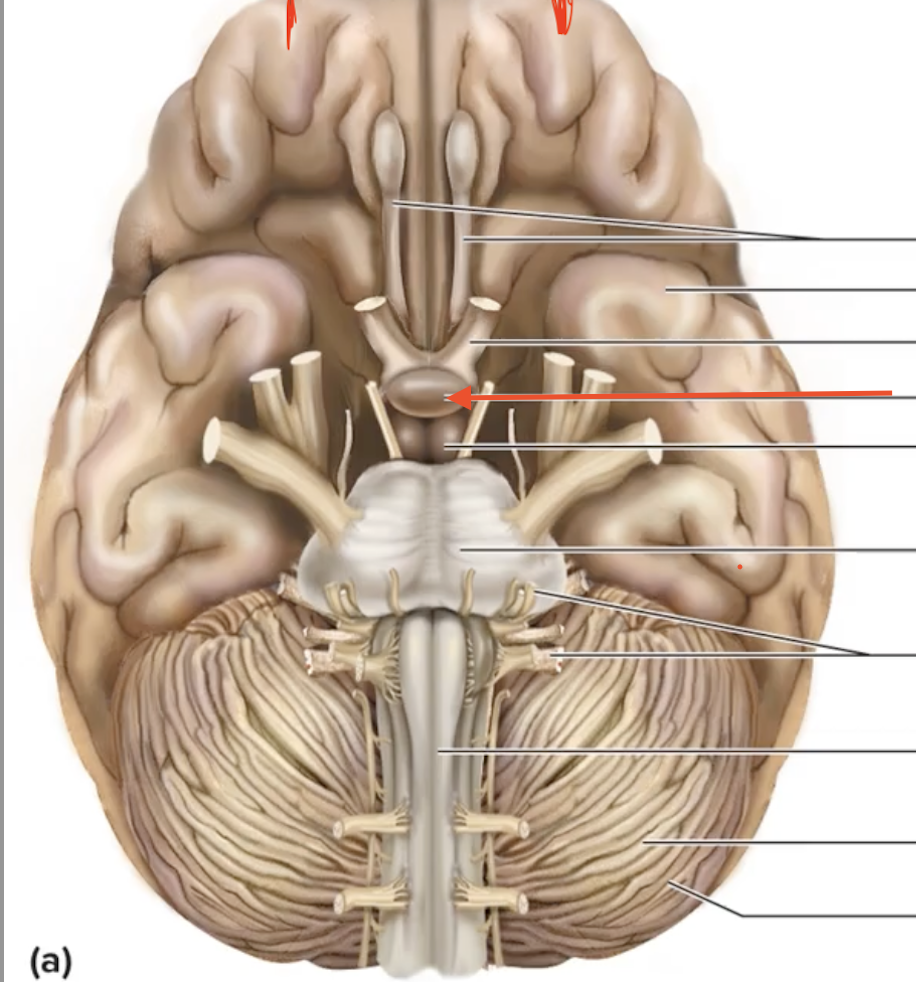
Identify the red arrow
Pituitary Gland

Identify the Red arrow
Mammillary bodies

Identify the red arrow
Pons

Identify the red arrow
Cranial nerves
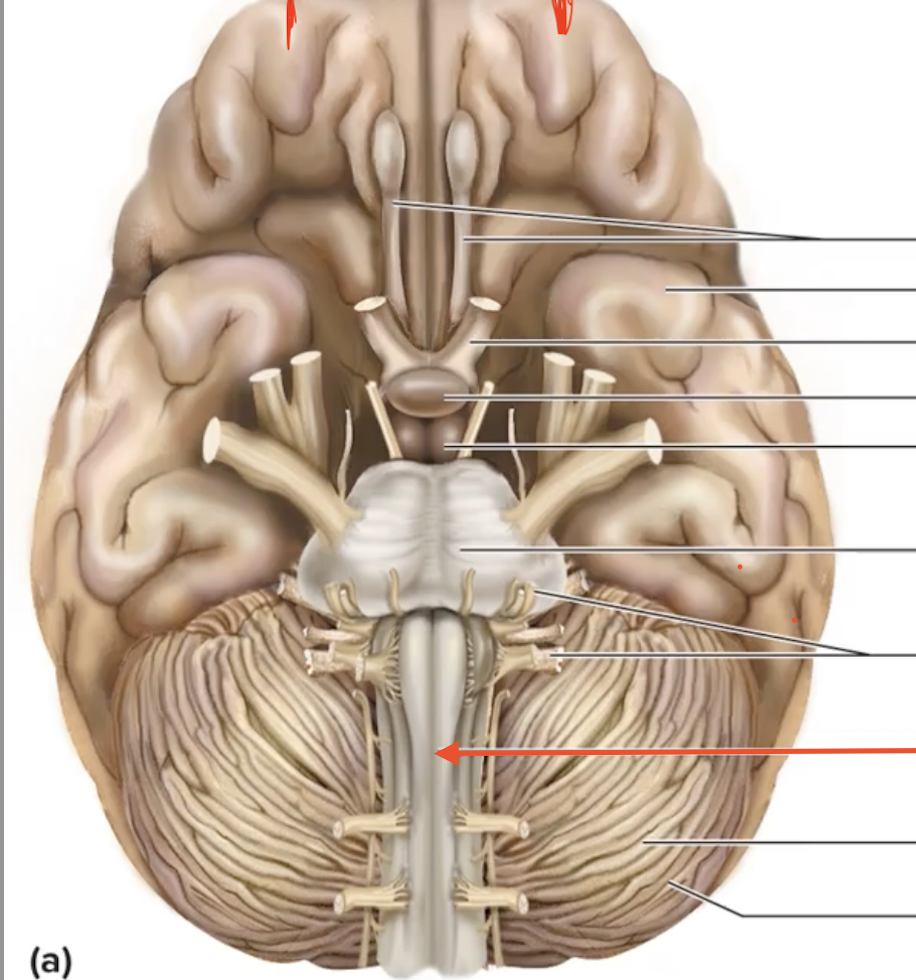
Identify the red arrow
Medulla Oblongata
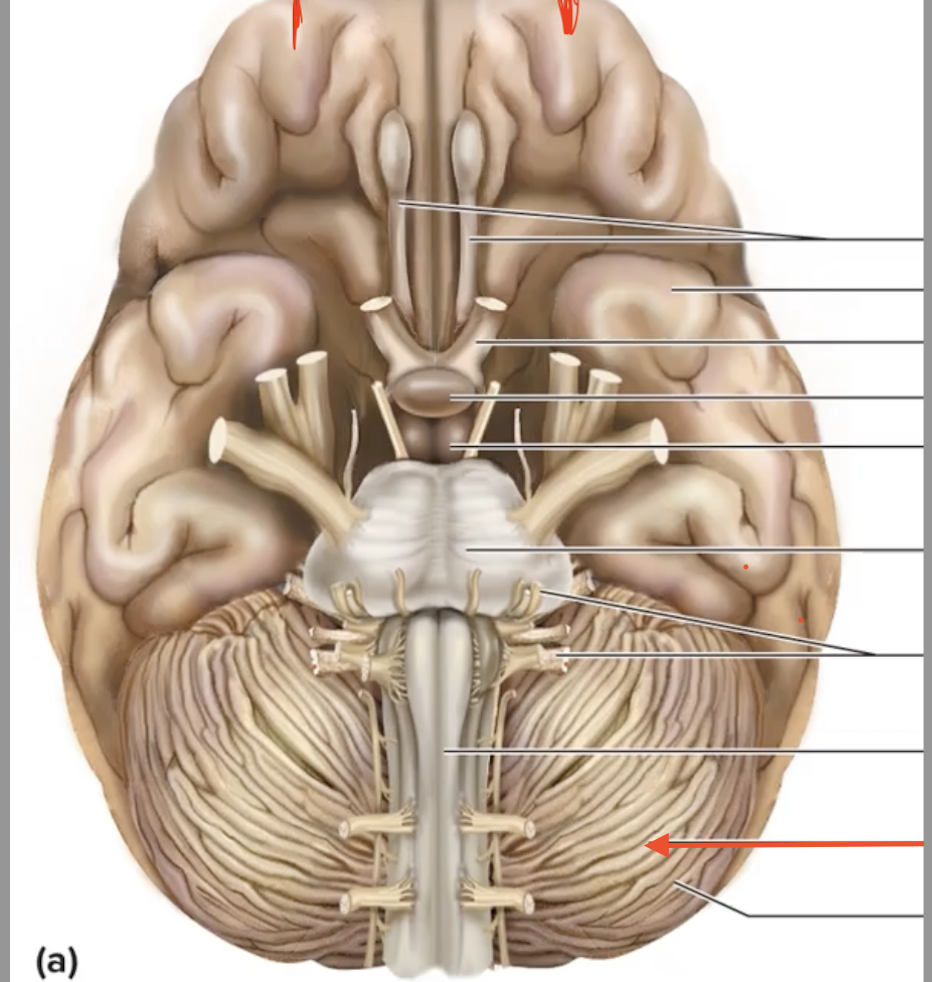
Identify the Red Arrow
Cerebellum
The cerebral hemispheres contain gray and white matter. Explain those matters.
Gray matter = cell bodies of cerebral neurons
White matter = myelinated fiber tracts
3 connective tissue membranes that protect the brain and spinals cord
pia mater (inner layer, highly vascular)
arachnoid mater (middle layer, weblike)
dura mater (outer layer, tough leathery)
Meningies
Are the PAD matter that PAD the brain
At the foramen magnum of the cranium
Cranial Nerve I (name)
Olfactory
Cranial nerve I (origin)
Olfactory Epithelium → olfactory bulb (cerebrum)
Cranial nerve I (Type)
Sensory
Cranial nerve I (Function)
Smell
Cranial nerve I (normal response)
Identify odors, such as vials of spices
Cranial Nerve II (Name)
Optic
Cranial nerve II (Origin)
Retina of eye → thalamus
Cranial nerve II (Type)
Sensory
Cranial nerve II (function)
Vision
Cranial nerve II (Normal Response)
Reading eye chart
Cranial nerve III (name)
Oculomotor
Cranial nerve III (origin)
Midbrain → eye muscles
Cranial nerve III (type)
Motor
Cranial nerve III (function)
Eye movement and pupil constriction
Cranial nerve III (Normal function)
Use a penlight to test for pupil constriction; track moving objects
Cranial nerve IV (Name)
Trochlear
Cranial nerve IV (Origin)
Midbrain → eye muscles
Cranial nerve IV (type)
Motor
Cranial nerve IV (Function)
Eye movement
Cranial nerve IV (Normal response)
Test with oculomotor - ability to follow moving object
Cranial nerve V (name)
Trigeminal
Cranial nerve V (Origin)
Pons → Face
Cranial nerve V (Type)
Both
Cranial nerve V (Function)
Facial sensation and mastication (chewing)
Cranial nerve V (Normal response)
Corneal reflex (test with cotton wisp); test ability to clench the teeth
Cranial Nerve VI (Name)
Abducens
Cranial Nerve VI (Origin)
Pons → eye muscle
Cranial Nerve VI (Type)
Motor
Cranial Nerve VI (Function)
Eye movement
Cranial Nerve VI (Normal response)
Move eyes laterally to the right or left
Cranial Nerve VII (Name)
Facial
Cranial Nerve VII (Origin)
Pons → Face → Tongue
Cranial Nerve VII (Type)
Both
Cranial Nerve VII (Function)
Taste and Facial expression
Cranial Nerve VII (Normal response)
Taste; symmetry of face while smiling, whistling, closing eyes
Cranial Nerve VIII (Name)
Vestibulocochlear
Cranial Nerve VIII (Origin)
Cochlea → Vestibule → Pons
Cranial Nerve VIII (Type)
Sensory
Cranial Nerve VIII (Function)
Hearing and equilibrium (balance)
Cranial Nerve VIII (Normal response)
Tuning fork held near ear and then on mastoid process
Cranial Nerve IX (Glosspharyngeal)
Medulla Oblongata → Tongue → Pharynx
Cranial Nerve IX (Type)
Both
Cranial Nerve IX (Function)
Taste and Swallow
Cranial Nerve IX (Normal Response)
Taste, swallowing; quality and sound of voice; gag reflex
Cranial Nerve X (Name)
Vagus
Cranial Nerve X (Origin)
Medulla Oblongata → thoracic → abdominal viscera
Cranial Nerve X (Type)
Both
Cranial Nerve X (Function)
Autonomic (involuntary) functions
Cranial Nerve X (Normal Response)
Saying ‘AHH’ should cause uvula to remain midline and pharynx to constrict medially; gag reflex
Cranial Nerve XI (Name)
Accessory
Cranial Nerve XI (Origin)
Spinal cord (Cervical 1-Cervical 5) → neck muscles
Cranial Nerve XI (Type)
Motor
Cranial Nerve XI (Function)
Shoulder and head movement
Cranial Nerve XI (Normal response)
Shrug shoulders; rotate head left and right
Cranial XII (Name)
Hypoglossal
Cranial XII (Type)
Motor
Cranial XII (Function)
Tongue movement
Cranial XII (Normal Response)
Stick out tongue with no deviation to left or right
Cranial XII (Origin)
Medulla oblongata → tongue

What type of neuron is this?
Mammalian motor neuron
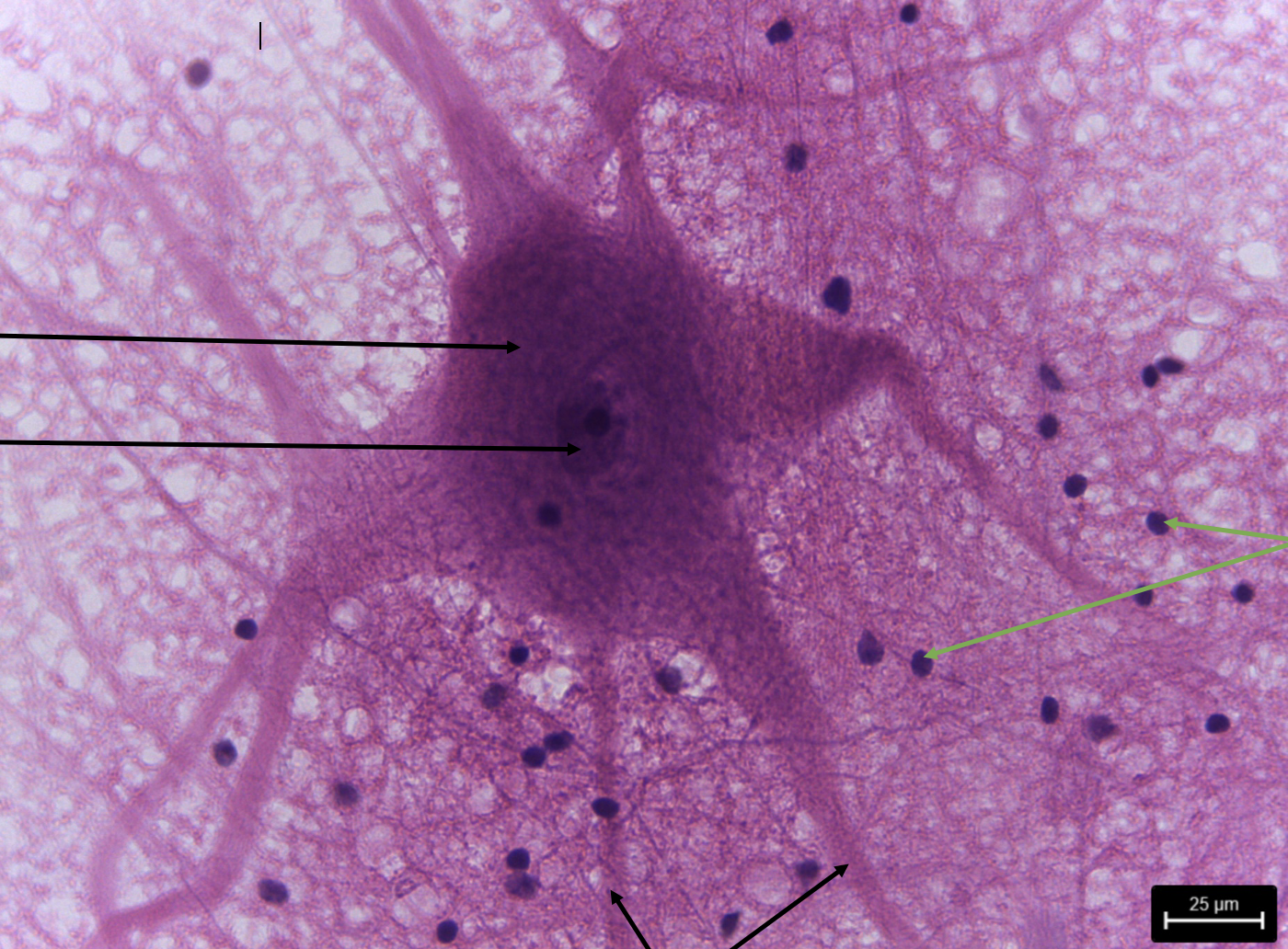
What are the highlighted arrows?
Nuclei of neuroglia