520: Pharmacokinetic Applications of Antiepileptic an Antipsychotic Medications
 Call Kai
 Learn
Learn Practice Test
 Spaced Repetition
 Match
Match Flashcards
 Knowt Play
1/47

There's no tags or description
Looks like no tags are added yet.
Name | Mastery | Learn | Test | Matching | Spaced | Call with Kai | Chat |
|---|
No analytics yet
Send a link to your students to track their progress
48 Terms
Learning Objectives
Discuss favorable pharmacokinetic characteristics of antiepileptic drugs
Recognize the unique pharmacokinetic properties of different antiepileptic and antipsychotic drugs and strategies for therapeutic drug monitoring
Develop an appropriate dosing regimen for phenytoin, carbamazepine, valproic acid, and lithium
Illustrate how pharmacokinetic principles are integrated into long-acting injectable antipsychotics
What are Pharmacokinetic characteristics of the Ideal AED?
Good bioavailability (F) → To avoid high doses to achieve desired therapeutic outcomes
Minimal protein binding → To avoid protein binding displacement interactions
Linear pharmacokinetics → To allow for simpler dosing and prescribing
Renal elimination → To avoid pharmacokinetic variability and active metabolites
No drug interactions → To not worry about co-administration of other medications
Half-life of 12-24 hours → To allow for once or twice daily dosing, improving patient compliance.
What is the MOA of phenytoin?
Block voltage-dependent sodium channels at high firing frequencies
What are the dosage forms of Phenytoin?
Phenytoin sodium:
100mg, 200mg, 300mg ER capsule, 50mg/ml IV solution (max=50mg/min)
Phenytoin acid:
50mg chewable tablet, 125mg/5ml oral suspension
Fosphenytoin:
50mg PE/ml IV solution (max= 150mg PE/min)
Salt correction:
0.92 for phenytoin sodium
What are some PK parameters of phenytoin?
Vd: 0.8 L/kg
Half-life: 9-36 hours
Protein binding: 90%
Excretion: 95% liver (metabolized by CYP 2C9 and 2C19)
Target range: 10-20 mg/L
Enzymatic activity: Broad-spectrum inducer (most inducing AED)
Follows Michaelis Menten kinetics (zero-order or nonlinear)
What are the toxicity ranges of Phenytoin?
>15mg/L: somnolence
>20 mg/L: nystagmus, diplopia
>30mg/L: ataxia,slurred speech
>40mg/L: confusion, lethargy, coma
>50mg/L: drug induced seizures
Describe the interpatient variability of phenytoin

Study done among 100 patients, everyone gets 300mg Phenytoin
Serum concentrations were all over the place (some low, some high). This led to the connection of Phenytoin following non-linear kinetics
What are Michaelis-Menten kinetics?
Non-linear kinetics - mathematical model that describes how the rate of an enzyme-catalyzed reaction depends on the concentration of a substrate

What’s the deal with phenytoin concentration vs dose?
For phenytoin, capacity for metabolism by CYP2C9 becomes saturated
Therefore, ↑ Dose =↓ Clearance = ↑t1/2
↑ in dose results in greater than proportional ↑ in concentrations
A slight increase in dose may lead to a considerable increase in plasma concentrations
Phenytoin has a narrow therapeutic window

What’s the relationship between phenytoin and albumin? Which form of drug can produce clinical effects? (bound or unbound)
Phenytoin is highly bound (~90%) to albumin
Only unbound drug can produce clinical and adverse effects
Variability in the fraction unbound drug can have a significant impact on its pharmacological effect
What are disease states and conditions that alter phenytoin plasma protein binding?
1) Insufficient Albumin Concentration (Hypoalbuminemia)
Liver disease
Nephrotic syndrome
Pregnancy
Cystic fibrosis
Burns
Trauma
Malnourishment
Elderly
2) Displacement By Endogenous Compounds
Hyperbilirubinemia
Jaundice
Liver disease
Renal dysfunction
3) Displacement By Exogenous Compounds
Drug interactions
Warfarin
Valproic acid
Aspirin (>2 g/d)
NSAIDs with high albumin binding
These conditions increase Phenytoin’s fraction unbound (fu)
What are the therapeutic/toxic ranges of total and free Phenytoin?
Therapeutic Range
Total: 10-20 mcg/mL
Free: 1-2 mcg/mL
Toxic Range
Total: >30 mcg/mL
Free: >2.5mcg/mL
Describe TDM for Phenytoin (total vs free serum concentrations)
Total phenytoin serum concentrations = mainstream way for routine therapeutic drug monitoring purposes.
Unbound phenytoin serum concentrations (free phenytoin) should be measured in patients with factors known to alter phenytoin plasma protein binding.
Which equation can we use to correct phenytoin for low albumin?
The Sheiner-Tozer Equation normalizes total phenytoin concentrations reliably in patients with low albumin concentrations
No correction is needed for albumin >3.2 g/dL.

Which equation can we use to correct phenytoin for renal failure?
In advanced renal failure, there is reduced phenytoin binding to albumin
In patients with Creatinine Clearance <25 ml/min, and adjustment of 0.1 is used

What does the Michaelis-Menten dosing method estimate?
In adults with normal liver, renal, and plasma protein binding:
Maximum rate of metabolism (mg/d) or Vmax = 7 mg/kg/d
Substrate Concentration or Km = 4 μg/mL
↓ Dose by 25-50% in patients with significant hepatic dysfunction
What is the Vd for phenytoin (Michaelis-Menten dosing)?
Vd for phenytoin = 0.7 L/kg
For obese individuals (>30% ideal body weight):
Vd = 0.7 L/kg * [IBW + 1.33(TBW − IBW) ]
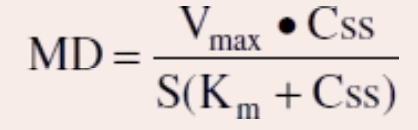
How do we dose Phenytoin in healthy patients? (Michaelis-Menten dosing method)
Loading Dose = (Vd * Css)/S
Css= target phenytoin concentration in μg/mL
S = fraction of the phenytoin salt form that is active phenytoin
0.92 phenytoin sodium injection, capsules, and fosphenytoin;
1.0 for phenytoin acid suspensions and tablets
Maintenance Dose:
What is the MOA of Valproic acid?
May enhance GABA transmission in specific circuits
Blocks voltage-dependent sodium channels
What are PK parameters of VPA?
Vd: 0.2 L/kg
Half-life: 6-18 hours
Protein binding: 90%
Excretion: 98% liver
Target range: 50-125 mg/L
Clearance: low clearance due to protein binding
Enzymatic activity: Broad-spectrum inhibitor (CYP 2C9)
How does protein binding displacment affect the pharmacologic effect of valproic acid?
Similar to phenytoin, valproic acid is highly protein bound → binding is concentration dependent and saturable.
The concentration-dependent protein binding of valproic acid causes the drug to follow nonlinear pharmacokinetics.
What’s the relationship between valproic and phenytoin?
Valproic acid displaces phenytoin from its plasma albumin binding sites, increasing the free fraction of phenytoin
As valproic acid concentrations increase, enzyme inhibition of phenytoin occurs via CYP2C9, thus decreasing the clearance of phenytoin
When co-administered with phenytoin, valproic acid can increase the free fraction of phenytoin by up to 60%, increasing its pharmacologic effects
Phenytoin is a potent inducer of CYP 2C9 and UDPglucuronosyltransferases (UGT), which ↑ Cl of valproic acid
The increased metabolism of valproic acid might ↑ the serum concentration of hepatotoxic valproate metabolites, increasing the risk for hyperammonemia.
What is the interaction between VPA & carbapenem?
Carbapenems:
1) Inhibit of the xenobiotic p-glycoprotein in erythrocytes, trapping VPA in erythrocytes
2) inhibit the intestinal absorption of VPA
3) directly inhibit the VPA-recovering enzyme glucuronidyl-hydrolase, thereby increasing excretion
Big interaction between carbapenems and VPA
What is Carbamazepine’s MOA?
Related to structure of TCA
Block voltage-dependent sodium channels at high firing frequencies
What are PK parameters of Carabmazepine?
Vd: 0.6-2L/kg
Half-life: 9-15 hours
Protein binding: 75%
Excretion: 99% liver
Target range: 4-12 mg/L
Rapid absorption and distribution
Enzymatic activity: metabolized by CYP 3A4; Broadspectrum inducer of CYP 1A2, 2C9, 3A4
Autoinduction
Toxicity of Carbamazepine
Diplopia, nystagmus, blurred vision, ataxia, dizziness, sedation, hyponatremia
Black-box warning for severe dermatologic reactions.
HLA B*1502 allele testing should be done in Asian patients prior to starting
What’s special about Carbamazepine’s metabolism?
It induces its own metabolism (autoinduction) via CYP3A4
Onset is as early as 24 hours, but may take 1-5 weeks for completion
Due to autoinduction, clearance ↑, therefore half-life ↓
Patients are typically started on 25-33% of the desired maintenance dose
Maximal autoinduction continues for 2-3 weeks after starting
Dose is increased q2-3 weeks until the total desired dose is achieved.
How should Carbamazepine therapy be initiated?
Initiate therapy at low dose → gradually increase every 2-3 weeks during the initial 4-6 weeks based on adverse effects and therapeutic response
A trough serum concentration should be measured after steady-state is attained in 3-4 weeks
Describe pseudolinear PK of Carbamazepine
To approximate new total serum concentrations (after a dose change), assume linear PK using this equation:

For dose increases → Subtract 10-20% to Cssnew
For dose reductions → Add 10-20% to Cssnew
A patient is on carbamazepine for partial seizures and reports compliance. He has been on 400 mg twice daily(800 mg/d) for 1 month, and his carbamazepine total concentration equals 3.8 μg/mL. What would his new expected concentration be if his dose is increased by 200mg?
Cssnew = (Dnew/Dold)Cssold = (1000 mg/d / 800 mg/d) * 3.8 μg/mL = 4.8 μg/mL.
Due to autoinduction, the serum concentration would be expected to decrease by 10-20%.
Css = 4.8 μg/mL x 0.90 = 4.3 μg/mL — Css = 4.8 μg/mL x 0.80 = 3.8 μg/mL
Therefore, a 200mg increase would result in a Cssnew of 3.8-4.3 μg/mL
What’s special about Lithium?
The PK follows a 2 compartment model
Does not bind to any proteins, almost exclusively excreted through the kidneys (much of which is excreted unchanged)
What is Lithium’s MOA?
Alters sodium transport in nerve and muscle cells resulting in intraneuronal metabolism of catecholamines
Describe the PK of Lithium:
2-compartment model
1) initial rapid serum concentration decline (2-3 hrs)
2) Long distribution phase (6-10 hrs)
Due to the long distribution phase, serum concentrations should be obtained at least 12 hours after a dose.
Steady-state lithium concentrations should be obtained after 1-2 weeks.
Lithium is not metabolized ➔ eliminated renally as free cation (80% reabsorbed in the proximal tubules with sodium)
Follows linear pharmacokinetics, so a simple dosage ratio can be used to change lithium doses:
What are factors that increase Lithium clearance?
Acute mania (can decrease by 50%)
High-sodium diet
Pregnancy
Daytime (30% due to circadian rhythm)
Caffeine
In what scenario would we want to double the Lithium dose?
When a patient presents with acute mania
Acute mania can decrease Lithium CL by 50%
What are factors that decrease Lithium clearance?
Dehydration (vomiting, diarrhea)
Low-sodium diet
Renal failure
Nephrogenic diabetes insipidus
Medications
Concomitant use of thiazide diuretics, ACE inhibitors, ARBs, NSAIDs
Which drugs decrease Lithium clearance when used concomitantly?
Thiazide diuretics, ACE inhibitors, ARBs, NSAIDs
How do we calculate lithium dosing?
1) Calculate patient’s CrCl
2) Determine lithium clearance in L/day
Lithium Clearance (mL/min) = 20% of CrCl = 0.2 (CrCl)
Expressed as liters/day → 0.288 * CrCl
**In acute mania, Lithium CL = 0.432 (CrCl)
3) Calculate maintenance dosing (Css)
Css = [F(D/τ)] / Cl
Or D/τ = (Css x Cl) / F
F = 1 for oral lithium
D is the lithium dose in mmol
τ is the dosage interval in days
Cl is lithium clearance in L/d
Everytime we dose lithium, we convert into mg of Lithium carbonate
What is the conversion factor of lithium to lithium carbonate?
Conversion factor is 300mg Lithium carbonate = 8.12 mmol Li+
What are target Lithium concentrations?
For acute mania → 0.8 - 1 mmol/L
For long term maintenance → 0.6 - 0.8 mmol/L
Which long-acting injectable antipsychotics can be used for schizophrenia and bipolar I disorder?
Schizophrenia:
Paliperidoen
Risperidone
Olanzapine
Aripiprazole
Bipolar I Disorder:
Paliperidone
Risperidone
Aripiprazole
Describe the PK of Aripiprazole monohydrate (Abilify Maintena)
Absorption:
Initial absorption period takes quite amount of time →
Must bridge therapy with oral aripiprazole for 2 weeks when starting injection
Rate of absorption is higher with deltoid injection vs gluteal muscle (tmax 4 days vs 7 days)
Gluteal muscle takes longer to get to steady state
Highly protein bound (>85%)
Elimination
Super long half-life, stays in body for 30 - 46 days
Watch out for drug interactions bc it stays in system for so long
Steady state reached by 4th month
Metabolized by CYP3A4 + 2D6
What did Aripiprazole lauroxil (Aristada) improve on compared to Abilify?
Serves as a prodrug for Aripiprazole → Has active metabolites
Stays in body for much longe, can be dosed every 2 months
Instead of bridging therapy with PO aripiprazole for 2 weeks, Aristada only requires a one-time 30mg PO dose + 1st Aristada injection
T1/2 = 57 days
But, similar to Abilify once we start, there’s no going back. Watch out for DIs because it stays in our system for so long
What are pros of using long-acting anti-psychotic injections?
Improves medication adherence by reducing the need for daily oral dosing
Provides consistent medication levels, reducing symptom fluctuations and relapse risk
Less frequent administration (e.g., monthly or every few months)simplifies treatment regimen.
Allows healthcare providers to monitor adherence and treatment progress during injection visits.
Discreet administration may reduce stigma
May reduce hospitalization costs by preventing relapses through better adherence.
Suitable for patients with difficulty swallowing pills or complex medication schedules.
What are cons of using long-acting antipsychotic injections?
Requires regular healthcare visits for injections, which may be inconvenient for some patients.
May take longer to adjust dose or switch medications due to prolonged drug release.
Injections can be painful or cause discomfort at the injection site.
Side effects (e.g., weight gain, sedation, or movement disorders) may persist longer due to extended drug release.
Some patients may feel stigmatized by receiving injections in clinical settings.
Higher upfront costs compared to oral medications; insurance coverage varies.
Less flexibility in stopping treatment quickly if side effects or adverse reactions occur.
What are drug interactions are present with LAIs?
Aripiprazole LAIs (Abilify Maintena, Aristada)
Metabolized by CYP3A4 and CYP2D6
Risperidone and Paliperidone LAIs (Risperdal Consta, Invega Sustenna):
Metabolized by CYP2D6
Olanzapine LAI (Zyprexa Relprevv):
Metabolized by CYP1A2 and CYP2D6
Which LAIs need renal or hepatic adjustments?
Paliperidone LAIs rely on renal clearance; severe impairment requires dose reductions (e.g., 25-50% lower)
Hepatic impairment affects metabolism of risperidone or olanzapine LAIs
What ADRs are seen with LAIs?
LAIs can enhance CNS depression or extrapyramidal symptoms (EPS) when combined with other sedatives or dopaminergics.