Airway anatomy and mechanics of Ventilation
 Call Kai
 Learn
 Practice Test
 Spaced Repetition
 Match
 Flashcards
 Knowt Play
1/48

There's no tags or description
Looks like no tags are added yet.
49 Terms
What is the order in which the tracheobrochial tree branches?
From the trachea → main bronchus → secondary bronchus → tertiary bronchus → intro segmental segments ( large and small)→ cartilage ends and bronchioles begin → terminal bronchioles → respiratory bronchioles → alveolar sacs

The conducting zone of the intrasegmental bronchi do what?
Conduct air bidirectionally, condition air, mucociliary clearance, immune defense
What is the respiratory zone? Function?
Starts at terminal bronchioles, respiratory bronchioles, alveolar sacs, and alveoli
Specializes in gas exchange → O2 in and CO2 out
When does the cartilage end?
When the bronchioles begin
Where is the smooth muscle of the respiratory tree?
This is most abundant at the bronchioles and terminal bronchioles
Absent at the alveoli
What makes up the lobule region of respiratory zone
Terminal bronchioles to alveolar sacs
What makes up the acinus region of respiratory zone
Respiratory bronchioles to alveolar sacs ( shorter segment)
What is the histology of bronchi?
Pseudostratified columnar ciliated epithelia with goblet cells that secrete mucus.
When someone inhales a pollutant what occurs in the lungs?
Pollutant sticks to mucus, the cilia treadmill the material out proximally by spitting or swallowing.
Smoking leads to what?
Ciliary dysfunction causing mucus retention causing a chronic productive cough that is characteristic of smokers
Definition of chronic bronchitis
Productive cough for 3 months of the year for two consecutive years
Sequence of acinus and vascular supply
Pulmonary arteries carry deoxygenated blood from RV
Pulmonary capillaries network of the alveoli facilitate diffusion of gases
Pulmonary veins carry oxygenated blood to LA

What does the bronchial artery serve?
Bronchi and bronchioles ( NOT the alveoli)
Some of the bronchus venous blood will drain into pulmonary veins
Type l pneumocytes are
What form the blood-gas barrier

Type lI pneumocytes
Produce surfactant to reduce surface friction
They also help facilitate alveolar repair

With pulmonary edema what accumulates fluid first?
interstitium and this impairs gas exchange
Interstitial lung disease: fibrosis, silicosis, coal worker pneumoeoshisis
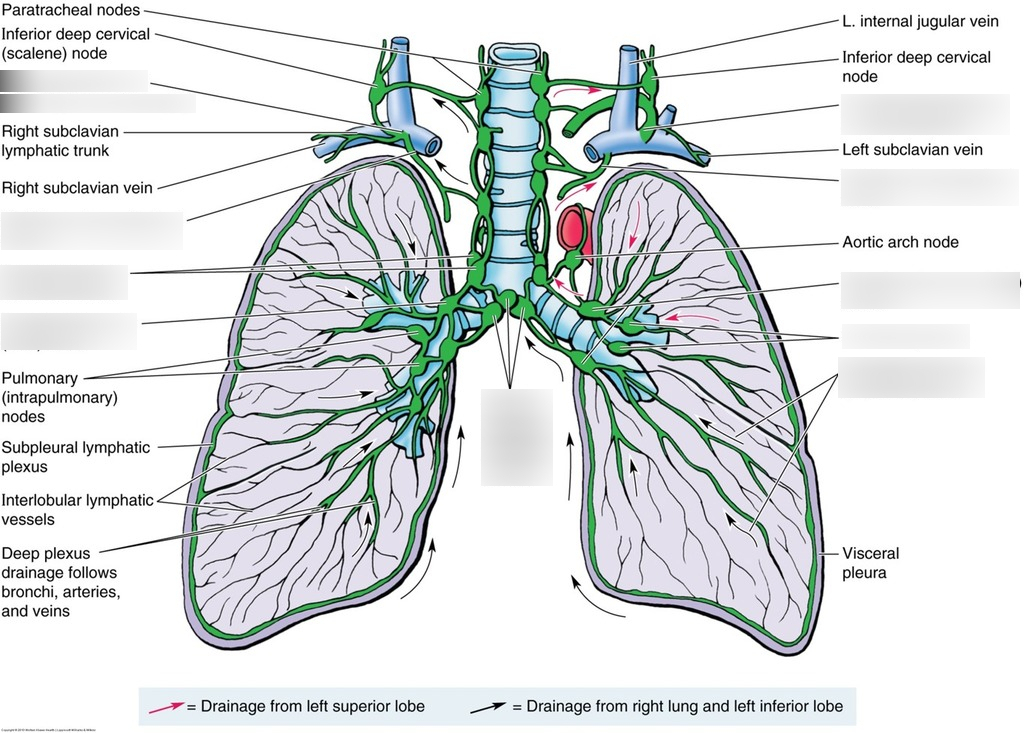
Label the lymph nodes

What supplies the sympathetic portion of tracheobronchial tree? What the function?
Sympathetic trunk of TI to T5 to activate B-2 adgenergic receptors for bronchodialation
What is an example of a b-2 agonist?
Albuterol
What supplies the parasympathetic system of trachea bronchial tree?
Vagus nerve which works on M3 muscarinic receptors
What do M3 muscarinic receptors activate to do?
Increase mucus production and causes bronchoconstriction
What are the core components of gas exchange?
Ventilation (V) : bulk flow of gas. Atmospheric ←→ alveoli
Gas exchange: ready diffusion of O2 and CO2 across blood-air barrier. Alveoli ← → pulmonary capillary blood
Blood flow ((Q)):gas transport in the pulmonary circuit
What is “quiet breathing”
The tidal volume ( 500ml)

What is the extra inspired air beyond the tidal inhalation
Inspiratory reserve volume (3000ml)

What is it called when the lungs deflate further than their tidal volume?
Expiratory reserve volume ( 1200ml)

Air remaining after maximal exhalation
Residual volume - can not fully be evacuated

Inspiratory capacity is what?
Tidal volume + inspiratory reserve = max amount the lungs can fill
Functional residual capacity
Expiratory reserve volume + residual volume = measure of remaining volume
Forced capacity vital
Inspiratory reserve volume + tidal volume + expiratory reserve volume = max amount of air the pt can move
Done by having pt maximally inhale then maximally exhale
What should the value of FEV1/ FVC be in a healthy adult?
> 80%
Forced expiratory flow ( FEF25-FEF75) is good for detecting what?
Sensitive for early stages of airflow obstruction because it can measure airway airflow.
Obstructive disease will have reduced...
FEV1, FEV1/ FVC, FEF 25-75
Volume/ restrictive diseases Will have reduced …
FVC
How does the lung move?
Chest wall expands to ↑ lung volume
This ↓ alveolar pressure ( only occurs when air is flowing in) but increases the volume
Air flows in to fill the airway.
Revisit slide 16 and 15
Volume and pressure relationship with inspiration and expiration
Volume increases pressure will decrease
Inspiration: increased volume and negative pleural and alveolar pressure
Expiration: decreasing volume and positive alveolar pressure and around -2 pleural pressure

What is transmural pressure?
This is what keeps the alveoli from collapsing even as we exhale.
Transmural directly translates to pressure across the wall
If the transmural pressure is positive what does that mean
The structure Will stay open
Negative → collapse
Sub compartments of the transmural pressure and what they mean
Pleural pressure: always negative across tidal volumes
Transpulmanary pressure: alveolar pressure - pleural pressure → has to be positive to keep alveoli inflated
Transairway pressure: tracheal pressure- alveolar pressure → pressure needed to move air. ( positive for inhalation and negative for expiration)
Why is there less pressure when inhaling?
The chest wall expands, so the pressure becomes negative from the chest wall moving away from lungs

When a pneumothorax occurs what has happened?
Air has entered the pleural cavity by damage in the visceral and parietal layer
What are the causes of a pneumothorax?
Traumatic: bullet, stab wound, impatement
Spontaneous: rupture of apical bleb ( emphysema is the leading cause of secondary pneumothorax)
Spontaneous pneumothorax are commonly seen in what what population?
Tall thin individuals ( slight male predominance)
Primary vs secondary spontaneous pneumothorax
Primary has no know lung disease. More smokers and tall thin individuals
Secondary is with an underlying lung disease ( COPD)
What causes a bleb?
Subpleural airspace created by a rupture of alveoli
What 'is pleurodesis
A type of management for pneumothoraxes or reoccurring pleural effusions. Done by chemicals. ( doxycycline or talc ). Mechanical or inflammatory abrasion
What fatal symptom outside of the lungs can be caused by tension pneumothorax
caval syndrome ( from ↓ venous return)
How should a thorocentesis be performed for tension pneumothorax
Patient supine and done at second intercostal and midclavicular line
Atelectasis occurs from
Loss of positive transpulmonary pressure causing collapse, can be from obstruction like mucus, aspiration or tumor.