chan: lec 5, pt1
 Call Kai
 Learn
 Practice Test
 Spaced Repetition
 Match
 Flashcards
 Knowt Play
1/27

Earn XP
Description and Tags
nucleotide metabolism
28 Terms
2 types of bases
purines & pyrimidine
nucleosides
base + ribose
nucleotide
base + ribose + 3 PO4

2'-deoxynucleotide
contains 2- deoxy ribose
dATP, dTTP, dGTP, dCTP

2'-OH nucleotide
contains 2’ OH base
ATP, UTP, GTP, CTP
adenine
X: H
nucleoside: adenosine
X: ribose
nucleotide: AMP, adenosine monophosphate
X: ribose phosphate

guanine
x: H
nucleoside: guanosine
X: ribose
nucleotide: GMP, guanosin monophosphate
X: ribose phosphate

cytosine
x: H
nucleoside: cytidine
X: ribose
nucleotide: CMP, cytidine monophosphate
X: ribose phosphate

uracil
x: H
nucleoside: uridine
X: ribose
nucleotide: UMP, uridine monophosphate
X: ribose phosphate

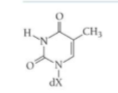
thymine
nucleoside: deoxythymidine = thymidine (understood to be 2’- deoxy)
X: ribose
nucleotide: dTMP, deoxythymidine monophosphate = thymidine monophosphate
X: ribose phosphate
hypoxanthine (base)
nucleoside: inosine
x: ribose
nucleotide: IMP
x: x ribose PO4

2 kinase reactions at nucleotide level
nucleoside monophosphate (NMP) kinases
nucleoside diphosphate (NDP) kinase
nucleoside monophosphate (NMP) kinases
interconert NMP to NDP (NMP⇆ NDP)
base-specific
does not discriminate btw ribose & deoxyribose
phosphate donor: ATP
nucleoside diphosphate NDP kinase
interconvert nucloeside di- and tri phosphates (NDP ⇆ NTP)
not base-specific
does not discriminate btw ribose & deoxyribose
phosphate donor: ATP
chemical equation
(d)NMP ⇆ (NMP kinase, plural) (d)NDP ⇆ (NDP kinase, singular) (d) NTP
need ATP energy —> ADP
kinase work very quickly
N= can be any base
NMP kinases: GMP kinase, CMP kinase —> different kinases, base specific
NDP kinase: GDP kinase, CDP kinase —> same kinase, not base specific

how to convert GDP to GTP
NDP kinase
uses ATP —> ADP
ribonucelotide reductase (RNR)
enzyme convcerts NDP —> dNDP irreversibly
under complicated allosteric control y ATP and dNTPs
goal: balance supply of dNTPs for DNA syntthesis
turns RNA building blocks to DNA building blocks

why must dNTP pools be balanced
to ensure accurate DNA synthesis, they’re used to make ATP
NDP —> (RNR) —> dNDP —→ —→ dNTP
dNTP: dATP, dTTP, dGTP, dCTP
what does RNR catalysis require
a tyrosyl radical
amino acid residue of RNR essential for catalysis
hydroxyurea destroys tyrosyl radical to become tyr
hydroxyurea
a drug for treatment by inhibiting RNR
ex: thrombocythemia (too many platelets), polycythemia Vera ( too many red blood cells)
RNR has 3 allosteric sites
a-site: activity site (NOT active site),
on/ off switch for catalytic activity, sneses balance of ATP & dATP
s-site: specificity site
normal allosteric regulation
Vo= kcat [ES], high ES = low Vo
controls enzyme binding, decides which DNA building block gets made next
hezamerization site (h-site): help stabilizw active state or shut things down
RNR active site
at the interface of R1 & R2 subunits
active RNR is in form of R1 hexamer (6R1 plus 6R2)
once assembled —> active moc
6 active sites carry the same rxn

active vs not active RNR
active RNR (R1 hexamer)
ATP binds to a-site —> h-site undergoes conf change —> h-site can bind
ATP binds and promote formation of active R1 hexamer
inactive RNR (not R1 hexamer)
dATP has high binding for a-site —> conf change of h site, can’t bind ATP
empty-h site —> R1 hexamer dissociates (can’t form)
regulation of RNR
starting up: ATP turns RNR on
ATP binds a-site (and h-site): active RNR
ATP in s-site (+): RNR helps CDP —> dCDP and UDP —> dUDP
NDP kinase adds a Pi, dCDP —> dCTP and dUDP —> —> —> dTTP
products build up
products can take over s-site (+), switch to production of next building block
dTTP in s-site, displaces ATP: GDP —> dGDP — (NDP kinase) → dGTP
dGTP in s-site, displaces dTTP: ADP —> dADP — (NDP kinase) —> dATP
shutiting down: dATP
dATP displaces ATP from a-site —> empty h-site —> inactive RNR
stop singal when DNA building blocks are a lot
cell stops overpoducing

de novo synthesis of purine ribonucleotides
structure of two-ring purine, where each atom comes from
N1: aspartate amine , a amino grp of asp
C2 & C8: N10-formyl-THF, active folate
N3 & N9: glutamine amide, side chain N of gln
N7, C4, C5 : glycine
THF: tetrahydrofolate

overall synthesis of purine nucleotide
synthesis occurs of top of ribose sugar
nuc attack and make 1’OH a good lg
glucose —> G6P —> pentophosphate pathway (rel NADPH) —> ribose 5-phosphate
R5P —> PRPP —> PRA —> (9 steps) —> IMP
2 paths
IMP —> —> AMP ⇆ ADP ⇆ ATP
IMP —>—> GMP ⇆ GDP ⇆ GTP
R5P —> PRPP
purine nucleotide syn
2 catalysis:
Mg2+ bind ATP
close prox & proper orientation
rxn:
a-D-ribose-5-phosphate (R5P) — > 5 -phosphoribosyl -a-pyrophosphate (PRPP)
enzyme: ribose phosphate pyrophosphokinase
ATP used —> AMP (donate 2 PI)
product: “activated” R5P