Astigmatism
 Call Kai
 Learn
Learn Practice Test
 Spaced Repetition
 Match
Match Flashcards
 Knowt Play
1/21

There's no tags or description
Looks like no tags are added yet.
Name | Mastery | Learn | Test | Matching | Spaced | Call with Kai | Chat |
|---|
No analytics yet
Send a link to your students to track their progress
22 Terms
An irregularly shaped cornea or lens that prevents light from focusing properly on the retina, the light-sensitive surface at the back of the eye
Astigmatism
What focal line image does power in the horizontal plane projects ?
Vertical
What focal line image does power in the vertical plane projects ?
Horizontal
Clinical classification of Astigmatism where the cornea has unequal curvature on the anterior surface
Corneal Astigmatism
Clinical classification of Astigmatism when the crystalline lens has an unequal curvature or its layer
Lenticular Astigmatism
Clinical classification of Astigmatism where it is the sum of corneal and lenticular astigmatism
Total Astigmatism
Clinical classification of Astigmatism based on principal meridians when the two principal meridians are perpendicular to each other
Regular Astigmatism
Clinical classification of Astigmatism based on principal meridians when the two principal meridian are not perpendicular to each other
Irregular Astigmatism
In regular astigmatism, where the greatest refractive power is within the vertical meridian. . Their axis is 0-30 and 150-180
With the rule
In regular astigmatism, where the greatest refractive power is within the horizontal meridian. Their axis is 60-120
Against the rule
In regular astigmatism, where the greatest refractive power is within 0-30 of the oblique meridians. Their axis is 31-59 and 121-149
Oblique
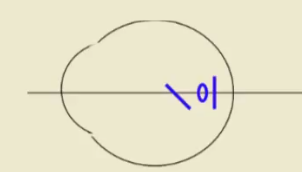
Clinical Classification of Astigmatism based on focal points
Compound Myopic
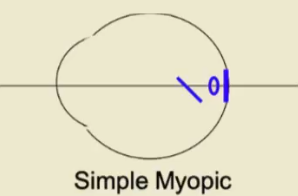
Clinical Classification of Astigmatism based on focal points
Simple Myopic
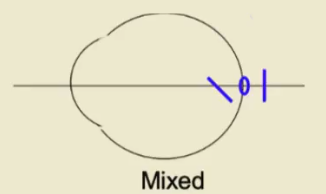
Clinical Classification of Astigmatism based on focal points
Mixed
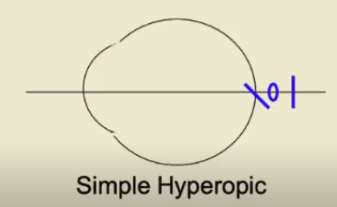
Clinical Classification of Astigmatism based on focal points
Simple Hyperopic
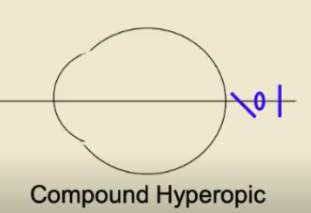
Clinical Classification of Astigmatism based on focal points
Compound Hyperopic
Clinical Classification of Astigmatism based on focal points relative location where the principal meridians or axes of the two eyes are symmetrical and the sum of the two axes of the two eyes equals approximately 180
Symmetrical Astigmatism
Clinical Classification of Astigmatism based on focal points relative location where the principal meridians or axes of the two eyes are not symmetrical and the sum of the two axes of the two eyes does not equal approximately 180
Asymmetrical Astigmatism
The infants already have against the rule astigmatism
True
The preschool children with little to no astigmatism
True
As the kid grow older, they will have the with the rule astigmatism
True
Adults will have against the rule astigmatism
True