MET166 Prelims/Midterms
 Call Kai
 Learn
 Practice Test
 Spaced Repetition
 Match
 Flashcards
 Knowt Play
1/81

Earn XP
Description and Tags
Module 1 and Module 2
82 Terms
what are the principal methods in shaping metals?
casting
mechanical working
fabrication by joining
machining
powder metallurgy
the production of shaped articles by pouring molten metal into moulds
Casting
the shaping of metals in the solid state by plastic deformation above or below the recrystallization temperature – by hot or cold working.
mechanical working
the production of structural units by the joining of smaller components manufactured in other ways.
fabrication by joining
The production of shaped articles by cutting from plain or roughly shaped forms using machine tools.
machining
The production of shaped parts by the die pressing and sintering of metal powders
powder metallurgy
what are the four couple phenomena controlling how casting is successful?
flow, heat, gas, shrinkage
what is the process sequence for casting cycle?
design > pattern > mold+core > melt > pour > solidify > finish + inspect
Advantages of metal casting as a manufacturing process
a. No restriction of the TYPE OF METAL OR ALLOY for casting operation
b. No restriction on the SIZE OF THE COMPONENT for casting
c. The most INTRICATE EXTERNAL AND INTERNAL shapes can be formed by casting process.
d. A wide RANGE OF PROPERTIES can be obtained in cast-parts by suitable choice of alloy and heat-treatment. Special properties like corrosion resistance, heat resistance, damping capacity, high strength etc., are possible.
e. .The casting process is ECONOMICALLY SUITABLE for both small quantity jobbing production as well as mass production by automatic machines
f. The casting process is still the CHEAPEST AVAILABLE TECHNIQUE for forming many components from raw materials to the final usage stage.
Disadvantages of Metal casting as a manufacturing process
a. Metal casting involves melting of metal which is a HIGH ENERGY CONSUMING PROCESS
b. Metal casting is still HIGHLY LABOUR-INTENSIVE compared to other processes
c. THE QUANTUM OF RAW MATERIALS REQUIRED for producing a ton of casting is quite high, needing exhaustive building, handling systems, large space and inventory cost.
d. THE TIME REQUIRED for the process of making casting
e. The WORKING CONDITION in foundries at different stages are quite bad compared to other process industry.
what does having ferrous materials indicate in your melting problems?
Higher pouring temperatures
Refractory and oxidation demands
Graphite or phase-control questions
Cupola, induction, or arc melting routes
what does non-ferrous materials indicate in your melting problem?
Lower melting ranges, but often higher oxidation, gas, or reactivity sensitivity
what are examples of non-ferrous materials?
Al, Mg, Zn, Cu alloys
what are the different classifications of foundries?
Jobbing, Production, Semi-production, Captive, Independent
one having a physical plant such that it usually contracts to produce a casting or a small number of castings of a given kind
jobbing
a highly mechanized shop which requires that large numbers of a given kind of casting be made in order to produce them at low cost
production
are those in which a portion of the work is a jobbing nature while the balance is production casting
semi-production
one which is an integral part of some manufacturing company and whose castings are consumed mainly in the products of the parent organization
captive
usually a separate company that produces castings for any number of customers
independent
type of mold that is destroyed in order to remove the casting
Expendable mold
a type of mold that is reused for repeated cycles
permanent mold
what do you call the top mold half?
cope
bottom mold half
drag
it creates internal voids
cores
why is green sand called “green”?
Green sand is ‘green’ because it is used moist and uncured, not because it is green in color.
a type of casting route using rotation driving metal to the mold wall. Used in pipes, rings, sleeves
centrifugal
a type of casting route where the metal freezes through a water cooled mold. Used in billets, blooms, slabs
continuous
a type of casting route where a foam pattern vaporizes during pouring. Used in complex one-piece geometry
lost foam
a type of casting route where the resin-coated sand forms a thin rigid shell. Used in better finish and accuracy materials
shell mold
a type of casting route where the controlled pressure fills a permanent mold. Used for wheels and sound aluminum parts
low pressure
engineering controlled problem: what happens when molten metal + moisture
explosion, splash, severe burns
engineering controlled problem: what happens when silica +dust
respirable exposure and silicosis
engineering controlled problem: what happens when fumes + gases
metal fumes, CO, binder decomposition
engineering controlled problem: what happens when heat + noise
heat stress and hearing damage
engineering controlled problem: what happens when handling + machinery
crush, strain, pinch, and ergonomic injury
what are the challenges for Filipino foundry industry
Lack of quality of raw material
Shortage of electric power in many regions
Shortage of capital/finance (use of obsolete equipment causing low productivity)
Lack of trained manpower
Metal casting is generally a low profit-making, low productive industry with larger risks from capital, employees, power and materials.
Environmental Pollution
how many foundries are reported by the DOST-MIRDC in its industry-challenges feature
68
Process in which molten metal flows by gravity or other force into a mold where it solidifies in the shape of the mold cavity
Casting
casting is usually performed in a _________
foundry
foundry = factory equipped for
making molds
melting and handling molten metal
performing the casting process
cleaning the finished casting
workers who perform casting are called
foundrymen
is a container with cavity whose geometry determines part shape
Mold
Actual size and shape of cavity must be slightly oversized to allow for __________ of metal during solidification and cooling
shrinkage
a type of mold that is simply a container in the shape of the desired part
open mold
a type of mold in which the mold geometry is more complex and requires a gating system (passageway) leading into the cavity
closed mold

name the parts
cast metal
flask
mold
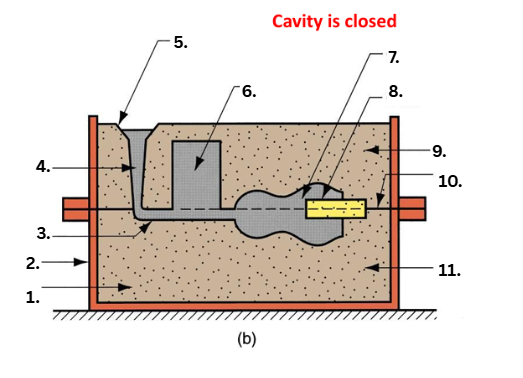
name the parts
mold
flask
runner
downsprue
pouring cup
riser
cast metal in cavity
core
cope
parting line
drag

is a cast part produced by forming a mold from a sand mixture and then pouring molten liquid metal into the cavity in the mold. The mold is then cooled until the metal has solidified
sand casting
require suitable refractories and control of the melt and mold
steel and nickel alloys
highly reactive. Specialized mold materials and controlled melting/pouring conditions are necessary
titanium
cannot be assumed suitable just because a metal can be melted
ordinary silica sand
general steps in casting
❑Pattern-making – design to be replicated
❑ Core-making – internal cavity surface
❑ Molding – preparation for the receiving of molten metal
❑ Melting and pouring
❑ Cleaning – removal of mold, core, scales, or excess metal

name the parts
drag
mold cavity
cope
core sand
open riser
vent
pouring rain
flask
sand
parting line
sand
gate
runner
choke
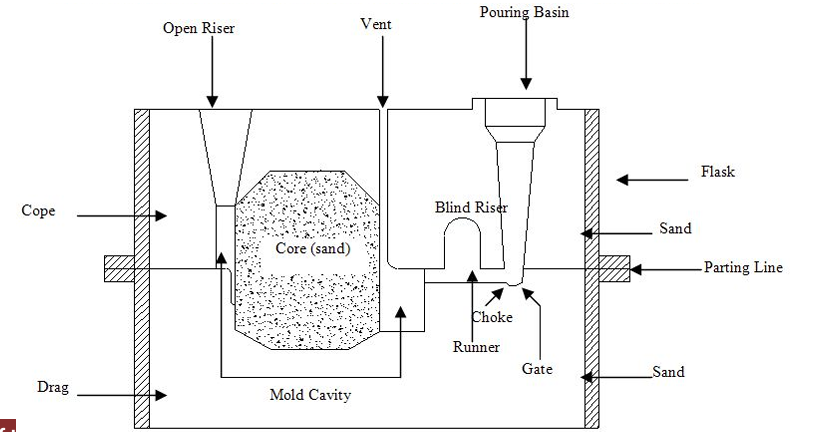
___________ in the sand mold is formed by packing sand around a pattern, then separating the mold into two halves and removing the pattern
cavity
If casting is to have internal surfaces, a ________ must be included in mold
core
it is the inverse of the final shape with shrinkage allowance
cavity
it is the model of the final stage with shrinkage allowance
pattern
it is made by adding binder in the sand
wet sand
provides the external features of the cast part
cavity
provides internal features of the part. It is placed inside the mold cavity with some support.
core
It is a reservoir in the mold which is a source of liquid metal to compensate for shrinkage of the part during solidification
riser
types of pattern
a. solid pattern
b. split pattern
c. match-plate pattern
d. cope and drag pattern
Problem in locating the parting line. Locating is skill dependent. Suitable for low production
solid pattern
Relatively easy to locate parting line. Used for low-medium size production
split pattern
The cope and drag portions of the pattern are mounted on opposite sides of a wood or metal plate conforming to the parting line. Match plates are also integrally cast in which cast pattern and plate are cast as one piece in sand or plaster molds. It is used with some type of molding machine, in order to obtain maximum speed of molding. Advantages of the match-plate patterns are: (a) Costly but good production rate (b) Increase the dimensional accuracy
Match-plate pattern
a.)Similar to match-plate pattern but split pattern halves are attached to separate plates.
b) The pattern contains built-in gating system thus save time for making separate gating system in each mold. Principles of Metal F
Cope and drag pattern
what forms the skeleton of a mold or core
refractory aggregate
moist sand-clay mixture. It is for fast preparation; gas control matters
green sand
mold dried or baked through. It is for higher dry strength; extra time/ energy
dry sand
only the cavity surface dried. It is for strong/dry face with a moist backing
skin-dried
binder cures by chemical reaction. It includes no-bake and gas-cured systems
chemically bonded
type of grain that usually improve casting surface finish and detail
finer grains
type of grain that generally provide larger gas-flow passages when other factors are comparable
coarser grains
describes how smooth the grain corners and edges are.
roundness
describes how closely the overall grain resembles a sphere.
sphericity
Classification of foundry sands: what type of aggregate is availability and cost
silica
Classification of foundry sands: what type of aggregate is low expansion; manganese-steel service
Olivine
Classification of foundry sands: what type of aggregate is low expansion and interface stability
Zircon
Classification of foundry sands: what type of aggregate is heat extraction and penetration resistance?
chromite
Classification of foundry sands: what type of aggregate is refractoriness and thermal stability
Aluminosilicates
principal mineral in silica
quartz (SiO2)
influences surface area, packing and flow
grain shape